In our last episode Bob finally got on the bus. Now the bus has arrived.
It was a rainy Thursday morning and I was puttering around the office, too nervous to do any real work. I was sure that I wouldn’t hear from Bob before the lunch hour. I even called Greyhound to check the progress of the bus that I thought Bob was on. I thought I had plenty of time.
So I had stepped away from the office when the call came. Several hours before I expected it.
I didn’t call back. I left immediately for the subway.
The Clinton stop on the CTA Blue Line is only a block away from the Greyhound terminal. Sure a cab would have been faster – but it was raining. You can’t get a cab in the Chicago Loop when it’s raining. The trains don’t run so well either, even underground, which is something I’ll never understand. It just happens to be true.
Just that morning Long Suffering Spouse asked me if I’d even recognize my brother; after all, I’d not seen him since shortly after my father’s funeral, nearly five years ago, when he took a truck full of things – now gone, all gone – back to Texas. Maybe I saw him once in between, at Betty’s house. Maybe.
But I needn’t have worried. I recognized Bob immediately.
He looked like my father – when my father was in the last stages of his last illness. Granted, no one will look their best after a 20 hour bus ride, but Bob was rail thin – cadaverous – eyes sunken, slouching, pasty complected. His hair was longish, perhaps intended to disguise his receding hairline and maybe calling more attention to it.
But Bob’s hair was still brown. What remains of mine is thoroughly gray.
I was remarking on this later, to Long Suffering Spouse, when Younger Daughter happened into the room. “I’m sure his hair is still dark because he has no daughters,” I said – provoking the immediate and expected reaction from Younger Daughter.
We could have walked to Haymarket, I suppose, but the skies were still threatening and Bob was carrying a large red, Marlboro-brand duffel and a weathered Samsonite briefcase. I was carrying my umbrella and a file folder full of papers to review. So a cab seemed like a good idea. And – thankfully – cabs were waiting in front of the Greyhound station.
The sign over the door of the old warehouse building at Sangamon and Washington Streets says McDermott Center. The place is named for the late Monsignor Ignatius D. McDermott. We went inside, up a few steps, through another set of glass doors. There was a chapel on our left; the security desk was straight ahead. We signed into Central Intake, received ID badges, and were directed up a stairway to the second floor. We were promptly intercepted and directed to a waiting room. Bob was told to leave his stuff in the hall; later it was also moved into the waiting room.
The waiting room is set up with three or four rows of plastic chairs facing a television set. A desk is at the entrance to the room, perpendicular to the chairs. On this desk is a sign-in book. Bob signed in. In what I later learned to be a breach of protocol, I did not. As a prospective client Bob was immediately ushered to the washroom to make a “drop.” As a visitor, I was exempted from this welcoming ceremony.
There were people everywhere. Staff people. Cleaning people. Clients. The waiting room was crowded. Next door to the waiting room was a ‘smoking room’ – but no more than three people were allowed in at a time. Which was important since the room was about the size of a closet. A small closet. The man working the desk when we came in wanted to know when our appointment was.
It is said that no battle plan survives contact with the enemy. None of my plans seem to survive contact with reality. The man with whom I’d spoken a couple of days before had given me bad information: Unless we came in through detox – where the police bring drunks picked up on the street – we were supposed to have an appointment. The waiting room attendant left to find someone for us to talk to; another took his place.
An admissions counselor was found; I told her why we were there and why we’d made no appointment. She said she’d try and fit Bob in – and she did. But it took awhile. A long while. In the meantime, I kept one eye on the stuff I brought, and watched Michael Keaton’s Clean and Sober with the other. At lunchtime the clients are offered the opportunity to have a meal. Bob didn’t want to go. So I stayed with Bob. People came, people went. Some were clearly being admitted. Some were just there for prearranged appointments. Everyone, so far as I could see – including Bob and me – were treated courteously and with respect. There was a degree of jocularity with those familiar to the staff, but everything seemed appropriate. Even – strange to say in the circumstances, I realize – nice.
Bob wasn’t talkative. Bob wasn’t much of anything. He sat there, reading a book he’d brought on the bus and occasionally watching the movie. We didn’t have a lot to talk about anyway.
Eventually, in the middle of the afternoon, Bob got to see an assessor and I got a chance to return to my office, eat my lunch and return the many phone calls that had accumulated in my absence. I negotiated the settlement of the case that I was talking about at the outset of this cycle during this brief interlude. And none of these calls would have come in were I sitting at my desk waiting for them.
I walked back to Haymarket, carrying nothing this time, trying to time my arrival so as to be there when Bob finished the assessment. They told me it would take around 2½ hours – my original informant had given me the straight dope on that aspect at least – but I wasn’t surprised that I still waited more than another hour for Bob to be done. The room thinned out as the afternoon dwindled away. We saw part of When a Man Loves a Woman with Meg Ryan. I thought I’d be interested in Meg Ryan reading the phone book – but it was hard to watch her as an alcoholic, careening out of control. I know at some point we also saw most of The Days of Wine and Roses (are you sensing a pattern here?) although someone had taped cartoons over the ending.
As time passed, I began to entertain hopes that this would all work out just as I wished: Bob would be admitted to a residential program. He’d find some way to rebuild his life – and see just how crazy it would be to settle for living in his sister’s basement.
It was then that Bob returned. With the assessor. Bob had given him full license to tell me anything I wanted to know. What I wanted to know was whether Bob would be admitted for treatment. But the assessor told me that, based on what Bob told him, in-patient treatment would not be necessary. Bob qualified for Level 1 Outpatient Services – and that would be fine, the assessor said, because Bob’s “drop” was “triple zero” (no alcohol or other problematic substances) and since Bob had plans to live with Betty.
That’s when I blew up. Live with Betty? Betty wasn’t even in town. She didn’t leave the key under the mat; Bob has no place to go. Bob was told this. Repeatedly. In an instant I knew what had happened: Bob had minimized. He had sugar-coated. He had under-reported. He had shot himself right in the foot. What I can’t understand is why he did this.
We were next ushered into the small office of the Manager of the Central Intake Unit. The office was on the opposite side of the floor from the waiting room. Because I was angry, I didn’t observe how or why we got there. I did observe the manager: She was a tall, gray-haired lady. The hairstyle was short and practical. Little kids – children of a client – barged in and helped themselves to candy in her drawer. The phone rang incessantly. Other people were clamoring for her time, too, even though it was past 5:00 pm now and everywhere else had quieted down – and here were Bob and me and the assessor and if the manager was less than gracious with us – with me – on this occasion it was only because she may have sized me up as some sort of spoiled Yuppie consumer expecting to get my own way.
I was angry, yes, but not at the manager, or at Haymarket. I was angry with Bob. I was also disappointed that the assessor had not seen through Bob’s deceptions. I wasn’t trying to force any outcome; I understood we were beggars here, not choosers. But after hearing my spiel – and that was part of it – the manager told us we were to return on Monday for an evaluation by a staff psychologist. The manager gave me her card, writing in her cell phone number, just in case Bob’s situation changed before Monday. In the meantime, the manager offered information about homeless shelters where Bob could stay. That got a rise out of Bob – and me too. I’ll take care of where he stays, I told the manager.
We walked back downtown; I had excess adrenaline to work off. I carried the Samsonite briefcase; Bob struggled with the oversized gym bag duffel. The Thursday morning showers had given way to a hot, sunny, humid early evening. As we walked across the bridge over the Spaghetti Bowl, the downtown interchanges where the Kennedy and Dan Ryan Expressways meet, I called home. I put on my best fake Irish brogue. “Put another couple of spuds in the pot,” I told my Long Suffering Spouse. “I’m bringing the brother home with me.”
Friday, August 18, 2006


Bob comes home -- Part III
In yesterday’s post, Bob had finally agreed to sell the car he couldn’t drive and to which he had no title. He would come to Chicago by bus. The Curmudgeon agreed to meet him and take him in for an alcohol assessment.
Bob wasn’t going to get the celebrity treatment at the Betty Ford Clinic; I knew that. I knew – or thought I knew – that there were a number of substance abuse treatment centers here in Chicago that required large amounts of money in order to secure admission. These were all out of Bob’s price range. He had no money, no home, no job, virtually no possessions. A friend, Steve, suggested the Haymarket Center as a possible destination.
Steve knew about Haymarket for a very good reason: He, too, has a brother like Bob. We’ll call him Sam. Steve and his other brothers had gotten Sam into Haymarket as a resident in a 28 day program. Unfortunately, after a day or two Sam declared himself cured and walked out. Steve thought he knew someone there who might be able to help Bob get in.
That’s the Chicago way. Nobody knows everybody. But everybody knows a guy, or at least a guy who knows a guy, who can help. Steve had a guy.
I called Haymarket one day during the lunch hour. I did not obtain the name of the person with whom I spoke, but I heard his life story. He was himself in recovery. He was in recovery too late to repair his relationship with his mother; she was dead. This was some years ago, it seems, but his emotions were still raw and close to the surface. I could feel his regret, solid and substantial, right through the phone. The person I needed to talk to was out to lunch, this man told me, but it would be alright to bring my brother by anytime. They would ‘assess’ him – and it would be the most searing 2½ hours of my brother’s life. My new friend told me that Bob would find out things about himself that he never knew. And Haymarket would determine the level of care necessary for Bob.
As I reached out for resources to help me figure out how to help Bob I learned something important: A lot of people have brothers like Bob. I knew about Steve’s brother Sam. And I knew a neighbor who has a brother; the brother lurks in the street by our house for hours at a time if our neighbor isn’t home. Or isn’t answering the door. But I didn’t know about the colleague who had to bring his brother home from an island jungle. And there were others.
I was discussing this with Long Suffering Spouse when Younger Daughter chimed in. “Which of my brothers,” she asked, “will turn out like Uncle Bob?”
None of them will, I immediately assured her. It’s a generational thing. Your generation will just have uncles.
I know that’s not true, certainly not for her entire generation. But I so want it to be true. And I hope and pray that “the Curse” will pass all of my children by.
We have such romantic names for alcoholism. The Curse. The Liquid Cross. That was a term I heard used just this year – at the wake and funeral for the son of another colleague. That young man – well, he was around Bob’s age – jumped into Lake Michigan rather than live another day with his alcohol addiction.
I also spoke with one of my ex-landlords. I recently learned that he had been involved in an intervention for a lawyer we both knew; I didn’t know that the intervention had even taken place until after that man had died. Not from drink. Not directly, anyway. My ex-landlord gave me the names and numbers of people at the Lawyers Assistance Program. I had a long chat with a clinician there; Bob’s not a lawyer, but she could talk to me because I am. The clinician recommended that I contact the Way Back Inn in Maywood. She could highly recommend the place because she was on the board there.
(In Chicago terms, that would make her my guy there. Even though she wasn’t a guy. Being a guy isn’t a vital component of being a guy. But don’t ask me who she is because I can’t tell you. If I told you, then she’d be your guy. I don’t know you well enough for that. Is that clear? No? Then you’re one step closer to understanding Chicago. Some day you can explain it to me.)
But, after mulling over the options, I decided to stay with Haymarket. I could walk there from my office. I could walk there from the bus station. There was even a Schaumburg location; I didn’t know at the time that no residential treatment is provided there. I was thinking that the suburban location might be more comfortable for Bob and more convenient for Betty. I’m the only one in the family who likes the City. And if Haymarket wouldn’t see Bob when he got here, I could always try the Way Back Inn next.
So I had a plan, even if I didn't have all the facts straight. All we needed was Bob.
Steve figured the odds at 80-20 against Bob showing up. I thought the odds about 50-50. Betty was sure Bob would get here – and she told me she felt really bad about leaving town under the circumstances. Then she laughed.
Somewhere along the line I spoke with Angel again. She promised to call me when she put Bob on the bus. That way, I’d know when to expect him.
Angel called back on August 2 – the day that Bob told me he’d probably arrive. Angel got him on the bus that morning. This is when she told me about the check. She told me the bus was expected in Chicago about mid-day Thursday, August 3. I did not have the presence of mind to ask the route number of the bus; when I went on line to look at the schedule, I didn’t find any bus that was scheduled to arrive when Angel said Bob was coming. But I found one that was scheduled to arrive within an hour of the time Angel mentioned. I figured that would be it.
Of course, I was wrong.
Bob wasn’t going to get the celebrity treatment at the Betty Ford Clinic; I knew that. I knew – or thought I knew – that there were a number of substance abuse treatment centers here in Chicago that required large amounts of money in order to secure admission. These were all out of Bob’s price range. He had no money, no home, no job, virtually no possessions. A friend, Steve, suggested the Haymarket Center as a possible destination.
Steve knew about Haymarket for a very good reason: He, too, has a brother like Bob. We’ll call him Sam. Steve and his other brothers had gotten Sam into Haymarket as a resident in a 28 day program. Unfortunately, after a day or two Sam declared himself cured and walked out. Steve thought he knew someone there who might be able to help Bob get in.
That’s the Chicago way. Nobody knows everybody. But everybody knows a guy, or at least a guy who knows a guy, who can help. Steve had a guy.
I called Haymarket one day during the lunch hour. I did not obtain the name of the person with whom I spoke, but I heard his life story. He was himself in recovery. He was in recovery too late to repair his relationship with his mother; she was dead. This was some years ago, it seems, but his emotions were still raw and close to the surface. I could feel his regret, solid and substantial, right through the phone. The person I needed to talk to was out to lunch, this man told me, but it would be alright to bring my brother by anytime. They would ‘assess’ him – and it would be the most searing 2½ hours of my brother’s life. My new friend told me that Bob would find out things about himself that he never knew. And Haymarket would determine the level of care necessary for Bob.
As I reached out for resources to help me figure out how to help Bob I learned something important: A lot of people have brothers like Bob. I knew about Steve’s brother Sam. And I knew a neighbor who has a brother; the brother lurks in the street by our house for hours at a time if our neighbor isn’t home. Or isn’t answering the door. But I didn’t know about the colleague who had to bring his brother home from an island jungle. And there were others.
I was discussing this with Long Suffering Spouse when Younger Daughter chimed in. “Which of my brothers,” she asked, “will turn out like Uncle Bob?”
None of them will, I immediately assured her. It’s a generational thing. Your generation will just have uncles.
I know that’s not true, certainly not for her entire generation. But I so want it to be true. And I hope and pray that “the Curse” will pass all of my children by.
We have such romantic names for alcoholism. The Curse. The Liquid Cross. That was a term I heard used just this year – at the wake and funeral for the son of another colleague. That young man – well, he was around Bob’s age – jumped into Lake Michigan rather than live another day with his alcohol addiction.
I also spoke with one of my ex-landlords. I recently learned that he had been involved in an intervention for a lawyer we both knew; I didn’t know that the intervention had even taken place until after that man had died. Not from drink. Not directly, anyway. My ex-landlord gave me the names and numbers of people at the Lawyers Assistance Program. I had a long chat with a clinician there; Bob’s not a lawyer, but she could talk to me because I am. The clinician recommended that I contact the Way Back Inn in Maywood. She could highly recommend the place because she was on the board there.
(In Chicago terms, that would make her my guy there. Even though she wasn’t a guy. Being a guy isn’t a vital component of being a guy. But don’t ask me who she is because I can’t tell you. If I told you, then she’d be your guy. I don’t know you well enough for that. Is that clear? No? Then you’re one step closer to understanding Chicago. Some day you can explain it to me.)
But, after mulling over the options, I decided to stay with Haymarket. I could walk there from my office. I could walk there from the bus station. There was even a Schaumburg location; I didn’t know at the time that no residential treatment is provided there. I was thinking that the suburban location might be more comfortable for Bob and more convenient for Betty. I’m the only one in the family who likes the City. And if Haymarket wouldn’t see Bob when he got here, I could always try the Way Back Inn next.
So I had a plan, even if I didn't have all the facts straight. All we needed was Bob.
Steve figured the odds at 80-20 against Bob showing up. I thought the odds about 50-50. Betty was sure Bob would get here – and she told me she felt really bad about leaving town under the circumstances. Then she laughed.
Somewhere along the line I spoke with Angel again. She promised to call me when she put Bob on the bus. That way, I’d know when to expect him.
Angel called back on August 2 – the day that Bob told me he’d probably arrive. Angel got him on the bus that morning. This is when she told me about the check. She told me the bus was expected in Chicago about mid-day Thursday, August 3. I did not have the presence of mind to ask the route number of the bus; when I went on line to look at the schedule, I didn’t find any bus that was scheduled to arrive when Angel said Bob was coming. But I found one that was scheduled to arrive within an hour of the time Angel mentioned. I figured that would be it.
Of course, I was wrong.
Thursday, August 17, 2006
Bob comes home -- Part II
In yesterday’s exciting, if a bit self-absorbed post, Bob was eventually warned by Betty not to come back to Chicago until August 15. Betty told Bob that she was going to be out of town on a couple of different trips during the first two weeks of August.
So I guess I should not have been too surprised when I found out from Betty that Bob would be here by August 2. The earlier departure was necessitated by the fact that Bob’s landlord was unwilling to provide any further hospitality beyond the 31st of July. That Bob was behind in his rent had previously been made clear; it was only now that we learned that he was in imminent expectation of eviction.
Bob was hoping to drive to Chicago, but his driver’s license had been suspended for failure to appear in court on a traffic ticket. Betty advanced the money to pay the ticket.
But Bob still couldn’t drive to Chicago because he was afraid his car would not survive the journey. It was old, and in delicate condition, he said. So he was hoping we could advance the bus fare.
Betty said she was tapped out. And I already mentioned that my own mortgage was unpaid. I suggested that Bob might sell the car.
It was at this point that Bob finally called me direct. (The phone in his apartment continued to work right up until the moment he vacated the premises. Don’t ask me how.)
Bob wasn’t happy with my logic, but it seemed to me that, since he did not think the car would survive the trip, and since he couldn’t afford the gasoline for the journey even if the car survived, bringing the car was not a smart idea. Bob suggested that he could store the car with friends. I pointed out that the car would not improve during a long period of disuse. I remained firm in my advice: Sell the car.
That’s when Angel called. Angel has apparently been Bob’s one and only real friend in recent years. She’s fed him when he was hungry; she’s been a confidante; she encouraged him to reach back out to his family when things really got bad. Angel is married and she and her husband are expecting their first child. Long Suffering Spouse raised both eyebrows when these facts were recited, but Betty is confident that Angel is only what she says she is: A friend. And Betty says she’s spoken with Angel’s husband, too.
Angel had called my house before, some months ago; Younger Daughter took the call. She asked if we’d heard from Bob, if he was OK, if we knew how to reach him. She told Younger Daughter that she was worried about Bob. But Angel didn’t leave her name or number, and she didn’t ask for me by the name by which I am usually known; she used my given name, which no one who knows me ever uses. I therefore dismissed the call as a new collection tactic. While it was never a daily occurrence, Bob has received collection calls at our house before. Younger Daughter was so worried, however, that I sent Bob an e-mail – and he promptly responded that everything was “fine.” I didn’t believe that – but I was satisfied there was no immediate crisis.
Now Angel was on the phone telling me that Bob was not fine, and had not been fine for some time. She was certain he needed to leave Texas immediately, to get away from people who were “bad influences” on him. She told me that Bob didn’t want to sell the car; it was the one remaining thing he had of his parents’ (he’d had a rather large truck full of things at one time, but I didn’t bring this up). She understood that my finances might be tight just now, but could I put up just half the bus ticket? She’d put up the other half.
I told Angel why I thought it best that he simply sell the car. And Angel agreed: It turns out that the car was so delicate it was in fact non-functional. It did not run.
Various numbers were discussed in subsequent conversations. When Bob and Angel told me of one supposed offer, I looked up the Blue Book values for the car – and told Bob to grab the offer with both hands and leave town immediately. Of course that offer fell through. Or never existed. But Bob did sell the car. I think. Angel took the money; she gave Bob some pocket money and bought the bus ticket; she wrote a check for the difference. The check was made payable to Betty; Angel didn’t trust Bob with the money. That was telling.
There was still some question about where the car title was located. There was also some question about where the car was located. But I think Bob sold the car. And not to Angel.
Bob was unhappy about selling the car, but he called me one night to tell me his travel arrangements. Betty was out of town, so I would meet the bus. Bob was calling from a woman’s cell phone. “A friend,” he said. But it wasn’t Angel. Bob sounded fine – no slurring, no slobbering. In fact, he was kind of eloquent. He complained that Betty was treating him “like a piece of broken glass.” Yes, he’d had some problems, he admitted, and he’d made some “bad business decisions.” Who wouldn’t be just a little bit crazy after all that?
But Betty had told me that Bob was sobbing when he first called her. Desperate. Out of options. Suicidal. Bob may have not realized how much Betty and I had spoken of his situation. So I was resolute. When I met the bus, we would go immediately for an alcohol assessment. You told Betty about your problems, I told him. Those problems are more than Betty and I can take care of. All we can do is try and get you help. That’s not treating you like “broken glass,” I told him; that’s trying to be helpful when you ask for help. The conversation ended, positively I thought, and I hung up the phone.
Two minutes later the phone rang again. I looked at the Caller ID; it was the same Texas cell phone number from which Bob had called minutes earlier.
“Hello?” I answered.
“Gary?” asked a woman with a shrill southern accent. She was also a trifle loud.
“There’s no Gary here,” I said. “I think you have the wrong number.”
“Gary’s my neighbor,” she announced, stretching out the syllables in ‘neighbor.’ “He’s over here!” ‘ Here’ acquired an extra syllable and at least another ‘h’ when she pronounced it. There was a pause. Then the tone changed; she put an edge on her shrill Texas twang. Suspicious now: “Who is this?”
“This is Bob’s brother,” I told her.
“Oh!” she said, clearly relieved. Then in a sing-song: “Bob, it’s for you!”
Bob took the phone. “Bob, did you call me back?” I asked. “No,” he said, sounding chagrined. He felt some need to explain: “Some friends are over helping me to pack.”
“OK,” I said. “I’ll talk to you later.” I hung up.
Oldest Son and Middle Son could contain themselves no longer. As soon as I terminated the connection, they were rolling on the floor, braying like donkeys and barking like hyenas. “Sure, it’s real funny,” I told them. “Your uncle is 45 years old.”
That sobered them up. And I use the word advisedly.
And so the Bob watch began.
So I guess I should not have been too surprised when I found out from Betty that Bob would be here by August 2. The earlier departure was necessitated by the fact that Bob’s landlord was unwilling to provide any further hospitality beyond the 31st of July. That Bob was behind in his rent had previously been made clear; it was only now that we learned that he was in imminent expectation of eviction.
Bob was hoping to drive to Chicago, but his driver’s license had been suspended for failure to appear in court on a traffic ticket. Betty advanced the money to pay the ticket.
But Bob still couldn’t drive to Chicago because he was afraid his car would not survive the journey. It was old, and in delicate condition, he said. So he was hoping we could advance the bus fare.
Betty said she was tapped out. And I already mentioned that my own mortgage was unpaid. I suggested that Bob might sell the car.
It was at this point that Bob finally called me direct. (The phone in his apartment continued to work right up until the moment he vacated the premises. Don’t ask me how.)
Bob wasn’t happy with my logic, but it seemed to me that, since he did not think the car would survive the trip, and since he couldn’t afford the gasoline for the journey even if the car survived, bringing the car was not a smart idea. Bob suggested that he could store the car with friends. I pointed out that the car would not improve during a long period of disuse. I remained firm in my advice: Sell the car.
That’s when Angel called. Angel has apparently been Bob’s one and only real friend in recent years. She’s fed him when he was hungry; she’s been a confidante; she encouraged him to reach back out to his family when things really got bad. Angel is married and she and her husband are expecting their first child. Long Suffering Spouse raised both eyebrows when these facts were recited, but Betty is confident that Angel is only what she says she is: A friend. And Betty says she’s spoken with Angel’s husband, too.
Angel had called my house before, some months ago; Younger Daughter took the call. She asked if we’d heard from Bob, if he was OK, if we knew how to reach him. She told Younger Daughter that she was worried about Bob. But Angel didn’t leave her name or number, and she didn’t ask for me by the name by which I am usually known; she used my given name, which no one who knows me ever uses. I therefore dismissed the call as a new collection tactic. While it was never a daily occurrence, Bob has received collection calls at our house before. Younger Daughter was so worried, however, that I sent Bob an e-mail – and he promptly responded that everything was “fine.” I didn’t believe that – but I was satisfied there was no immediate crisis.
Now Angel was on the phone telling me that Bob was not fine, and had not been fine for some time. She was certain he needed to leave Texas immediately, to get away from people who were “bad influences” on him. She told me that Bob didn’t want to sell the car; it was the one remaining thing he had of his parents’ (he’d had a rather large truck full of things at one time, but I didn’t bring this up). She understood that my finances might be tight just now, but could I put up just half the bus ticket? She’d put up the other half.
I told Angel why I thought it best that he simply sell the car. And Angel agreed: It turns out that the car was so delicate it was in fact non-functional. It did not run.
Various numbers were discussed in subsequent conversations. When Bob and Angel told me of one supposed offer, I looked up the Blue Book values for the car – and told Bob to grab the offer with both hands and leave town immediately. Of course that offer fell through. Or never existed. But Bob did sell the car. I think. Angel took the money; she gave Bob some pocket money and bought the bus ticket; she wrote a check for the difference. The check was made payable to Betty; Angel didn’t trust Bob with the money. That was telling.
There was still some question about where the car title was located. There was also some question about where the car was located. But I think Bob sold the car. And not to Angel.
Bob was unhappy about selling the car, but he called me one night to tell me his travel arrangements. Betty was out of town, so I would meet the bus. Bob was calling from a woman’s cell phone. “A friend,” he said. But it wasn’t Angel. Bob sounded fine – no slurring, no slobbering. In fact, he was kind of eloquent. He complained that Betty was treating him “like a piece of broken glass.” Yes, he’d had some problems, he admitted, and he’d made some “bad business decisions.” Who wouldn’t be just a little bit crazy after all that?
But Betty had told me that Bob was sobbing when he first called her. Desperate. Out of options. Suicidal. Bob may have not realized how much Betty and I had spoken of his situation. So I was resolute. When I met the bus, we would go immediately for an alcohol assessment. You told Betty about your problems, I told him. Those problems are more than Betty and I can take care of. All we can do is try and get you help. That’s not treating you like “broken glass,” I told him; that’s trying to be helpful when you ask for help. The conversation ended, positively I thought, and I hung up the phone.
Two minutes later the phone rang again. I looked at the Caller ID; it was the same Texas cell phone number from which Bob had called minutes earlier.
“Hello?” I answered.
“Gary?” asked a woman with a shrill southern accent. She was also a trifle loud.
“There’s no Gary here,” I said. “I think you have the wrong number.”
“Gary’s my neighbor,” she announced, stretching out the syllables in ‘neighbor.’ “He’s over here!” ‘ Here’ acquired an extra syllable and at least another ‘h’ when she pronounced it. There was a pause. Then the tone changed; she put an edge on her shrill Texas twang. Suspicious now: “Who is this?”
“This is Bob’s brother,” I told her.
“Oh!” she said, clearly relieved. Then in a sing-song: “Bob, it’s for you!”
Bob took the phone. “Bob, did you call me back?” I asked. “No,” he said, sounding chagrined. He felt some need to explain: “Some friends are over helping me to pack.”
“OK,” I said. “I’ll talk to you later.” I hung up.
Oldest Son and Middle Son could contain themselves no longer. As soon as I terminated the connection, they were rolling on the floor, braying like donkeys and barking like hyenas. “Sure, it’s real funny,” I told them. “Your uncle is 45 years old.”
That sobered them up. And I use the word advisedly.
And so the Bob watch began.
Wednesday, August 16, 2006
Bob comes home -- Part I
Already the details are starting to fade; too much has happened, with too little time for processing. Strong impressions remain; some incidents stand out in stark relief. But I’m writing now, quickly, because there’s a lull in the action. But it’s not over, not by a long shot.
I was stressed to begin with. College tuition was falling due. Middle Son had totaled one of our cars in mid-July. My largest case was threatening to go into discovery overdrive – in theory good for me as a lawyer who bills by the hour – but in practice a disaster, because the client hadn’t paid me and apparently lacked the funds to pay for a protracted discovery battle. This in a case we had essentially ‘won’ in March: The United States District Court had accepted our reading of the relevant insurance policies, granting summary judgment in our favor on this issue – meaning that the insurance company defendants had underpaid my client’s claim by well over a million dollars. But the insurance company acted as if it were bound and determined to make us spend every last dime of our prospective winnings on pointless depositions and document productions.
I knew we were in trouble the day we went to court to protest the defendants’ discovery requests: When I walked into court there was a full size replica of a locomotive on the wall opposite the jury box. Every hose, every ladder, every safety sticker was faithfully reproduced. That’s what discovery in Federal court will lead to – so how could we expect the judge to sympathize with our complaints about being forced to go to Florida to watch opposing counsel wade through a room full of boxed documents having nothing whatsoever to do with the remaining issues in our case? No matter how legitimate our complaints – no matter how disproportionate the discovery was in our case, it was in keeping with the way things are done in that court. Nor did it matter that we had not filed in that court and that the insurers would never get away with this nonsense in the Chancery Court; we’d been removed there by the insurers entirely in accord with the law. The court gave the defendants carte blanche to do what they pleased in discovery; the sop to us was that we could, if we survived to the end of the case, attempt to persuade the court that the defendants had ‘multiplied the pleadings unreasonably and vexatiously’ and attempt to recover our fees from the defendants at that time.
That didn’t sound very promising to me.
In the meantime, the mortgage was unpaid. This has happened before, and if I was handling it better this time, it was still bothersome. There’s always something vaguely upsetting about your wife and children being put out onto the street.
Now this lack of funds was not entirely the fault of the non-paying client, although its was (and still is) by far the largest outstanding bill. The real problem was that I had sent so few other bills: So much time was spent moving or getting ready to move – and moving again – and, sadly, on the loss of a colleague who’d moved with us – that I didn’t have a healthy crop of receivables coming due now. We’re like farmers, you know: We plant our time today, and reap payment (we hope) 90 or more days down the road.
And, of course, I do spend a fair amount of time on this soapbox, confiding to the world.
It was in the middle of all this that Betty called.
Not Bob. Betty.
Betty told me that Bob didn’t want to talk to me. Not right away, anyway. Betty told me that she’d told Bob to come back to Illinois. That he could live with her. And her family. And her bipolar ex-husband.
Betty was pretty shaken: Bob had not only disclosed his lifetime of drinking, but he told Betty that he was also hearing ‘voices’ in his head that made him do ‘bad things.’ He had thought of ending it all.
Betty – thanks to her ex-husband – has some experience in mental health matters. She figured Bob was bipolar, too.
And this image came unbidden to my mind: Bob and Bill (Betty’s ex-husband), sitting in the basement of Betty’s home, trading pills: “That big green one looks interesting,” Bob said. “I’ll trade you two of my red ones for one of your greens.”
I suggested to Betty that the proposed living arrangements might not be a good idea – at least not at the outset. We know Bob has an alcohol problem, I told her; let’s get him treatment for that and we can work on these other issues as we go. Bob living with her might be a step in his recovery, but it should not be the first step.
So I was to begin investigating alcohol rehab centers available to penniless and soon-to-be homeless persons. Betty continued her discussions with Bob, and started talking to him about the need for treatment upon arrival in Chicago. One thing was made clear to Bob: Betty had a number of out-of-town trips planned in the first two weeks of August. He should not plan on coming home before August 15.
I was stressed to begin with. College tuition was falling due. Middle Son had totaled one of our cars in mid-July. My largest case was threatening to go into discovery overdrive – in theory good for me as a lawyer who bills by the hour – but in practice a disaster, because the client hadn’t paid me and apparently lacked the funds to pay for a protracted discovery battle. This in a case we had essentially ‘won’ in March: The United States District Court had accepted our reading of the relevant insurance policies, granting summary judgment in our favor on this issue – meaning that the insurance company defendants had underpaid my client’s claim by well over a million dollars. But the insurance company acted as if it were bound and determined to make us spend every last dime of our prospective winnings on pointless depositions and document productions.
I knew we were in trouble the day we went to court to protest the defendants’ discovery requests: When I walked into court there was a full size replica of a locomotive on the wall opposite the jury box. Every hose, every ladder, every safety sticker was faithfully reproduced. That’s what discovery in Federal court will lead to – so how could we expect the judge to sympathize with our complaints about being forced to go to Florida to watch opposing counsel wade through a room full of boxed documents having nothing whatsoever to do with the remaining issues in our case? No matter how legitimate our complaints – no matter how disproportionate the discovery was in our case, it was in keeping with the way things are done in that court. Nor did it matter that we had not filed in that court and that the insurers would never get away with this nonsense in the Chancery Court; we’d been removed there by the insurers entirely in accord with the law. The court gave the defendants carte blanche to do what they pleased in discovery; the sop to us was that we could, if we survived to the end of the case, attempt to persuade the court that the defendants had ‘multiplied the pleadings unreasonably and vexatiously’ and attempt to recover our fees from the defendants at that time.
That didn’t sound very promising to me.
In the meantime, the mortgage was unpaid. This has happened before, and if I was handling it better this time, it was still bothersome. There’s always something vaguely upsetting about your wife and children being put out onto the street.
Now this lack of funds was not entirely the fault of the non-paying client, although its was (and still is) by far the largest outstanding bill. The real problem was that I had sent so few other bills: So much time was spent moving or getting ready to move – and moving again – and, sadly, on the loss of a colleague who’d moved with us – that I didn’t have a healthy crop of receivables coming due now. We’re like farmers, you know: We plant our time today, and reap payment (we hope) 90 or more days down the road.
And, of course, I do spend a fair amount of time on this soapbox, confiding to the world.
It was in the middle of all this that Betty called.
Not Bob. Betty.
Betty told me that Bob didn’t want to talk to me. Not right away, anyway. Betty told me that she’d told Bob to come back to Illinois. That he could live with her. And her family. And her bipolar ex-husband.
Betty was pretty shaken: Bob had not only disclosed his lifetime of drinking, but he told Betty that he was also hearing ‘voices’ in his head that made him do ‘bad things.’ He had thought of ending it all.
Betty – thanks to her ex-husband – has some experience in mental health matters. She figured Bob was bipolar, too.
And this image came unbidden to my mind: Bob and Bill (Betty’s ex-husband), sitting in the basement of Betty’s home, trading pills: “That big green one looks interesting,” Bob said. “I’ll trade you two of my red ones for one of your greens.”
I suggested to Betty that the proposed living arrangements might not be a good idea – at least not at the outset. We know Bob has an alcohol problem, I told her; let’s get him treatment for that and we can work on these other issues as we go. Bob living with her might be a step in his recovery, but it should not be the first step.
So I was to begin investigating alcohol rehab centers available to penniless and soon-to-be homeless persons. Betty continued her discussions with Bob, and started talking to him about the need for treatment upon arrival in Chicago. One thing was made clear to Bob: Betty had a number of out-of-town trips planned in the first two weeks of August. He should not plan on coming home before August 15.
Monday, August 14, 2006
Enter The Curmudgeon's siblings
The Curmudgeon has a sister, Betty, and a brother, Bob.
Betty's a schoolteacher, a divorced mother of three. Two of the children take medication to control their attention deficit problems. Betty's ex-husband probably had these problems as a child; he's since been diagnosed as bipolar. And he now lives in Betty's basement.
Betty explains it this way: Her ex-husband can afford either rent or child support, but not both. And Betty needs the child support money so she can send her daughter to the Catholic high school. She agrees that these arrangements may not be conventional, but insists they are practical.
Betty is more or less normal.
At least compared to Bob.
Bob lived with The Curmudgeon's parents well into his 30's, moving out shortly before, or maybe shortly after, their parents became ill with the his and her cancers that would, eventually, kill them.
Bob didn't move out until later in life, but he moved out farther than either of his siblings, going all the way to Texas, where he lived until the last couple of weeks.
Bob came back to Chicago infrequently during this interval. He made it to his father's wake, but stiff as a hinge, according to The Curmudgeon's Long Suffering Spouse. Had he noticed his brother's condition at the time, The Curmudgeon might have been slightly envious -- but if The Curmudgeon noticed at all, he promptly forgot about it.
Bob never married. He may have owned a house once; he said he did -- but he lost it somewhere along the line. He lost every item he brought down from his parents' house. He lost every dollar he obtained from his parents' estates. Most of his stories ended with the police becoming involved, and some species of burglary. Then there were the stories about living with strippers, one in particular apparently, who had a daughter. The daughter was in her late teens. The story ended badly. The Curmudgeon wasn't much interested in these stories, but he heard about them second-hand from some of his cousins, with whom Bob would also, occasionally, communicate. When Bob spoke with The Curmudgeon he talked about his various business ventures. These always ended badly, too.
Bob never talked about his drinking. But The Curmudgeon was always convinced that Bob drank. A lot. And for a long time. The Curmudgeon knew of one incident, when Bob was still in high school, when their father noticed a ceiling tile askew in the basement.
The basement of the house in which Bob, Betty, and The Curmudgeon passed their adolescence was "finished" with wood paneling on the walls, tile on the floor, and a suspended ceiling -- acoustic tiles suspended in a light metal grill. There was no reason for the tile to be askew, not any that Bob's father could puzzle out, looking at it. So he reached up to move it back into place -- and was nearly smothered in the ensuing avalanche of empty beer cans. Bob had stored his empties there.
Bob called Betty about three weeks ago and admitted his drinking. He was out of options. Eviction proceedings were underway to kick him out of his apartment. He wanted to come home.
Betty's a schoolteacher, a divorced mother of three. Two of the children take medication to control their attention deficit problems. Betty's ex-husband probably had these problems as a child; he's since been diagnosed as bipolar. And he now lives in Betty's basement.
Betty explains it this way: Her ex-husband can afford either rent or child support, but not both. And Betty needs the child support money so she can send her daughter to the Catholic high school. She agrees that these arrangements may not be conventional, but insists they are practical.
Betty is more or less normal.
At least compared to Bob.
Bob lived with The Curmudgeon's parents well into his 30's, moving out shortly before, or maybe shortly after, their parents became ill with the his and her cancers that would, eventually, kill them.
Bob didn't move out until later in life, but he moved out farther than either of his siblings, going all the way to Texas, where he lived until the last couple of weeks.
Bob came back to Chicago infrequently during this interval. He made it to his father's wake, but stiff as a hinge, according to The Curmudgeon's Long Suffering Spouse. Had he noticed his brother's condition at the time, The Curmudgeon might have been slightly envious -- but if The Curmudgeon noticed at all, he promptly forgot about it.
Bob never married. He may have owned a house once; he said he did -- but he lost it somewhere along the line. He lost every item he brought down from his parents' house. He lost every dollar he obtained from his parents' estates. Most of his stories ended with the police becoming involved, and some species of burglary. Then there were the stories about living with strippers, one in particular apparently, who had a daughter. The daughter was in her late teens. The story ended badly. The Curmudgeon wasn't much interested in these stories, but he heard about them second-hand from some of his cousins, with whom Bob would also, occasionally, communicate. When Bob spoke with The Curmudgeon he talked about his various business ventures. These always ended badly, too.
Bob never talked about his drinking. But The Curmudgeon was always convinced that Bob drank. A lot. And for a long time. The Curmudgeon knew of one incident, when Bob was still in high school, when their father noticed a ceiling tile askew in the basement.
The basement of the house in which Bob, Betty, and The Curmudgeon passed their adolescence was "finished" with wood paneling on the walls, tile on the floor, and a suspended ceiling -- acoustic tiles suspended in a light metal grill. There was no reason for the tile to be askew, not any that Bob's father could puzzle out, looking at it. So he reached up to move it back into place -- and was nearly smothered in the ensuing avalanche of empty beer cans. Bob had stored his empties there.
Bob called Betty about three weeks ago and admitted his drinking. He was out of options. Eviction proceedings were underway to kick him out of his apartment. He wanted to come home.
Friday, August 11, 2006
Security: The first thing we do, let's search all the lawyers
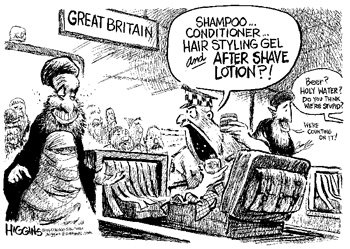
They who can give up essential liberty to obtain a little temporary safety deserve neither liberty nor safety. -- Benjamin Franklin, 1755
You know you’re in trouble when an alleged humorist opens with an epigram.
But don't worry: I’m not going to contend that having toothpaste in my carry-on luggage is an “essential liberty.” I just wish more people would keep Dr. Franklin's very true statement in mind. Besides – unlike my Younger Daughter – my life does not revolve around hair care products: The shampoo provided by even the cheaper chain motels is just fine for my purposes, thank you.
On the other hand, notwithstanding the contrary suggestion in the accompanying Jack Higgins cartoon from this morning’s Chicago Sun-Times, it wasn’t vigilance by airport security that unmasked the liquid bomb plotters in England yesterday – it was plain old, dull, boring – and obviously brilliant – police work.

And airport security today surely is better than the stereotype skewered in the 1982 movie Airplane II in which Sonny Bono played the most obvious mad bomber imaginable – and still got on board the ill-fated moon shuttle without serious challenge. But stopping would-be bombers in the airport is cutting things a bit close, isn’t it?
So instead, airport security makes a lot of fat, sweaty men take off their shoes – surely an environmental hazard for those around them, as well as a health hazard for those fat, sweaty men doing all of that unscheduled bending. (Damn you Richard Reid!)
I have a great natural sympathy for fat, sweaty men, being one myself and all. Fortunately for all concerned, I don’t have to travel often.
But the first time I did travel after 9/11, and after the capture of the aforementioned Mr. Reid, was late on a Friday afternoon in 2002. I was catching a plane to Kentucky to join my family, away with Middle Son at a baseball tournament. It was Summer. It was hot. I was wearing a suit. I’d been running to and from court and on one errand or another all day long. I was barely on time for the plane as it was. And I was dog tired.
Thus, instead of complying cheerfully, or at least dutifully, with the request to remove my shoes, in my fatigue, I responded with a smart-aleck response – not particularly witty, you understand, just something along the lines of, “You really don’t want me to do this.”
But they really did.
Now I have noticed, on the few occasions that I’ve traveled since, that whatever other sterling qualities they may possess, the fine people of the TSA are not generally endowed with a sense of humor. Nor were they so equipped on this occasion: I was removed from the line where I was and put in a different line. For special handling. I thought I heard the distinctive *snap* of rubber gloves being pulled on. And it occurred to me, a little late perhaps, that this was neither the time nor the place to make a stand for individual liberty and freedom.
I began to remove my shoes. A security guard was watching closely.
Close enough, I’m afraid, that his eyes began to water as soon as I’d peeled off the first shoe. I was thereafter passed through the line without additional difficulty.
So I’ve learned that compliance with security is necessary, and I know, even if I don’t understand entirely why this is so, that increased security measures make a lot of people feel safer in these dangerous times. And I also knew what would happen yesterday when I went to court.
At the Daley Center in Chicago, Sheriff’s deputies make most visitors go through metal detectors, and they run the purses, bags and briefcases of those people through an x-ray machine. This is not entirely a consequence of 9/11; security measures were initially imposed after a lawyer and judge were shot dead by a disgruntled litigant during a court hearing some years ago. Ordinarily excepted from these measures are lawyers and judges, who carry special ID cards, presumably on the grounds that they are more likely to be targets than perpetrators. The ID cards are, of course, checked when we enter the building. However, since terrorists in London were caught in the process of planning to blow up airplanes with liquid explosives, I was certain that the Sheriff’s police in Chicago would deem it necessary to also search all the lawyers coming into the courthouse, just in case. (And, of course, they did.)
Is the reputation of our profession really sunk so low?
Thursday, August 10, 2006
New Declaration of Independence necessary -- this time from oil
No attempt is made at being funny in this post; sometimes the state of the world intrudes.
I saw a reprint of this story in this morning’s Sun-Times; what follows is from Malia Rulon’s article in the Cincinnati Enquirer:
The Enquirer article notes that the new alternate-fuel Tahoe retails for $34,000-$47,000 – a fact that has been sized upon by “Schmidt's Democratic opponent, Victoria Wulsin, who... said Schmidt's purchase ‘smacks of insincerity... because not only does it not help us, but she's driving a model that none of her constituents can afford.’"
Somebody has to buy these vehicles, however, so the price can come down: This is the way of technology. Cell phones and computers are ready examples of products which were formerly very expensive, but which became less and less expensive (or providing more and more ‘goodies’ for the same price, which is an illustration of the same principle) as more and more people bought in. What the Republican Congressperson from Ohio is doing – if I may cite on Ms. Schmidt’s behalf a mantra from the Democratic Party – is providing an illustration of the principle, “Think Globally, Act Locally.”
The Curmudgeon is in the market for a new car at present. That is the topic of a much more amusing post which I hope to someday write. Unfortunately, there are no hybrid vehicles or E-85 vehicles anywhere in my price range. I will have to settle for a compact car with the best possible gas milage – and hope that, when next I am forced to buy a car, I will be able to buy one that does not make me contribute, however unwillingly, to further violence in or from the Middle East. Obtaining true independence from oil and gasoline should be a national objective – indeed, an international one, among all of us here in the dar al-Harb.
The need for a real alternative to gasoline is brought home by these two other stories in the news today, one the big story about the Brits foiling a plot to blow up multiple U.S.-bound airplanes, possibly using some sort of liquid explosives – and the other an update on the 11 of 17 Egyptian exchange students who disappeared en route from New York to a “cultural exchange program at Montana State University last month.” Shannon Prather’s story in the St. Paul Pioneer Press describes the arrest yesterday of one of the students in Minneapolis. Two others were arrested in New Jersey after they turned themselves in Wednesday.
Prather quotes FBI sources as saying none of the three students arrested so far posed any threat to national security.
I saw a reprint of this story in this morning’s Sun-Times; what follows is from Malia Rulon’s article in the Cincinnati Enquirer:
WASHINGTON - U.S. Rep. Jean Schmidt, R-Miami Township, said Wednesday that she has struck her own blow in the war on terrorism: She bought an ethanol-powered vehicle.The Congresswoman is imprecise. There are no problems that arise per se in giving money to Saudi sheiks; the problems come from where the Saudi sheiks send so much of that money. (The alliance with Wahhabism, if now on somewhat shaky ground, has long provided the means by which our Saudi allies have kept their monarchy intact.) And there may not be “Iranian terrorists” as such; the Persians merely finance and supply and train their Shi’a brethren, such as Hezbollah.
"I will be one of the first in line to buy ethanol this month," said Schmidt, the proud owner of a red 2007 Chevy Tahoe that runs on either the E85 blend of 85 percent ethanol and 15 percent gasoline or - if it must - gasoline. Her license plate reads: "E85 4 OH."
But Schmidt said she didn't buy the SUV because ethanol is less expensive or better for the environment. For her, the new car is about stopping terrorism by reducing the amount of money being sent to the Persian Gulf.
"I'd rather give my money to a farmer in Ohio than a Saudi sheik or an Iranian terrorist," she said in an interview.
The Enquirer article notes that the new alternate-fuel Tahoe retails for $34,000-$47,000 – a fact that has been sized upon by “Schmidt's Democratic opponent, Victoria Wulsin, who... said Schmidt's purchase ‘smacks of insincerity... because not only does it not help us, but she's driving a model that none of her constituents can afford.’"
Somebody has to buy these vehicles, however, so the price can come down: This is the way of technology. Cell phones and computers are ready examples of products which were formerly very expensive, but which became less and less expensive (or providing more and more ‘goodies’ for the same price, which is an illustration of the same principle) as more and more people bought in. What the Republican Congressperson from Ohio is doing – if I may cite on Ms. Schmidt’s behalf a mantra from the Democratic Party – is providing an illustration of the principle, “Think Globally, Act Locally.”
The Curmudgeon is in the market for a new car at present. That is the topic of a much more amusing post which I hope to someday write. Unfortunately, there are no hybrid vehicles or E-85 vehicles anywhere in my price range. I will have to settle for a compact car with the best possible gas milage – and hope that, when next I am forced to buy a car, I will be able to buy one that does not make me contribute, however unwillingly, to further violence in or from the Middle East. Obtaining true independence from oil and gasoline should be a national objective – indeed, an international one, among all of us here in the dar al-Harb.
The need for a real alternative to gasoline is brought home by these two other stories in the news today, one the big story about the Brits foiling a plot to blow up multiple U.S.-bound airplanes, possibly using some sort of liquid explosives – and the other an update on the 11 of 17 Egyptian exchange students who disappeared en route from New York to a “cultural exchange program at Montana State University last month.” Shannon Prather’s story in the St. Paul Pioneer Press describes the arrest yesterday of one of the students in Minneapolis. Two others were arrested in New Jersey after they turned themselves in Wednesday.
Prather quotes FBI sources as saying none of the three students arrested so far posed any threat to national security.
"We have no indication that these individuals posed a terror or criminal threat," said FBI Special Agent Richard Kolko, based in Washington, D.C. "In the post-9/11 world, the U.S. government works very hard to connect all the dots. There is nothing wrong with these guys. It's just an abundance of caution."This is all very reassuring, of course – but what about the eight still missing?
Tuesday, August 08, 2006
Imagine a metronome
You know, the thing that used to keep time when you were allegedly practicing the piano. Big long pointy needle, swaying back and forth, straight as an arrow, ticking and tocking just a split second ahead... or behind... whatever note you were hitting (or missing) at any particular moment.
Can you see the metronome in your mind now?
Imagine it going forward, to the right -- falling, if you will, toward the top of the piano.
It never quite falls all the way.
But I did. Like a metronome, straight down, without any flexion whatsoever, last night on my way home from work. The tip of my shoe caught in a lip between one slab of sidewalk and the next. The lip was no more than 1½" tall -- barely actionable-- and then only maybe -- according to Illinois case law.
But the difference in slab heights was enough. The tip of my shoe lodged against the upraised slab, and I went forward on my face. I did manage to move my left hand ahead of me, to absorb the worst of the fall (otherwise we might not be chatting at this moment), but my forehead bounced off the concrete, leaving a small, but noticeable, quantity of skin behind.
The sidewalk was uninjured.
My pride is expected to recover.
Can you see the metronome in your mind now?
Imagine it going forward, to the right -- falling, if you will, toward the top of the piano.
It never quite falls all the way.
But I did. Like a metronome, straight down, without any flexion whatsoever, last night on my way home from work. The tip of my shoe caught in a lip between one slab of sidewalk and the next. The lip was no more than 1½" tall -- barely actionable-- and then only maybe -- according to Illinois case law.
But the difference in slab heights was enough. The tip of my shoe lodged against the upraised slab, and I went forward on my face. I did manage to move my left hand ahead of me, to absorb the worst of the fall (otherwise we might not be chatting at this moment), but my forehead bounced off the concrete, leaving a small, but noticeable, quantity of skin behind.
The sidewalk was uninjured.
My pride is expected to recover.
Monday, August 07, 2006
Proof of reincarnation?
The pseudo-Buddhist monk in the new Comcast Cable "guru" commercials sounds eerily like the late Buddy Hackett.
Tuesday, August 01, 2006
Back to School -- already?
It seems that the school year starts earlier and earlier each year.
July ended yesterday -- and the school year began in our house.
Younger Daughter got a call from her AP History teacher: She had a term paper due July 15 (talk about your Summer reading!) -- and he was gently inquiring as to its whereabouts. His voice mail mentioned how the assignment was clearly posted on the school website.
Younger Daughter has three basic operating modes -- asleep, on the phone, or on line. But she vehemently denied seeing the assignment on the school site. She claimed to have spoken with a classmate who assured her that nothing was due before the first week of school. Perhaps this girl also got a call yesterday....
Youngest Son is still playing baseball -- although I'm done coaching, the Bluejay Park 13/14 All-Star teams are still in tournament play. But football equipment is being handed out tomorrow. That's a sure sign that the school year is nearly upon us.
LSS got a call from a fellow teacher yesterday; the middle school schedule is a muddle... as it generally is at this time of year. They've begun trying to hash out the various conflicts.
And Oldest Son went back to school shopping yesterday. Mostly, it's true, to replace the clothes he lost on his ill-fated trip to Pittsburgh -- that's one that you'll have to read about in the book -- but he and Middle Son have already started inquiring about when they can use the van to move out. Oldest Son will be gone in just about two weeks.
Yes, some in the family are sad that it's almost school time again. But not me: Soon I'll have my couch back....
July ended yesterday -- and the school year began in our house.
Younger Daughter got a call from her AP History teacher: She had a term paper due July 15 (talk about your Summer reading!) -- and he was gently inquiring as to its whereabouts. His voice mail mentioned how the assignment was clearly posted on the school website.
Younger Daughter has three basic operating modes -- asleep, on the phone, or on line. But she vehemently denied seeing the assignment on the school site. She claimed to have spoken with a classmate who assured her that nothing was due before the first week of school. Perhaps this girl also got a call yesterday....
Youngest Son is still playing baseball -- although I'm done coaching, the Bluejay Park 13/14 All-Star teams are still in tournament play. But football equipment is being handed out tomorrow. That's a sure sign that the school year is nearly upon us.
LSS got a call from a fellow teacher yesterday; the middle school schedule is a muddle... as it generally is at this time of year. They've begun trying to hash out the various conflicts.
And Oldest Son went back to school shopping yesterday. Mostly, it's true, to replace the clothes he lost on his ill-fated trip to Pittsburgh -- that's one that you'll have to read about in the book -- but he and Middle Son have already started inquiring about when they can use the van to move out. Oldest Son will be gone in just about two weeks.
Yes, some in the family are sad that it's almost school time again. But not me: Soon I'll have my couch back....
Thursday, July 27, 2006
The White Sox have fallen out of the Wild Card lead
And they're 8½ games behind Detroit in the AL Central pending today's action.
But we'll always have 2005. (Hopefully that's not all we'll have for another 88 years -- but that's a different worry....)
No one can take that championship away from us. Which puts us way ahead of Floyd Landis.
But we'll always have 2005. (Hopefully that's not all we'll have for another 88 years -- but that's a different worry....)
No one can take that championship away from us. Which puts us way ahead of Floyd Landis.
Wednesday, July 26, 2006
Privacy vs. anonymity vs. invisibility
We are never truly alone, not here in the Blogosphere. A local news program ran a feature recently about how what we post online can come back to haunt us. The Tribune had a feature this week about MySpace, complete with suggestions such as don’t post an embarrassing photo of yourself, especially posing with a bottle or near a keg. There is a growing realization that prospective employers can Google you, find your web page, and decide that the buttoned-down corporate image you projected in your interview is at fatal variance with the wild and crazy party animal you depict on the Internet.
The kids seem to think this unfair; they think there’s some expectation of privacy here.
I don’t know how you can make something available on every computer in the world and still expect “privacy.” But that’s just The Curmudgeon in me.
From time to time I will search on my own real surname, looking to see what’s out there about me. Not that I’ve posed in the vicinity of any kegs lately – but I am a self-employed attorney with websites, for which I pay through the nose, and a “public” blog. If a prospective client is looking for me, I want my professional sites to be “visible.”
Of course, my children share my surname – and that can be interesting: A few weeks ago, following a link from a Yahoo! search, I came across what amounted to a girl’s diary, on line. My Oldest Son figured in a paragraph about some outing or other, one of many names, several of which were familiar to me because the diarist is from our neighborhood.
So I read on.
In the next paragraph, the writer wrote about her excitement at the prospect of meeting again with her boyfriend, after a prolonged separation, and how she, and he, acted on that excitement.
There are some things I don’t need to know. I understand that, in general, 20-something girls may not always save themselves for the marriage night; I went to college during the height of the Sexual Revolution, when herpes seemed to be the scariest thing out there, and when virtually random copulation seemed the order of the day. (I was 4-F during the Sexual Revolution. I tried to enlist at every opportunity – but to no avail – and that’s a different story.) I just don’t want to have my nose rubbed in the nocturnal adventures of my children’s circle of friends while browsing the Web. Let me cling to my illusions for as long as possible.
Not that this girl forced me to read her diary – but it was on line for me to find. Anyone could find it – even her parents. I can’t believe that this is what she had in mind in creating her personal blog. (And I think the site has been taken down. I didn’t keep track of the web address for the girl’s site – I didn’t want to keep track – but I recently ran the same search argument and her site no longer came up... so maybe her parents did find it. Yikes!)
Her site was by no means private.
And neither is this one – although it is anonymous. But all anonymous means is that I’m not using my real name.
Actually, when I started blogging I thought that choosing “The Curmudgeon” as my nom de plume would give me a distinctive online identity. I should have known better. There are all sorts of sites for blogging curmudgeons – old curmudgeons, young curmudgeons, 'gamer' curmudgeons, knitting curmudgeons, even a gay curmudgeon. One I’ve bookmarked and starting reading regularly is The Comics Curmudgeon.
So I went for anonymous with this site – and wound up invisible. I just put a Site Meter on this page to document how invisible I am. But I think that will change in due course.
At least it might, if my next post is more amusing.
The kids seem to think this unfair; they think there’s some expectation of privacy here.
I don’t know how you can make something available on every computer in the world and still expect “privacy.” But that’s just The Curmudgeon in me.
From time to time I will search on my own real surname, looking to see what’s out there about me. Not that I’ve posed in the vicinity of any kegs lately – but I am a self-employed attorney with websites, for which I pay through the nose, and a “public” blog. If a prospective client is looking for me, I want my professional sites to be “visible.”
Of course, my children share my surname – and that can be interesting: A few weeks ago, following a link from a Yahoo! search, I came across what amounted to a girl’s diary, on line. My Oldest Son figured in a paragraph about some outing or other, one of many names, several of which were familiar to me because the diarist is from our neighborhood.
So I read on.
In the next paragraph, the writer wrote about her excitement at the prospect of meeting again with her boyfriend, after a prolonged separation, and how she, and he, acted on that excitement.
There are some things I don’t need to know. I understand that, in general, 20-something girls may not always save themselves for the marriage night; I went to college during the height of the Sexual Revolution, when herpes seemed to be the scariest thing out there, and when virtually random copulation seemed the order of the day. (I was 4-F during the Sexual Revolution. I tried to enlist at every opportunity – but to no avail – and that’s a different story.) I just don’t want to have my nose rubbed in the nocturnal adventures of my children’s circle of friends while browsing the Web. Let me cling to my illusions for as long as possible.
Not that this girl forced me to read her diary – but it was on line for me to find. Anyone could find it – even her parents. I can’t believe that this is what she had in mind in creating her personal blog. (And I think the site has been taken down. I didn’t keep track of the web address for the girl’s site – I didn’t want to keep track – but I recently ran the same search argument and her site no longer came up... so maybe her parents did find it. Yikes!)
Her site was by no means private.
And neither is this one – although it is anonymous. But all anonymous means is that I’m not using my real name.
Actually, when I started blogging I thought that choosing “The Curmudgeon” as my nom de plume would give me a distinctive online identity. I should have known better. There are all sorts of sites for blogging curmudgeons – old curmudgeons, young curmudgeons, 'gamer' curmudgeons, knitting curmudgeons, even a gay curmudgeon. One I’ve bookmarked and starting reading regularly is The Comics Curmudgeon.
So I went for anonymous with this site – and wound up invisible. I just put a Site Meter on this page to document how invisible I am. But I think that will change in due course.
At least it might, if my next post is more amusing.
Thursday, July 20, 2006
A coaching career ends
Saturday morning, before the Bluejay Park Picnic, my Pony League Reds will play their last game. And I will have coached my last game.
It's about time.
You remember Bull Durham -- when Kevin Costner manufactures a "rainout"?
We got one of those today, only I didn't turn on the sprinklers. God did.
But we need a rainout that lasts the length of Noah's flood: We lost our last game 20-2. This was an improvement, I think, over our last loss: 25-3. The numbers are, however, proportionate.
Our best players have quit, or are injured, or have simply disappeared. And our left fielder returned from vacation with an earring. Not even Charlie Brown had to worry about a left fielder with an earring.
But I did.
No, it's time for me to hang it up. I like baseball. I like the kids. But I don't know enough baseball to teach what these kids need to learn in order to keep playing.
Youngest Son pitched most of a 13 run inning in that 25-3 debacle. He was part of a nine run inning on Tuesday.
And yet, speaking as a neutral observer -- as neutral as I can be in the circumstances -- I swear it was not entirely his fault. Or even mostly. If a ground ball jumped into an infielder's glove in either of these last two games, he would have dropped it instead of throwing it to a base. We made more errors than the CIA did in concluding that Iraq had stockpiled weapons of mass destruction.
There was one positive development in Tuesday night's game. Because so many of our regular players were out, for one reason or another, we had to give a kid his first opportunity to pitch.
This is a big kid, a kid who's played a good first base for us most of the season. He caught a lot of games last year, but his last year's coach warned me that the kid was injured and lost for the season while catching. He broke both thumbs. We don't want kids hurt -- and his mother was fine with him playing first base. But as the defections mounted, we put him at catcher -- and he has a cannon for an arm.
Still, I didn't pitch him. He wasn't pushing for it either. But the 14 year-old All Star coach had given him some opportunities to throw batting practice, so he could get used to the idea of throwing while someone is standing at the plate. And he was starting to like the idea....
So I gave him a shot Tuesday night -- and he did well.
OK, so he gave up four runs. But he struck out the side in the first innning he pitched, walking only one (who, as kids do in our league, came around to score on a combination of wild pitches and stolen bases....)
Most importantly, the coach of the team we were playing is the freshman coach at the local high school. He asked me where this kid's parents were -- and I pointed out his mother, who comes to all the games. This other coach has now seen this kid at three positions -- and he wants him for the freshman team. And the kid is going to that school.
So I feel good about that.
But it's definitely time for me to go.
I've been a popular coach -- popular with most of the parents, that is -- because I don't try to bend the rules about playing everyone for three innings. Ours is a recreational league. Everyone is supposed to get their shot. And, for all the success my sons have enjoyed, it's the less talented kids with whom I identify. I was like them -- only not as good.
But the kids now are coming up on high school. If they want to play there, they have to play better. And (see above) I can't teach them.
At the picnic on Saturday, after our last game, I will tell them that I hope to read about their accomplishments -- in the Sports pages, sure, if it works out that way, but more imporantly in the "Schools" section in the local paper, where they publish the names of all the kids who make the honor roll.
It's about time.
You remember Bull Durham -- when Kevin Costner manufactures a "rainout"?
We got one of those today, only I didn't turn on the sprinklers. God did.
But we need a rainout that lasts the length of Noah's flood: We lost our last game 20-2. This was an improvement, I think, over our last loss: 25-3. The numbers are, however, proportionate.
Our best players have quit, or are injured, or have simply disappeared. And our left fielder returned from vacation with an earring. Not even Charlie Brown had to worry about a left fielder with an earring.
But I did.
No, it's time for me to hang it up. I like baseball. I like the kids. But I don't know enough baseball to teach what these kids need to learn in order to keep playing.
Youngest Son pitched most of a 13 run inning in that 25-3 debacle. He was part of a nine run inning on Tuesday.
And yet, speaking as a neutral observer -- as neutral as I can be in the circumstances -- I swear it was not entirely his fault. Or even mostly. If a ground ball jumped into an infielder's glove in either of these last two games, he would have dropped it instead of throwing it to a base. We made more errors than the CIA did in concluding that Iraq had stockpiled weapons of mass destruction.
There was one positive development in Tuesday night's game. Because so many of our regular players were out, for one reason or another, we had to give a kid his first opportunity to pitch.
This is a big kid, a kid who's played a good first base for us most of the season. He caught a lot of games last year, but his last year's coach warned me that the kid was injured and lost for the season while catching. He broke both thumbs. We don't want kids hurt -- and his mother was fine with him playing first base. But as the defections mounted, we put him at catcher -- and he has a cannon for an arm.
Still, I didn't pitch him. He wasn't pushing for it either. But the 14 year-old All Star coach had given him some opportunities to throw batting practice, so he could get used to the idea of throwing while someone is standing at the plate. And he was starting to like the idea....
So I gave him a shot Tuesday night -- and he did well.
OK, so he gave up four runs. But he struck out the side in the first innning he pitched, walking only one (who, as kids do in our league, came around to score on a combination of wild pitches and stolen bases....)
Most importantly, the coach of the team we were playing is the freshman coach at the local high school. He asked me where this kid's parents were -- and I pointed out his mother, who comes to all the games. This other coach has now seen this kid at three positions -- and he wants him for the freshman team. And the kid is going to that school.
So I feel good about that.
But it's definitely time for me to go.
I've been a popular coach -- popular with most of the parents, that is -- because I don't try to bend the rules about playing everyone for three innings. Ours is a recreational league. Everyone is supposed to get their shot. And, for all the success my sons have enjoyed, it's the less talented kids with whom I identify. I was like them -- only not as good.
But the kids now are coming up on high school. If they want to play there, they have to play better. And (see above) I can't teach them.
At the picnic on Saturday, after our last game, I will tell them that I hope to read about their accomplishments -- in the Sports pages, sure, if it works out that way, but more imporantly in the "Schools" section in the local paper, where they publish the names of all the kids who make the honor roll.
Wednesday, July 19, 2006
The ties that bind are being loosened
One of my favorite columnists, Neil Steinberg , announced in his column Monday that he will no longer wear ties on hot days. He wrote, “I'm instituting what I call the 90-degree rule: If it's above 90, the necktie -- an antique bit of empty ritual that does no good to anybody except lawyers, and I'm not a lawyer -- stays in the closet.”
Well, I am a lawyer, and Tuesday was my day to serve as an arbitrator in the Cook County Mandatory Court Annexed Arbitration Program. That may sound more impressive than it actually is. About five or six times a year I sit as a member of a panel – each panel consisting of three lawyers – hearing smaller cases (cases in which less than $30,000 in damages are sought) filed in the Municipal Department of the Circuit Court of Cook County. Some of the rules of evidence are relaxed so that hearings can be conducted more swiftly. Each hearing takes less than two hours; we are assigned to hear three a day. We decide the facts and assess damages and costs and prepare written awards – awards which can be, and frequently are, rejected by one side or the other on payment of a $250 fee.
A disproportionate number of our cases involve “substandard” insurers – the kind that advertise on late night TV, not the ones that advertise during sporting events (although it is becoming increasingly difficult to articulate meaningful distinctions between the corporate behavior of the substandards and that of the so-called standard lines insurers). So there are dreary and repetitive cases involving property damage to cars that have been rear-ended (that should have settled with a phone call, with no suit ever being filed – or which should at least have been resolved in inter-company arbitration) and lots of cases involving modest injuries to people involved in low impact accidents – all treated with ‘therapy’ that consists largely of hot packs.
But now I’ve understated the case: It’s fun to serve as an arbitrator, particularly for a judge wanna-be like myself. One of the three lawyers has to preside at the hearing, and I usually get to be the chair. So, except for the much smaller pay, it’s kind of like being a judge. As close as I’m likely to get anytime soon, anyway.
And the other panelists are usually interesting people. Many are retirees. The Chicago Bar Association Senior Lawyers Committee supplied much of that first crop of arbitrators, more than 12 years ago. (In fact, that’s how I got to be an arbitrator; my father – a senior lawyer – was invited to go, and told me to go instead.) A lot of these original arbitrators are gone, now, just like my father - but the ones that are left are treasures. So I usually have great fun chatting before the lawyers come in to present their cases.
And that’s where we come back to the original thread of this story: The lawyers who present cases at the Arbitration Center are often young; these smaller cases provide useful training for budding trial lawyers. And the young lawyers may be harbingers of a change in the practice of law: Neither of the first two lawyers that came in Tuesday was wearing a tie. One wore a suit and an open-necked shirt. The other was dressed in khakis and a sport shirt – not tucked in. His client failed to appear; when he walked in with a folder and without anyone in tow, I initially thought he was a pro se – a person representing himself.
At our second hearing Tuesday, one of the lawyers wore a suit – but the other wore jeans and a denim shirt, sleeves rolled up, like he’d just come in from punching dogies home on the range. Although I don’t think he was wearing cowboy boots – I really didn’t have the heart to look.
Apparently, Mr. Steinberg, even the lawyers are starting to abandon neckties. What are we going to do without our ‘antique bits of empty ritual’?
Well, I am a lawyer, and Tuesday was my day to serve as an arbitrator in the Cook County Mandatory Court Annexed Arbitration Program. That may sound more impressive than it actually is. About five or six times a year I sit as a member of a panel – each panel consisting of three lawyers – hearing smaller cases (cases in which less than $30,000 in damages are sought) filed in the Municipal Department of the Circuit Court of Cook County. Some of the rules of evidence are relaxed so that hearings can be conducted more swiftly. Each hearing takes less than two hours; we are assigned to hear three a day. We decide the facts and assess damages and costs and prepare written awards – awards which can be, and frequently are, rejected by one side or the other on payment of a $250 fee.
A disproportionate number of our cases involve “substandard” insurers – the kind that advertise on late night TV, not the ones that advertise during sporting events (although it is becoming increasingly difficult to articulate meaningful distinctions between the corporate behavior of the substandards and that of the so-called standard lines insurers). So there are dreary and repetitive cases involving property damage to cars that have been rear-ended (that should have settled with a phone call, with no suit ever being filed – or which should at least have been resolved in inter-company arbitration) and lots of cases involving modest injuries to people involved in low impact accidents – all treated with ‘therapy’ that consists largely of hot packs.
But now I’ve understated the case: It’s fun to serve as an arbitrator, particularly for a judge wanna-be like myself. One of the three lawyers has to preside at the hearing, and I usually get to be the chair. So, except for the much smaller pay, it’s kind of like being a judge. As close as I’m likely to get anytime soon, anyway.
And the other panelists are usually interesting people. Many are retirees. The Chicago Bar Association Senior Lawyers Committee supplied much of that first crop of arbitrators, more than 12 years ago. (In fact, that’s how I got to be an arbitrator; my father – a senior lawyer – was invited to go, and told me to go instead.) A lot of these original arbitrators are gone, now, just like my father - but the ones that are left are treasures. So I usually have great fun chatting before the lawyers come in to present their cases.
And that’s where we come back to the original thread of this story: The lawyers who present cases at the Arbitration Center are often young; these smaller cases provide useful training for budding trial lawyers. And the young lawyers may be harbingers of a change in the practice of law: Neither of the first two lawyers that came in Tuesday was wearing a tie. One wore a suit and an open-necked shirt. The other was dressed in khakis and a sport shirt – not tucked in. His client failed to appear; when he walked in with a folder and without anyone in tow, I initially thought he was a pro se – a person representing himself.
At our second hearing Tuesday, one of the lawyers wore a suit – but the other wore jeans and a denim shirt, sleeves rolled up, like he’d just come in from punching dogies home on the range. Although I don’t think he was wearing cowboy boots – I really didn’t have the heart to look.
Apparently, Mr. Steinberg, even the lawyers are starting to abandon neckties. What are we going to do without our ‘antique bits of empty ritual’?
Nothing succeeds like success succession primogeniture
News Item: Todd Stroger, son of former Cook County Board President John Stroger, is slated by the Cook County Democratic Central Committee to take his father’s place as candidate for the presidency of the Cook County Board. John Stroger recently retired following a stroke he suffered earlier this year, in March – mere days before he won renomination in a hotly contested primary.
If elected in November, Todd Stroger will not be assuming his father’s separate seat on the Cook County Board. That office will pass to Alderman Bill Beavers – clearing the way for Beavers’ daughter, presently his chief of staff, to assume his aldermanic office.
Comment:Say, who should we complain to about this?
President Bush?
Illinois Attorney General Lisa Madigan?
Illinois State Comptroller Dan Hynes?
Chicago Mayor Richard M. Daley?
No, wait, these politicians all got their jobs because of their Daddies. (The list could go on... and on....)
I know! How about Illinois Governor Rod R. Blagojevich?
No, that won’t work either. He got his job through the good offices of his father-in-law, Ald. Dick Mell – although they’re feuding now.
This kind of stuff always comes as a shock to newspaper editorial writers and other people who you’d think would know better.
When I first ran for judge, 12 years ago now, I had to go door-to-door to collect signatures to get on the ballot. People would ask me about my credentials – but not what kind of a lawyer I am, or the kinds of cases I work on. No: They wanted to know, almost without exception, who my father was. Was he a judge? Police? Fire Department? Streets and San?
When I told them that my poor father had only worked as a lawyer for nearly 50 years, most of them with various title companies, and – excepting only a stint in the Army – never on a public payroll, my neighbors regarded me, not with disdain, or pity, but with a knowing look that said, “You’ll never get anywhere with this.” Some of them said this out loud. In those cases I always replied that this was certain to be true if they wouldn’t sign my petition – and most then did.
But, of course, I did lose. Badly.
In the tangled politics of Chicago, I was – well – not a peasant, not exactly – but certainly not royalty. My neighbors asked about my pedigree because they wanted to evaluate my chances. Might I be the slated candidate? Or was I just spitting in the wind? They knew what the editorial writers can't quite seem to understand: One must be born to the purple to get elected here.
Ah, democracy.
If elected in November, Todd Stroger will not be assuming his father’s separate seat on the Cook County Board. That office will pass to Alderman Bill Beavers – clearing the way for Beavers’ daughter, presently his chief of staff, to assume his aldermanic office.
Comment:Say, who should we complain to about this?
President Bush?
Illinois Attorney General Lisa Madigan?
Illinois State Comptroller Dan Hynes?
Chicago Mayor Richard M. Daley?
No, wait, these politicians all got their jobs because of their Daddies. (The list could go on... and on....)
I know! How about Illinois Governor Rod R. Blagojevich?
No, that won’t work either. He got his job through the good offices of his father-in-law, Ald. Dick Mell – although they’re feuding now.
This kind of stuff always comes as a shock to newspaper editorial writers and other people who you’d think would know better.
When I first ran for judge, 12 years ago now, I had to go door-to-door to collect signatures to get on the ballot. People would ask me about my credentials – but not what kind of a lawyer I am, or the kinds of cases I work on. No: They wanted to know, almost without exception, who my father was. Was he a judge? Police? Fire Department? Streets and San?
When I told them that my poor father had only worked as a lawyer for nearly 50 years, most of them with various title companies, and – excepting only a stint in the Army – never on a public payroll, my neighbors regarded me, not with disdain, or pity, but with a knowing look that said, “You’ll never get anywhere with this.” Some of them said this out loud. In those cases I always replied that this was certain to be true if they wouldn’t sign my petition – and most then did.
But, of course, I did lose. Badly.
In the tangled politics of Chicago, I was – well – not a peasant, not exactly – but certainly not royalty. My neighbors asked about my pedigree because they wanted to evaluate my chances. Might I be the slated candidate? Or was I just spitting in the wind? They knew what the editorial writers can't quite seem to understand: One must be born to the purple to get elected here.
Ah, democracy.
Sunday, July 09, 2006
Soccer fails as substitute for war and other observations
France beat Germany.
That should have proved the point.
But then France faces Italy in a battle for world domination! (That, you should pardon the expression, is overkill.)
A.J. Pierzynski secures election as the 'last man' on the American League All-Star Team because Chicagoans vote early and often for the controversial catcher.
Meanwhile, in an unrelated story in a Chicago Federal court, four high-ranking members of Mayor Daley's administration, including Daley's former patronage chief, are convicted of fraud.
Or is it an unrelated story?
Former George Bush pal and disgraced Enron chairman Ken Lay succumbs to a heart attack before he could be sentenced.
In an unrelated story, George Bush celebrates his 60th birthday in Chicago with current pal Mayor Daley -- the same day that the Federal jury returns mostly guilty verdicts against the aforementioned four high-ranking members of Mayor Daley's administration.
Are these stories unrelated?
That should have proved the point.
But then France faces Italy in a battle for world domination! (That, you should pardon the expression, is overkill.)
A.J. Pierzynski secures election as the 'last man' on the American League All-Star Team because Chicagoans vote early and often for the controversial catcher.
Meanwhile, in an unrelated story in a Chicago Federal court, four high-ranking members of Mayor Daley's administration, including Daley's former patronage chief, are convicted of fraud.
Or is it an unrelated story?
Former George Bush pal and disgraced Enron chairman Ken Lay succumbs to a heart attack before he could be sentenced.
In an unrelated story, George Bush celebrates his 60th birthday in Chicago with current pal Mayor Daley -- the same day that the Federal jury returns mostly guilty verdicts against the aforementioned four high-ranking members of Mayor Daley's administration.
Are these stories unrelated?
Monday, July 03, 2006
All-Star Last Chance Ballot inspires best election slogan
White Sox catcher and enfant terrible A.J. Pierzynski is on the MLB "last chance" ballot, with a chance to be the seventh White Sox player to go to Pittsburgh for next week's All Star Game.
It's a classic Chicago-type election: We can vote as often as we wish, without fear of consequences. In fact, voting early and often is encouraged.
Pierzynski's candidacy has inspired a number of slogans, but none better the one I heard on the radio this morning.
It's a Chicago slogan. (And we revere catchy slogans here: "Punch 10" is still etched in our collective memories; pale imitations of that slogan were used even in the last primary, years after the demise of straight ticket voting, and even though the old punch ballots have been abandoned in the aftermath of Bush v. Gore).
It's a slogan even Michael Barrett can get behind.
Now, excuse me while I get back to voting: Punch Pierzynski.
It's a classic Chicago-type election: We can vote as often as we wish, without fear of consequences. In fact, voting early and often is encouraged.
Pierzynski's candidacy has inspired a number of slogans, but none better the one I heard on the radio this morning.
It's a Chicago slogan. (And we revere catchy slogans here: "Punch 10" is still etched in our collective memories; pale imitations of that slogan were used even in the last primary, years after the demise of straight ticket voting, and even though the old punch ballots have been abandoned in the aftermath of Bush v. Gore).
It's a slogan even Michael Barrett can get behind.
Now, excuse me while I get back to voting: Punch Pierzynski.
Friday, June 30, 2006
Bad karma, or something
From an AP story posted yesterday in Yahoo News:
BUFFALO, N.Y. - A pair of pot smokers picked the wrong day to use the drive-thru window at a KFC restaurant in Buffalo. Two men in their 20s pulled up to the restaurant's window and asked for the Wednesday special.Sometimes the only luck you have is bad. I imagine Messrs. Morris and Quick, desperate with munchies, still having the presence of mind to purposely bypass a Dunkin' Donuts moments before pulling into the KFC: "Whoa! Dude, don't pull in there, that's, like, a donut shop. It's like a cop magnet or something, man. There's a KFC up ahead. Let's go there!" (I'm hearing the voices of Cheech and Chong as I imagine this dialog; perhaps this is a function of my age; perhaps it's the reference to the 'biggest marijuana cigar you ever saw' that triggers this.)
Meanwhile, a couple of narcotics detectives were inside ordering their food. That's when a cloud of marijuana smoke wafted into the restaurant. The detectives then spotted the two men smoking what one of the cops called "the biggest marijuana cigar you ever saw."
The detectives went outside and arrested 23-year-old Charles Morris and 26-year-old Gregory Quick, both of Buffalo. The two men were charged with possession of marijuana and smoking it in public
Monday, June 19, 2006
Be careful what you change the channel to in the Curmudgeon's house
The White Sox had just finished sweeping Cincinnati and we were flipping channels to see what else was on -- a lazy Sunday afternoon in Middle America. Almost all of the family was gathered around the one-eyed monster, all except Younger Daughter. She was working at the neighbrohood hardware store. I had possession of the remote control device (a happenstance due largely to the fact that it was Father's Day and the children were humoring me -- ordinarily, they won't let me near the remote for fear I might put on an old movie, or, worse yet, an old musical).
To appreciate what happened next, it will be necessary to indulge in some backstory: Oldest Son can be the noisiest person in the world when he wants -- or doesn't want -- something. It was ever thus.
Once, when he was an infant, my late mother thought it would be a good idea to take my wife shopping. We had only two children at the time, Older Daughter and Oldest Son, and Oldest Son was still a bottle-feeding infant. I assume both of them came along, too; only Oldest Son figures in the story.
Oldest Son never ate much; as I've said before, we were convinced for a long time that he derived nourishment directly from air molecules.
But when he wanted his bottle, he wanted it. Right then. And there would be a couple of times a day where he would become most insistent about it. It didn't matter where we were; it didn't matter what we were doing. For a kid who doesn't eat much, being hungry is a need that must be attended to immediately.
Long Suffering Spouse tried to warn my mother; they were in Marshall Field's downtown which was then, and will be a few months still, a shopper's paradise. (It will shortly be re-named Macy's. Macy's may be a fine chain of stores. It figures in a great Christmas movie. But renaming Field's is a lousy idea that will only further New York-i-fy Chicago.)
And my mother was a shopper. When she died we found that she had more shoes than Imelda Marcos, many of them never worn -- and all of them purchased "on sale."
Sticking a sale sign in a pile of merchandise -- any merchandise -- was an irresistible lure for my mother. It wasn't fair. It wasn't sporting. It was like hunting deer over a salt lick.
And there were many such piles between the spot where Oldest Son first began to note that he was hungry and the 7th floor dining room where my mother wanted to do her grandmother thing. Those 7th floor dining rooms were just chock full, at luncheon, of matronly ladies, their slightly-stressed daughters or daughters-in-law, and their well-scrubbed and often bored grandkids.
I know my mother was looking forward to participating in this tradition, this rite of passage. But there were so many 'sale' signs along the way.
LSS' warnings got more urgent as the clock ticked ominously toward Oldest Son's (self-)appointed mealtime. My mother wasn't listening, though. It wasn't just the sales signs, though these mesmerized her; she was a grandmother now, a graduate mother, a fully experienced dispenser of maternal wisdom. No, she must have thought, babies fuss when their lunch is delayed. Babies always fuss, but all will be forgiven and forgotten when we get to the dining room.
LSS tried to explain to my mother the difference between normal fussing and what Oldest Son was about to do. And my mother must have thought, "Poor dear. She'll learn eventually. You just don't panic everytime a baby cries a little."
But Oldest Son didn't fuss. And he didn't cry.
He erupted! He exploded!
He had store patrons looking for the air-raid shelter signs they'd not looked for since the early '60's. And he made these deafening shrieks all the way to the 7th floor -- all the way to their table (they were seated quickly, for obvious reasons). He paused briefly when LSS stuck a bottle in his mouth. She'd had one ready; it needed only to be warmed and a staff person was only too glad to take the bottle from LSS the moment if was proffered.
But the bottle came back boiling hot, something which, in her eagerness to get Oldest Son to subside, LSS didn't notice. Neither, for a blessed silent second or two, did Oldest Son.
But he noticed then.
And resumed shrieking.
My mother had to hold him while LSS dashed off to the ladies' room to try and cool the bottle down. It must have been like holding an air horn that won't go off.
But eventually LSS returned -- and Oldest Son stopped shrieking -- and my mother never took him shopping again.
The other thing you need to know is that Oldest Son hates soccer.
He threatened to boycott ESPN when it profaned "Take Me Out to the Ballgame" by running it behind a World Cup promotion. Since he's an ESPN addict, this proved an empty threat.
But Oldest Son was far from animated yesterday afternoon. He was subdued. He was, we thought, possibly even hung over. He'd gone out Saturday night -- and come home in the wee small hours of Sunday morning. He was laying on the floor, in front of the TV, not trying to crowd anyone off the couch, as he usually would do.
So, mean old Curmudgeon that I am, possessed however briefly with the remote as I was, I flipped to ABC -- which was showing a World Cup Soccer match. And what did Oldest Son do?
He erupted! He exploded!
The windows rattled. The neighbors surely cringed.
I laughed so hard, I cried. I may have pulled a muscle.
I changed the channel quickly, however, and Oldest Son subsided. (Yes, I repeated this a couple of times, just for fun. If he was hung over, he paid a heavy price for keeping up this act....)
LSS said only, "He hasn't changed much, has he?"
-------------------------------------------------------------------
Later last night, I turned on the Jack Benny Show. Hey, it was still Father's Day and it's what I wanted to watch.
Older Daughter hates Jack Benny. She tried to imitate her brother's moves.
It was just as funny -- and thankfully not as loud.
I relinquished the remote and went to bed.
To appreciate what happened next, it will be necessary to indulge in some backstory: Oldest Son can be the noisiest person in the world when he wants -- or doesn't want -- something. It was ever thus.
Once, when he was an infant, my late mother thought it would be a good idea to take my wife shopping. We had only two children at the time, Older Daughter and Oldest Son, and Oldest Son was still a bottle-feeding infant. I assume both of them came along, too; only Oldest Son figures in the story.
Oldest Son never ate much; as I've said before, we were convinced for a long time that he derived nourishment directly from air molecules.
But when he wanted his bottle, he wanted it. Right then. And there would be a couple of times a day where he would become most insistent about it. It didn't matter where we were; it didn't matter what we were doing. For a kid who doesn't eat much, being hungry is a need that must be attended to immediately.
Long Suffering Spouse tried to warn my mother; they were in Marshall Field's downtown which was then, and will be a few months still, a shopper's paradise. (It will shortly be re-named Macy's. Macy's may be a fine chain of stores. It figures in a great Christmas movie. But renaming Field's is a lousy idea that will only further New York-i-fy Chicago.)
And my mother was a shopper. When she died we found that she had more shoes than Imelda Marcos, many of them never worn -- and all of them purchased "on sale."
Sticking a sale sign in a pile of merchandise -- any merchandise -- was an irresistible lure for my mother. It wasn't fair. It wasn't sporting. It was like hunting deer over a salt lick.
And there were many such piles between the spot where Oldest Son first began to note that he was hungry and the 7th floor dining room where my mother wanted to do her grandmother thing. Those 7th floor dining rooms were just chock full, at luncheon, of matronly ladies, their slightly-stressed daughters or daughters-in-law, and their well-scrubbed and often bored grandkids.
I know my mother was looking forward to participating in this tradition, this rite of passage. But there were so many 'sale' signs along the way.
LSS' warnings got more urgent as the clock ticked ominously toward Oldest Son's (self-)appointed mealtime. My mother wasn't listening, though. It wasn't just the sales signs, though these mesmerized her; she was a grandmother now, a graduate mother, a fully experienced dispenser of maternal wisdom. No, she must have thought, babies fuss when their lunch is delayed. Babies always fuss, but all will be forgiven and forgotten when we get to the dining room.
LSS tried to explain to my mother the difference between normal fussing and what Oldest Son was about to do. And my mother must have thought, "Poor dear. She'll learn eventually. You just don't panic everytime a baby cries a little."
But Oldest Son didn't fuss. And he didn't cry.
He erupted! He exploded!
He had store patrons looking for the air-raid shelter signs they'd not looked for since the early '60's. And he made these deafening shrieks all the way to the 7th floor -- all the way to their table (they were seated quickly, for obvious reasons). He paused briefly when LSS stuck a bottle in his mouth. She'd had one ready; it needed only to be warmed and a staff person was only too glad to take the bottle from LSS the moment if was proffered.
But the bottle came back boiling hot, something which, in her eagerness to get Oldest Son to subside, LSS didn't notice. Neither, for a blessed silent second or two, did Oldest Son.
But he noticed then.
And resumed shrieking.
My mother had to hold him while LSS dashed off to the ladies' room to try and cool the bottle down. It must have been like holding an air horn that won't go off.
But eventually LSS returned -- and Oldest Son stopped shrieking -- and my mother never took him shopping again.
The other thing you need to know is that Oldest Son hates soccer.
He threatened to boycott ESPN when it profaned "Take Me Out to the Ballgame" by running it behind a World Cup promotion. Since he's an ESPN addict, this proved an empty threat.
But Oldest Son was far from animated yesterday afternoon. He was subdued. He was, we thought, possibly even hung over. He'd gone out Saturday night -- and come home in the wee small hours of Sunday morning. He was laying on the floor, in front of the TV, not trying to crowd anyone off the couch, as he usually would do.
So, mean old Curmudgeon that I am, possessed however briefly with the remote as I was, I flipped to ABC -- which was showing a World Cup Soccer match. And what did Oldest Son do?
He erupted! He exploded!
The windows rattled. The neighbors surely cringed.
I laughed so hard, I cried. I may have pulled a muscle.
I changed the channel quickly, however, and Oldest Son subsided. (Yes, I repeated this a couple of times, just for fun. If he was hung over, he paid a heavy price for keeping up this act....)
LSS said only, "He hasn't changed much, has he?"
-------------------------------------------------------------------
Later last night, I turned on the Jack Benny Show. Hey, it was still Father's Day and it's what I wanted to watch.
Older Daughter hates Jack Benny. She tried to imitate her brother's moves.
It was just as funny -- and thankfully not as loud.
I relinquished the remote and went to bed.
Friday, June 16, 2006
"Clean Living" Has a Downside -- Or -- Why Dust Bunnies Are Good for You After All
This clip is from an AP story posted this afternoon on Yahoo:
In an early Woody Allen movie, Sleeper, Woody Allen's character awakens in a future in which scientists have learned that everything we thought was bad for you was good after all. Cigars and red meat are still suspect -- for now.
WASHINGTON - Gritty rats and mice living in sewers and farms seem to have healthier immune systems than their squeaky clean cousins that frolic in cushy antiseptic labs, two studies indicate. The lesson for humans: Clean living may make us sick.Think about it: All those times you told your toddler to stop eating dirt -- you never dreamed you were doing the kid long-term damage.
The studies give more weight to a 17-year-old theory that the sanitized Western world may be partly to blame for soaring rates of human allergy and asthma cases and some autoimmune diseases, such as Type I diabetes and rheumatoid arthritis. The theory, called the hygiene hypothesis, figures that people's immune systems aren't being challenged by disease and dirt early in life, so the body's natural defenses overreact to small irritants such as pollen.
The new studies, one of which was published Friday in the peer reviewed Scandinavian Journal of Immunology, found significant differences in the immune systems between euthanized wild and lab rodents.
When the immune cells in the wild rats are stimulated by researchers, "they just don't do anything they sit there; if you give them same stimulus to the lab rats, they go crazy," said study co-author Dr. William Parker, a Duke University professor of experimental surgery. He compared lab rodents to more than 50 wild rats and mice captured and killed in cities and farms.
Also, the wild mice and rats had as much as four times higher levels of immunoglobulins, yet weren't sick, showing an immune system tuned to fight crucial germs, but not minor irritants, Parker said. He said what happened in the lab rats is what likely occurs in humans: their immune systems have got it so cushy they overreact to smallest of problems.
* * *
Challenged immune systems — such as kids who grow up with two or more pets — don't tend to develop as many allergies, said Dr. Stanley Goldstein, director of Allergy & Asthma Care of Long Island.
In an early Woody Allen movie, Sleeper, Woody Allen's character awakens in a future in which scientists have learned that everything we thought was bad for you was good after all. Cigars and red meat are still suspect -- for now.
Thursday, June 15, 2006
I haven't done 'law stuff' here for awhile...
There are two reasons: First, I have a 'public' (i.e., not anonymous) blog that I started fairly recently for legal-type posts.
You never know what may drum up business. (So far, however, nothing.)
Second, we lost a colleague here at our Undisclosed Location. To a heart attack. Over the Memorial Day weekend. This man had been our ringleader in organizing the move to this new office; while he was far from enamored with the practice of law (who is?) he was happy with our accommodations here. At least after the carpet was replaced.
So, just at the moment, 'law stuff' isn't really funny, for me.
But, as Adlai Stevenson III famously said, 'the sap is rising.'
An essay is beginning to take shape on file churning and discovery abuse. If I put this forthcoming rant on the 'public' blog, where my observations might more readily be related to specific cases, it might be seen as a personal attack on the persons whose conduct has, well, inspired me. Since that is not my intention, I hope to post it here, some time in the next few days.
I assume we can always sort out what should have gone where when the book contracts are signed....
You never know what may drum up business. (So far, however, nothing.)
Second, we lost a colleague here at our Undisclosed Location. To a heart attack. Over the Memorial Day weekend. This man had been our ringleader in organizing the move to this new office; while he was far from enamored with the practice of law (who is?) he was happy with our accommodations here. At least after the carpet was replaced.
So, just at the moment, 'law stuff' isn't really funny, for me.
But, as Adlai Stevenson III famously said, 'the sap is rising.'
An essay is beginning to take shape on file churning and discovery abuse. If I put this forthcoming rant on the 'public' blog, where my observations might more readily be related to specific cases, it might be seen as a personal attack on the persons whose conduct has, well, inspired me. Since that is not my intention, I hope to post it here, some time in the next few days.
I assume we can always sort out what should have gone where when the book contracts are signed....
Monday, June 12, 2006
Screwing up a kids' game...
The following story is true; only the names have been changed for the protection of the innocent, the guilty, and, of course, the Curmudgeon.
The Bluejay Park Pony Reds had a make-up game last night in West Pond against the West Pond Pony White Sox; we rescheduled the game some weeks ago after an early season rainout.
Things haven't gone well for the Reds this season: We have a losing record. OK, we have an abysmal record. Coming into last night, we had won only three games -- and lost many, many more.
Part of the reason for our lack of success is the coaching: I love baseball -- but I never played the game at any organized level. I was a baseball fan, never a player. Other fathers teach their sons how to throw; I taught mine how to keep score. I'm a couch potato and a sci-fi geek. At one point in my life, I could actually use a slide rule. The good news is that I'm not trying to live out my athletic fantasies through little kids. I've seen people trying this and it is always ugly. And when it happened to Youngest Son, I was self-employed, and able to foolishly do something about it: I volunteered to coach.
When Youngest Son was 9, it was OK. My job was to carry the bag, put out the bases, and speak in reassuring tones to the over-concerned parents about their sons' blossoming talents. Nobody knew I didn't know anything; even when I told them I didn't know anything, they didn't believe me. I had the shirt and the hat; therefore, I was the wise old coach. And I could throw batting practice slow enough for the kids to hit. Of course, I couldn't throw any harder if I tried. (And sometimes I tried, so I know.)
But by the time kids are 13 and 14, they steal bases; they look for signs. They want to know who should take the throw at second. They want you to explain what is and is not a balk. I've known this day was coming, and I've been trying to quit for two years now -- but the good fathers in the Bluejay Park Baseball Association keep asking me to take another team. I'm in so far over my head that all the kids know just how little I really do know... and even the parents are finally beginning to suspect.
Fortunately for me -- and more fortunately for the kids -- I have an 'assistant' coach who actually does know a lot about baseball. And who can, and does, teach it well. He's happy to be the 'assistant' coach because he already coaches the grammar school team -- and, this way, he doesn't have to take or make the phone calls from the kids, nor does he have to keep the bag at his house. And he can play golf on Tuesdays, whether we have a game or not, because he's the 'assistant.' It would be an understatement to say that I defer to his better judgment on all occasions.
So -- despite my shortcomings -- coaching is not the sole reason for our sorry record. Part of it is that we're not too big. And what we lack in size, we lack in speed as well. I think all of the kids on the Bluejay Park Reds want to play baseball -- but most of them don't really want to work too hard at it. And some of them really would be happier as couch potatoes.
But this would be true, I suspect, of any random group of 13 and 14 year-olds who come out for baseball. And ours is a recreational league: Every kid, no matter how uncoordinated, must play for three innings in every seven inning game. Truth be told, I'd rather play a completely clueless and uncoordinated kid than a kid with a bad attitude. The uncoordinated kids will get better by playing, or hurt themselves trying. The kid with a bad attitude makes everyone around him worse. And nothing is his fault. Ever.
(You may think I have someone in mind as I write these words. I'd rather not admit that -- but there was a kid who, in our last game, missed an easy ground ball at his third base position -- so easy that one of our least coordinated kids would have had a better than 50/50 chance of picking it up and making the throw. And this kid blamed the third base coach on the other team for the error.)
At Bluejay Park, we take 'em all. The tall, the short, the skinny, the fat. The kids who want to play and the kids who want to play around. The kids who support their teammates and the kids who have a bad attitude. We have a draft, so to the problem children are, in theory, divided up equally.
But there are only three teams in our Pony Division at Bluejay Park.
There are six Pony teams at Gitche Gumee Park. They're supposed to take all comers, too.
But they never seem to have fat kids, or really slow ones, or kids who look like they may hurt themselves swinging a bat in the on-deck area. I tell our kids that these guys from Gitche Gumee Park drive themselves to the games. And they bring their own kids. And I tell myself I'm kidding -- but we had a game a couple of Saturdays ago, where we held off one of those Gitche Gumee teams for six innings before they finally punched through at the end. And when we lined up at the end of the game to shake hands, there were four kids taller than me on that other team.
They're supposed to be 13 or 14 years old. And I'm 6'2".
This brings us to last night, at West Pond. After our last humiliating defeat at the hands of another giant Gitche Gumee team, I told the kids that West Pond only had short kids, and fat ones, and kids with wooden legs. I was making it up, yes, but I wanted them to have some hope coming in.
So Youngest Son and I pull up to the park last night and there are kids taking infield/outfield on the diamond. And every last one of them was six feet tall.
"You told us they were midgets, Dad!" Youngest Son yelled.
I hadn't gotten entirely out of the car when I was met by one of the moms from our team. "Don't bother getting out the equipment," she said, "we probably won't play."
The good news was that the giants on the field weren't the team we were supposed to play. They were a Colt team -- 15 and 16 years old, and they were supposed to be bigger and taller than our kids.
The bad news was that the Colt team was scheduled to play on that same diamond at 8:00 pm, just as we were.
The West Pond Pony coach found me a few minutes later. The temperature was around 55°, but this guy was wearing a torn, sleeveless White Sox shirt, the better to show off the fact that he still lifts weights. Or moves boxes or cases of stuff for a living. And he had an earring.
Coach Earring was friendly enough, and apologetic: He would talk with the Colt coach and see if he could get him to relinquish the field. He told me if he couldn't talk the other coach off the field, he'd give us a forfeit. He said that the Colt coach had been at his house at 5:30 pm -- just a couple hours before -- trying to get the Pony coach to switch his game -- our game -- to 6:00 pm. If we all had beepers and helicopters we couldn't have arrived in West Pond in time. So Coach Earring had wisely rejected that plan.
As Coach Earring moved off to discuss real estate possession issues with the Colt coach, I gathered our troops and briefed parents as they arrived about our situation. One of the other moms came over with her younger children, pointing to the youngest, saying that they had to move because they were standing too close to the discussion between Coach Earring and the Colt coach, then ongoing, and the youngest child was learning too many new words. I resolved that, in the event of fisticuffs, I would advise our people to run away as fast as possible.
But violence was averted, and Coach Earring returned in due course: We had the field. Our kids stretched out and took infield practice; his kids started loosening up in left field. I didn't count their noses; what mattered to me was that we had 10 of ours ready to play. I made out a line-up and figured who'd sit the first inning. We gave them a pep talk; the 'assistant' coach had a good story about a game he played in high school, on a team that was better than its record showed.
It was then that I realized it was after 8:00. I wandered over to find Coach Earring and exchange line-ups. He was standing at the backstop. The Colt team was still hanging around, too, down the left field line -- and the team they were supposed to play was milling around the parking lot, waiting.
Coach Earring was unhappy. He only had seven kids, one of them a move-up. League rules require him to have eight to start a game, and he was minutes away from having to forfeit. A kid I took to be Coach Earring's son -- another one who was easily six feet tall -- was asking Coach Earring to call everyone on the team again. Apparently one kid on the team had showed up early -- and had been run off by the Colt team. When Coach Earring called the first time, the kid's mom said he wasn't coming back. Two kids on his 10-man roster were in Washington, on their 8th grade class trip. The whereabouts of the 10th man were unknown. "Who can I call?" Coach Earring asked.
Coach Earring asked if I'd agree to let him play with seven and take the two outs at the bottom of the order; I looked at the two Colt teams hovering just offstage and thought that my consent might be irrelevant. The umpire dashed Coach Earring's hopes about playing with seven shortly thereafter.
So we won by forfeit. And our kids seemed happy about it -- a win is a win. The parents seemed of two minds: They were aggravated to have come so far for nothing, but they, too, seemed happy to take away a 'victory.' I didn't mind getting home earlier than I expected -- but I also wanted the kids to play. I had set aside the time to be there.
As I was packing our bag to leave, Coach Earring came by and asked if maybe we could reschedule this rescheduled game and avoid a forfeit that way. You don't have to do that, he said, which even I already knew. I looked around at the rapidly departing Reds. "I don't think I can," I said. I'm afraid the parents might stone me if I agreed, I thought to myself.
Homework assignment: What would you have told Coach Earring?
The Bluejay Park Pony Reds had a make-up game last night in West Pond against the West Pond Pony White Sox; we rescheduled the game some weeks ago after an early season rainout.
Things haven't gone well for the Reds this season: We have a losing record. OK, we have an abysmal record. Coming into last night, we had won only three games -- and lost many, many more.
Part of the reason for our lack of success is the coaching: I love baseball -- but I never played the game at any organized level. I was a baseball fan, never a player. Other fathers teach their sons how to throw; I taught mine how to keep score. I'm a couch potato and a sci-fi geek. At one point in my life, I could actually use a slide rule. The good news is that I'm not trying to live out my athletic fantasies through little kids. I've seen people trying this and it is always ugly. And when it happened to Youngest Son, I was self-employed, and able to foolishly do something about it: I volunteered to coach.
When Youngest Son was 9, it was OK. My job was to carry the bag, put out the bases, and speak in reassuring tones to the over-concerned parents about their sons' blossoming talents. Nobody knew I didn't know anything; even when I told them I didn't know anything, they didn't believe me. I had the shirt and the hat; therefore, I was the wise old coach. And I could throw batting practice slow enough for the kids to hit. Of course, I couldn't throw any harder if I tried. (And sometimes I tried, so I know.)
But by the time kids are 13 and 14, they steal bases; they look for signs. They want to know who should take the throw at second. They want you to explain what is and is not a balk. I've known this day was coming, and I've been trying to quit for two years now -- but the good fathers in the Bluejay Park Baseball Association keep asking me to take another team. I'm in so far over my head that all the kids know just how little I really do know... and even the parents are finally beginning to suspect.
Fortunately for me -- and more fortunately for the kids -- I have an 'assistant' coach who actually does know a lot about baseball. And who can, and does, teach it well. He's happy to be the 'assistant' coach because he already coaches the grammar school team -- and, this way, he doesn't have to take or make the phone calls from the kids, nor does he have to keep the bag at his house. And he can play golf on Tuesdays, whether we have a game or not, because he's the 'assistant.' It would be an understatement to say that I defer to his better judgment on all occasions.
So -- despite my shortcomings -- coaching is not the sole reason for our sorry record. Part of it is that we're not too big. And what we lack in size, we lack in speed as well. I think all of the kids on the Bluejay Park Reds want to play baseball -- but most of them don't really want to work too hard at it. And some of them really would be happier as couch potatoes.
But this would be true, I suspect, of any random group of 13 and 14 year-olds who come out for baseball. And ours is a recreational league: Every kid, no matter how uncoordinated, must play for three innings in every seven inning game. Truth be told, I'd rather play a completely clueless and uncoordinated kid than a kid with a bad attitude. The uncoordinated kids will get better by playing, or hurt themselves trying. The kid with a bad attitude makes everyone around him worse. And nothing is his fault. Ever.
(You may think I have someone in mind as I write these words. I'd rather not admit that -- but there was a kid who, in our last game, missed an easy ground ball at his third base position -- so easy that one of our least coordinated kids would have had a better than 50/50 chance of picking it up and making the throw. And this kid blamed the third base coach on the other team for the error.)
At Bluejay Park, we take 'em all. The tall, the short, the skinny, the fat. The kids who want to play and the kids who want to play around. The kids who support their teammates and the kids who have a bad attitude. We have a draft, so to the problem children are, in theory, divided up equally.
But there are only three teams in our Pony Division at Bluejay Park.
There are six Pony teams at Gitche Gumee Park. They're supposed to take all comers, too.
But they never seem to have fat kids, or really slow ones, or kids who look like they may hurt themselves swinging a bat in the on-deck area. I tell our kids that these guys from Gitche Gumee Park drive themselves to the games. And they bring their own kids. And I tell myself I'm kidding -- but we had a game a couple of Saturdays ago, where we held off one of those Gitche Gumee teams for six innings before they finally punched through at the end. And when we lined up at the end of the game to shake hands, there were four kids taller than me on that other team.
They're supposed to be 13 or 14 years old. And I'm 6'2".
This brings us to last night, at West Pond. After our last humiliating defeat at the hands of another giant Gitche Gumee team, I told the kids that West Pond only had short kids, and fat ones, and kids with wooden legs. I was making it up, yes, but I wanted them to have some hope coming in.
So Youngest Son and I pull up to the park last night and there are kids taking infield/outfield on the diamond. And every last one of them was six feet tall.
"You told us they were midgets, Dad!" Youngest Son yelled.
I hadn't gotten entirely out of the car when I was met by one of the moms from our team. "Don't bother getting out the equipment," she said, "we probably won't play."
The good news was that the giants on the field weren't the team we were supposed to play. They were a Colt team -- 15 and 16 years old, and they were supposed to be bigger and taller than our kids.
The bad news was that the Colt team was scheduled to play on that same diamond at 8:00 pm, just as we were.
The West Pond Pony coach found me a few minutes later. The temperature was around 55°, but this guy was wearing a torn, sleeveless White Sox shirt, the better to show off the fact that he still lifts weights. Or moves boxes or cases of stuff for a living. And he had an earring.
Coach Earring was friendly enough, and apologetic: He would talk with the Colt coach and see if he could get him to relinquish the field. He told me if he couldn't talk the other coach off the field, he'd give us a forfeit. He said that the Colt coach had been at his house at 5:30 pm -- just a couple hours before -- trying to get the Pony coach to switch his game -- our game -- to 6:00 pm. If we all had beepers and helicopters we couldn't have arrived in West Pond in time. So Coach Earring had wisely rejected that plan.
As Coach Earring moved off to discuss real estate possession issues with the Colt coach, I gathered our troops and briefed parents as they arrived about our situation. One of the other moms came over with her younger children, pointing to the youngest, saying that they had to move because they were standing too close to the discussion between Coach Earring and the Colt coach, then ongoing, and the youngest child was learning too many new words. I resolved that, in the event of fisticuffs, I would advise our people to run away as fast as possible.
But violence was averted, and Coach Earring returned in due course: We had the field. Our kids stretched out and took infield practice; his kids started loosening up in left field. I didn't count their noses; what mattered to me was that we had 10 of ours ready to play. I made out a line-up and figured who'd sit the first inning. We gave them a pep talk; the 'assistant' coach had a good story about a game he played in high school, on a team that was better than its record showed.
It was then that I realized it was after 8:00. I wandered over to find Coach Earring and exchange line-ups. He was standing at the backstop. The Colt team was still hanging around, too, down the left field line -- and the team they were supposed to play was milling around the parking lot, waiting.
Coach Earring was unhappy. He only had seven kids, one of them a move-up. League rules require him to have eight to start a game, and he was minutes away from having to forfeit. A kid I took to be Coach Earring's son -- another one who was easily six feet tall -- was asking Coach Earring to call everyone on the team again. Apparently one kid on the team had showed up early -- and had been run off by the Colt team. When Coach Earring called the first time, the kid's mom said he wasn't coming back. Two kids on his 10-man roster were in Washington, on their 8th grade class trip. The whereabouts of the 10th man were unknown. "Who can I call?" Coach Earring asked.
Coach Earring asked if I'd agree to let him play with seven and take the two outs at the bottom of the order; I looked at the two Colt teams hovering just offstage and thought that my consent might be irrelevant. The umpire dashed Coach Earring's hopes about playing with seven shortly thereafter.
So we won by forfeit. And our kids seemed happy about it -- a win is a win. The parents seemed of two minds: They were aggravated to have come so far for nothing, but they, too, seemed happy to take away a 'victory.' I didn't mind getting home earlier than I expected -- but I also wanted the kids to play. I had set aside the time to be there.
As I was packing our bag to leave, Coach Earring came by and asked if maybe we could reschedule this rescheduled game and avoid a forfeit that way. You don't have to do that, he said, which even I already knew. I looked around at the rapidly departing Reds. "I don't think I can," I said. I'm afraid the parents might stone me if I agreed, I thought to myself.
Homework assignment: What would you have told Coach Earring?
Friday, June 09, 2006
English to be our national language...
And what was it before?
Yet recent Congressional action adopting English as our lingua franca has sparked outrage among the literati: Fr. Greeley's reaction in this morning's Chicago Sun-Times is typical.
I guess they fear that we'll descend to the level of the French, who routinely, and with impeccable comic effect, try to purge non-French words from common usage. Nothing escapes the French 'language police' -- even the term for e-mail had to be appropriately frenchified.
Yet, somehow, I don't see latter day Edwin Newmans or William Safires campaigning to strip English of invading words like 'pizza' or 'taco.' It would be far better to acquaint the allegedly English-speaking masses in this country with the richness (dare I say, the glorious pastiche) of the English language -- and move their vocabulary beyond George Carlin's Seven Dirty Words.
Yet recent Congressional action adopting English as our lingua franca has sparked outrage among the literati: Fr. Greeley's reaction in this morning's Chicago Sun-Times is typical.
I guess they fear that we'll descend to the level of the French, who routinely, and with impeccable comic effect, try to purge non-French words from common usage. Nothing escapes the French 'language police' -- even the term for e-mail had to be appropriately frenchified.
Yet, somehow, I don't see latter day Edwin Newmans or William Safires campaigning to strip English of invading words like 'pizza' or 'taco.' It would be far better to acquaint the allegedly English-speaking masses in this country with the richness (dare I say, the glorious pastiche) of the English language -- and move their vocabulary beyond George Carlin's Seven Dirty Words.
Tuesday, June 06, 2006
Middle Son still unemployed
He's applied at a number of places, I'm told, and he's clearly a bit defensive about it. Just the other night, when Oldest Son -- the one with two jobs, but both unpaid -- began gooning Middle Son about his jobless state, the volume level increased and the quality of language decreased to the point where, next day, the neighbor made a point of asking my Long Suffering Spouse, "Is everything OK?"
But Middle Son has raised a number of obstacles to obtaining employment: He can't work evenings and maybe not even in the late afternoons because the weight room at his school is only open then. And he's slated to pitch on weekends for a team in the summer league his college coach has put together. This Sunday's doubleheader was cancelled at the last minute -- so I begin to question the necessity of scheduling around these things.
And Middle Son would apparently be willing to work around these scheduling difficulties, too, for the right kind of money: Last week he answered an ad that promised employment at $1,000 to $1,200 a week. The ad did not specify what sort of work might be required for this princely sum, but Middle Son was invited to interview for the position when he called to inquire.
The job was near Midway Airport; we live near O'Hare -- but for that kind of money, Middle Son was willing to travel. After his interview, I asked what Middle Son would be doing.
"Driving an SUV," he said, "delivering stereo equipment." He explained that the job would be five days a week, 10 hours a day, from 8:30 am to 6:30 pm.
"Where?" I asked.
"I don't know."
"Does this job just involve delivery or do you sell the equipment as well?"
"I don't know."
"What kind of equipment is it?"
"I don't know."
"To what sorts of places would you be delivering this equipment?"
"I don't know."
The interview continued a while longer yet, but the pattern did not change. Long Suffering Spouse said, "This sounds like a scam to me."
"Of course it's a scam," I replied, if for no other reason than no real employer would turn an 18-year old loose driving any vehicle in the City of Chicago, much less an SUV, but Middle Son wanted to return the next morning for the start of his three day "training." He left the house early in the morning to make certain he'd be on time. Ninety minutes later, he was on his way home.
"It was a scam," Middle Son said. "It was a sales job.... They told us we'd be starting our own business...."
The college coach has since offered Middle Son an exciting opportunity in the field of telemarketing. Middle Son is increasingly tempted, but still hopes to find something on his own.
I suggested that something in the fast food industry might be in order: He could work the early morning hours that he says he wants and still put together enough hours in a week to earn some meaningful spending money for the coming school year. He certainly has vast experience as a product tester. Moreover, I told him, when he's rich and famous he can be part of a national ad campaign touting his first successful foray into the world of work.
But Middle Son said he would rather call business people like me and endure the abuse we dish out to telemarketers who routinely interrupt our days than be spattered with a little bit of french fry grease. I told him I don't like calling people I know, much less strangers; I'd much rather push a mop and pail around the floor while wearing a silly paper hat. "Well, that's how we're different, Dad," Middle Son said.
Homework assignment: Which would you choose? Telemarketer? Or entry level fast food drone?
But Middle Son has raised a number of obstacles to obtaining employment: He can't work evenings and maybe not even in the late afternoons because the weight room at his school is only open then. And he's slated to pitch on weekends for a team in the summer league his college coach has put together. This Sunday's doubleheader was cancelled at the last minute -- so I begin to question the necessity of scheduling around these things.
And Middle Son would apparently be willing to work around these scheduling difficulties, too, for the right kind of money: Last week he answered an ad that promised employment at $1,000 to $1,200 a week. The ad did not specify what sort of work might be required for this princely sum, but Middle Son was invited to interview for the position when he called to inquire.
The job was near Midway Airport; we live near O'Hare -- but for that kind of money, Middle Son was willing to travel. After his interview, I asked what Middle Son would be doing.
"Driving an SUV," he said, "delivering stereo equipment." He explained that the job would be five days a week, 10 hours a day, from 8:30 am to 6:30 pm.
"Where?" I asked.
"I don't know."
"Does this job just involve delivery or do you sell the equipment as well?"
"I don't know."
"What kind of equipment is it?"
"I don't know."
"To what sorts of places would you be delivering this equipment?"
"I don't know."
The interview continued a while longer yet, but the pattern did not change. Long Suffering Spouse said, "This sounds like a scam to me."
"Of course it's a scam," I replied, if for no other reason than no real employer would turn an 18-year old loose driving any vehicle in the City of Chicago, much less an SUV, but Middle Son wanted to return the next morning for the start of his three day "training." He left the house early in the morning to make certain he'd be on time. Ninety minutes later, he was on his way home.
"It was a scam," Middle Son said. "It was a sales job.... They told us we'd be starting our own business...."
The college coach has since offered Middle Son an exciting opportunity in the field of telemarketing. Middle Son is increasingly tempted, but still hopes to find something on his own.
I suggested that something in the fast food industry might be in order: He could work the early morning hours that he says he wants and still put together enough hours in a week to earn some meaningful spending money for the coming school year. He certainly has vast experience as a product tester. Moreover, I told him, when he's rich and famous he can be part of a national ad campaign touting his first successful foray into the world of work.
But Middle Son said he would rather call business people like me and endure the abuse we dish out to telemarketers who routinely interrupt our days than be spattered with a little bit of french fry grease. I told him I don't like calling people I know, much less strangers; I'd much rather push a mop and pail around the floor while wearing a silly paper hat. "Well, that's how we're different, Dad," Middle Son said.
Homework assignment: Which would you choose? Telemarketer? Or entry level fast food drone?
Subscribe to:
Posts (Atom)