Showing posts with label History. Show all posts

Tuesday, April 15, 2025

No, actually, child sacrifice is violent

The article is on CBS News: "Ancient altar found in Guatemala jungle apparently used for sacrifices, 'especially of children,' archaeologists say."

The article is about the discovery of an altar from the Teotihuacan culture in Tikal National Park in Guatemala, the center of Mayan culture. The Teotihucan culture was centered more to the north, closer to Mexico City, so this discovery proves some sort of "sociopolitical and cultural interaction between the Maya of Tikal and Teotihuacan's elite between 300 and 500 A.D."

According to the linked article, Lorena Paiz, the archaeologist who led the discovery, said that the Teotihuacan altar was believed to have been used for sacrifices, "especially of children." The remains of three children, no more than than four years old, were found on three sides of the altar, according to a quote from Paiz in the article.

Quoting directly, now, from the article:
María Belén Méndez, an archaeologist who was not involved with the project, said the discovery confirms "that there has been an interconnection between both cultures and what their relationships with their gods and celestial bodies was like."

"We see how the issue of sacrifice exists in both cultures. It was a practice; it's not that they were violent, it was their way of connecting with the celestial bodies," she said.
No.

Killing little children is violent. Period. Full stop. People who would countenance the killing of little children are violent. Period. Full stop.

Perhaps Belén Méndez made such a ridiculous statement because she doesn't want people to dismiss either the Mayan or Teotihuacan cultures as uncivilized. The existence of their ruined cities is more than sufficient evidence that these cultures achieved a type of civilization. In addition to building cities, they made advances in astronomy, developed an intricate and accurate calendar, and made discoveries in agriculture, allowing them to feed large populations in a jungle (albeit possibly triggering, at least in the case of the Maya, a climate catastrophe that brought their civilization crashing down).

But if we must acknowledge that these were civilizations, we must also admit that these were violent civilizations. They murdered little children. I cannot fathom why there is a perceived need to sugarcoat this obvious fact.

I suppose this desire to paper-over-the-child-sacrifice business may come from a need to denigrate the Christian, European civilization that ultimately displaced these cultures: At least in academic circles, the Mesoamerican cultures must be considered as at least morally equivalent, if not, indeed, superior to the bad, evil, European colonizers.

Horsefeathers.

The intellectual sophistication and intelligence of some of the indigenous leaders over the barely-literate younger sons of perpetually impoverished Extremaduran noblemen may be conceded without hesitation -- but Christian Eurpoean civilization did not demand child sacrifice. In that sense, clearly, Christian European civilization was superior to the cultures it displaced. At least, it was superior to those cultures which killed little children (even if it was just "their way of connecting with the celestial bodies").

At least our civilization was superior until recently....

Friday, October 18, 2013

On the increasingly controversial Washington "Redskins"

Seems like everyone these days has an opinion -- mostly hostile opinions -- about the name used by the Washington NFL franchise.  This recent editorial cartoon by Tom Stiglich illustrates a widely shared view:

Editorial cartoon by Tom Stiglich obtained from Creators.com.

The issue here is not whether some find the "Redskins" nickname offensive -- it is established beyond question that some do take offense.

Nor would I presume to argue that those complaining about the nickname should simply 'get over it.' There's no question that the term 'redskin' can be an intentionally offensive insult or slur.

But I will assert that, as used by the Washington NFL franchise, the term "Redskins" is absolutely not used as a racial slur. As I wrote last year, the name Redskins, like the names Indians, Chiefs, and Braves, were adopted by sports teams in honor of other teams or qualities they admired, or that they wished to emulate -- "and early in the 20th Century, most athletes (of any ancestry) wanted to emulate the skill and success of Jim Thorpe and the Carlise Indians."

In the early days of the 20th Century, the Carlisle Indian Industrial School played a major college schedule (and college football was then firmly at the apex of the football pyramid). Coached by Glenn "Pop" Warner (yes, there was a real Pop Warner), the Carlisle Indians dominated the college football world.

Now, you don't have to have a lot of skill at argument to prevail on a claim that the very premise of the Carlisle Indian Industrial School was racist, at least by any standard we understand today. The original purpose of the school was to take Indian boys off their reservations, strip away all vestiges of their heritage, and thereby 'civilize' them. Boarding schools like the Carlisle Indian Industrial School were determined to assimilate their charges into American society. Carlisle's founder, Richard H. Pratt, described the philosophy of the boarding school program as, "Kill the Indian in him, and save the man."

And Pratt was sympathetic to the Indians. He thought he was helping.

But teams didn't take up the banner of Indians, Braves or Chiefs or, yes, Redskins because they were in favor of the destruction of Native American culture. Nor did they take up the names to mock indigenous peoples. They took up the names because they wanted to be as successful as -- as good as -- the Carlisle Indians generally and Jim Thorpe in particular. (Thorpe excelled at baseball, too; it was the discovery that he'd picked up some money playing minor league baseball in the summers between school terms that led to his being stripped of the medals he earned at the 1912 Olympics.)

Stiglich's use of the Confederate battle flag in his cartoon is thought-provoking. There is a wing-nut school of historical revisionists that claim that the Civil War wasn't about slavery. From this, the wing-nut revisionists argue that the Confederate battle flag and similar symbols are not emblems of racial oppression, but of states' rights.

This is, of course, utter nonsense. The Civil War was absolutely about slavery -- even though it is also true that most Confederate soldiers were not slaveowners. Some Union soldiers were slaveholders. We like to think of big plantation owners as the only supporters of chattel slavery. That would be so much more convenient than the actual truth: Poor whites in the North and South alike feared economic competition from freed African-Americans and many -- most? -- were implacably opposed to abolition. Their descendants became casual, and sometimes virulent or violent, racists. As Reconstruction ended, as Jim Crow laws were being put in place, the view grew up that many Confederate soldiers had been chivalrous Cavaliers, possessed of honorable qualities well worth emulating. Many sports teams in the South adopted nicknames like "Rebels" as a result. The Confederate battle flag was a common sideline symbol at sports events for decades. This wasn't necessarily a deliberate slap at African-American sensibilities; it is probably more correct to say that, in the racist culture of the time, the effect of the use of these symbols on African-American sensibilities was never given a moment's thought.

But the meaning of symbols can evolve. By the 1960s the symbols of the old Confederacy became increasingly and indelibly identified with the worst, most-violent, die-hard racists. And while historians can still point to the careers of gallant, chivalrous Cavaliers who mistakenly fought for The Lost Cause, we have matured as a society to the point where the hurtful, hateful aspects of the Confederate battle flag overwhelm any virtues that this symbol might once have represented for sportsmen.

How does this apply to the current Redskins controversy? I'd agree that the feelings of indigenous peoples were not taken into account by those adopting the Redskins name. But the Redskins name and logo is, at bottom, an homage to Native Americans, not a deliberate slur. There is no feat of sophistry that can be conjured to transmute the Confederate battle flag into an homage to African-Americans.

Thus, the analogy suggested by Mr. Stiglich's cartoon does not hold.

The Redskins name is not deliberately insulting or an intentional racial slur. The PC Police are wrong to say otherwise. Still, while the "Redskins" name is just another homage traceable ultimately to Jim Thorpe and the Carlisle Indians, it is the least sensitive of all. Granted, in 70 years, the Redskins name has become a "brand name" and there are many positive things associated with that brand. Nevertheless, if I were advising the team, I wouldn't counsel Daniel Snyder to dig in his heels and refuse to consider changing the name of his franchise. But let's do so for the right reasons, OK?

Friday, April 12, 2013

Remembering the "Great Chicago Flood"

In the course of preparing this week's posts for The Blog of Days, I couldn't help but notice that April 13 will mark the 21st anniversary of the Great Chicago Flood. April 13 also happened to be the date of the White Sox home opener that year. Oh yes, I remember it well -- and then I found a journal entry I'd made within a few days of the event. Here is that entry, cleaned up a bit, with many of the digressions removed, and with naming conventions conforming to those previously used here....

Our alarm went off at 5:30 a.m., as usual. As usual, it was closer to 6:30 a.m. before I could actually focus in on what the radio was saying.

The first alarm had been turned in at 5:57 a.m. from the Merchandise Mart. Unexplained basement flooding. The City was looking to turn off a 48" water main, underneath Lake Street, I think, in the hopes that this would stop the problem which, early on, was reported as having spread to Marshall Field's and other landmarks. Then, a few minutes later, fish were reported in some of the affected sub-basements. That's when it became apparent -- at least to me -- that the Chicago River had sprung a leak.

Although it was Opening Day, I had to be in the office in the morning, because I had an 11:00 a.m. motion in court. My plan was to take the train to work. Why fight traffic at the ball park when I could ride the CTA and then drink with impunity?

I scrapped this plan early on, however. I told Long Suffering Spouse that the subway would be effected by this problem. It was already understood that freight tunnels used in the first half of this century by the Chicago Tunnel Company were involved. I didn't know how that would affect the subways, or how the tunnels intersected, if at all. I just knew that the subway would go down as the waters came up. So I resolved to drive.

Ordinarily, on Opening Day, the key problem is what to wear. There are two criteria, usually, for me: What can I wear to both the office and the ballpark -- and how can I keep from freezing? The plan was to wear my heavy brown sportjacket and my Levis for old, fat people (which the company prefers to refer to as "Dockers") and risk being called Frazier throughout the game.

The weather forecast was cold, wet and miserable. The Frazier get-up would not be warm enough. My heaviest clothes were full suits. My warmest coats were for work as well. So I wore a Winter suit.

By the time these momentous decisions had been taken, the flood waters had knocked out several buildings in the Loop. The 10 S. LaSalle Building was one of the first to go out. The flood waters reached the electrical panels of that building (in a second sub-basement) causing a brief, smoky fire. The 222 N. LaSalle Street Building was also an early casualty. [There were a lot of law firms in that building -- and many of those lawyers had Sox tickets -- but their tickets were in the building. And they couldn't get in.]

I called Steve at home before I left. It sounded like I woke him up -- and I later confirmed that I had. (He had planned on taking the whole day off.) I told him about the flooding -- and City Hall was reporting severe problems of its own by this time -- and warned him about the subway, too, even though the radio was still saying the CTA was experiencing no service problems and was still in fact encouraging people to use public transit. Steve went back to bed muttering dark imprecations against me.

The drive in was not that bad, probably because the media's exhortations to use public transportation. But the morning, if I can use this term, was a washout. I listened more to the radio than I worked. I did go to court in time for my 11:00.

When I left for court, at 10:30, the subway was still open, but it had just been announced that power would be shut down and buildings evacuated in an area bounded by the River, Adams, Dearborn and Michigan at 11:00. I decided to walk [my office back then was about a mile north of the Daley Center].

City Hall and the State of Illinois Building were, I believe, already closed. The Daley Center, though right in the middle of all this, was still open and was apparently dry. The explanation offered for this was simple: Buildings build after about 1959 were not tied into the freight tunnel system, which in its heyday delivered coal to buildings and hauled ashes away. The tunnel openings had been sealed after the bankruptcy of the narrow gauge railroad that ran through it, but the brick and mortar walls that were typically erected for this purpose had been swept aside in the torrent of water that morning like toy blocks.

When I got to the Daley Center I asked the deputy who checked my ID if there had been any announcements about closing the courthouse down. She'd heard none, she said, but she thought it was crazy that they were still working when much of the Loop had already been abandoned.

The exodus in fact was well underway as I walked to the courthouse. Gold Coast residents (I assume) were strolling home, happy, for the most part, for the unexpected holiday. But I had to go to court. I didn't necessarily expect my opponent to be there. I knew his building was not open. But, if there's a chance the hearing would proceed, there was an obligation on my part to be there.

My opponent was there, although I didn't spot him immediately. I later found out that he had been in the courtroom since the door was unlocked. This was the only motion on his docket for the day. He had nowhere else to go.

The judge was running late, as she often did. I'd arrived about 10:55, and the judge started started the 11:00 call at about 11:10 -- and that wasn't too bad in that courtroom in those days. The problem was that the judge had gotten through only motion number 1 (we were motion no. 9) when the evacuation order came. (The Daley Center never lost power, but it was evacuated in case they had to cut power there suddenly. At this point, remember, the waters were still rising relentlessly.)

The judge made the announcement. She said that the elevators would stop running in an hour. I was sitting in the back of the room. I hollered out, "How will we know the difference?" and got a big laugh. (The elevators in the courthouse had been under repair for a year or more and are incredibly slow.) But the call was over for the day and everything was continued to her next available date -- May 29. [All this, according to my Journal, to get a decision on a motion taken under advisement on February 19.] Opposing counsel and I tried to ask her if she could make her decision available any time before that, but she was not interested in idle chit-chat. She wanted to get out of the building.

So now it was time to turn my attention back to Opening Day. My car was parked in front of the office. Steve was supposed to be on his way -- but I had found out, before leaving the courthouse, that the subways were now also shut down. The waters had arrived.

Steve called shortly after I got back. Long Suffering Spouse and Charlotte were looking at houses [without reading further I don't remember if they were looking for Steve and Charlotte, or whether Long Suffering Spouse was already looking for a new house for us.] Charlotte was willing to drive Steve downtown, or to the ballpark, but not real pleased about it. I told Steve to have her come down to our office.

He got there fairly quickly.

We left the office shortly he arrived. Having listened to the radio all morning, I thought I was prepared to make an intelligent approach to the ballpark. I knew traffic would be a mess and the radio confirmed that the Ryan was a zoo. So I took Lake Shore Drive to the Stevenson, got off at Damen (that's about 31st Street) and went South to 35th. This took maybe 15 minutes. Then I turned left -- and stopped.

It was no later than 12:45 when we got onto 35th Street. It was 2:47p.m. -- the fifth inning -- when we finally got to our Uecker seats, 24 rows high in the right field upper deck.

The only thing that the radio had said about traffic in the immediate vicinity of the ballpark was that there was plenty of parking. When we finally got to the lot by the old coal yard (West of the viaduct), we were waved off. The game had just started then. The police told us to keep moving East.

Police. Ordinarily, there's a cop on every block from Halsted East. On this Opening Day, there were no cops until the coal yard lot, not even by the police station a block West. All but a skeleton traffic patrol had apparently been pulled out and sent downtown.

So we moved East. Glaciers have moved faster. No parking at the site of the old park. We turned down Wentworth. And sat. And sat some more. Some idiots were honking horns. What good does that do anyone? We could all maybe melt away and he could ease into his God-given parking spot? No one melted away; we continued to sit.

There was no parking along the east side of the ballpark. Or along the south. Nor were there any helpful private lot owners waving people in. The City had cracked down on them, Steve told me. He was in a position to know.

So we snaked back through Bridgeport west of the ballpark, winding up on Canal heading back toward home. It was after 2:00. Where was the first legal street parking north of the ballpark? The parking expert with said we had to go North of 31st Street. In fact, we had to go North of 29th Street. We parked -- legally -- on the street at 28th and Canal. And then we walked back. I was damned if I would give up. I had entertained thoughts of going back to the office -- a mile north of the Loop, remember? -- but Steve had no office to go to even if he'd wanted to. His building had been among those evacuated. I did not want to sit in a gin mill watching the game.

So we walked a mile and a half to the park -- and another mile and half up the ramps and stairs. We stopped at the bathroom (and waited in a long line) and Steve bought three beers (one for both of us, and one for the gentleman were were supposed to meet at the park -- and he was there). Because it was so cold, there was no real wait for beer. We got our seats at 2:47. Even with all the Opening Day festivities, the game started by about 1:30. The record will reflect it was played in two hours and 18 minutes. It was over at 4:00 and I was home by 5:30. I had no interest in stopping along the way.

The Sox won 1-0. We had missed the run by the time we arrived.

The Subways (which, after all, run beneath the Chicago River) stayed closed for at least two weeks -- and I believe they did not reopen until sometime in May).

Monday, December 10, 2012

Curmudgeon on the idiocy of modern 'education' part 2,374

The pastor was on a bit of a roll early Sunday morning.

The retired nun who was supposed to pitch the Archdiocesan Retirement Fund for Religious at the 7:00 a.m. Mass hadn't shown up for some reason, and Fr. Ed (no, not his real name) was left to make the pitch himself.

Fr. Ed is about to be involuntarily retired himself; he's closer to 80 than 70 (though he's recently taken to fibbing about his age) and, though he's got 20 years on me at least, I can only envy his energy level.

But he didn't talk about himself; instead he talked about the nuns who taught him in his North Side grade school many years ago. He was effusive in his praise. He focused on their teaching of history -- clearly a favorite subject of his to this day -- and I'd recount this part of the homily in further detail (it drew scattered applause at one point) but I still fret about my anonymity.

Suffice to say that in praising the good sisters of his youth, he inadvertently panned the teaching of history at present by contrasting how much he and his peers knew about local history compared to what today's kids know.

Regulars here will know that my Long Suffering Spouse is a Spanish teacher, but this year she was asked to take one intermediate grade history class.

Only we don't even call it "history" any more. It's been dumbed down to "social studies."

So my wife took the jibe personally. "He doesn't know what we're up against," my wife fumed as we got into the car after Mass.

The teachers are expected to read to the children from the textbook in class (they won't read on their own -- and, if they do, they don't understand what they read). And while short-term comprehension is desirable, long term retention is absolutely not the goal.

The principal, it seems, does not want to bother the little darlings with learning "facts." Facts can be looked up on "devices." Instead, today's 21st Century kids have to be taught to "analyze." This is what passes for modern educational thinking. (And ours is a good school!)

"How in the heck does one 'analyze' when one does not know facts?" I asked.

"That's my argument," my wife responded, "but we're told that kids don't have to know anything because that's available on their screens."

Facts might as well be buried below miles of granite, for all the good they'll do today's kids if this is really the way teachers are supposed to teach.

I can't remember everything; neither can you. When I can't remember something, I can look it up. But I had to know it in the first place -- once upon a time -- to remember that I don't know it now. I have a second screen going at home all the time these days, or multiple tabs open at the office; I'm always Googling something, or looking in Lexis or Wikipedia (or, at home, IMDb).

This will come as a newsflash to some of you, perhaps, but not everything one reads on the Internet is entirely accurate; for example, although it's usually reliable, Wikipedia has been famously pranked from time to time. Without a framework -- a skeleton -- of understanding, how is even the screen-equipped modern student supposed to evaluate anything he or she has looked up?

Educators are so incredibly stupid. The word 'story' is right there in the word hiSTORY. What 'educators' worry about as dry, dull facts are the details that make the stories of the past come alive. You don't 'force' kids to 'memorize' and 'regurgitate' boring 'names, dates and places,' you teach them one gripping yarn after another, and those 'names' are the characters that populate the stories, the 'places' are the locations, and the 'dates' just help us keep straight which story happened first.

"But that's not what they want us to do!" Long Suffering Spouse lamented.

Well, why in tarnation not?

Wednesday, November 21, 2012

What happens to the TV when the Curmudgeon dozes

It's Younger Daughter's fault, really. Younger Daughter who burns toast. Who reduces bagels to ash. Who once almost set fire to the house by so badly over-stuffing the wash machine that the agitator couldn't move and the motor began smoking -- but that's off topic.

Younger Daughter is not a cook, much less a "chef," but somewhere along the way she's become enamored of The Food Network, especially cooking competition shows like Iron Chef or Chopped. Or maybe it is that these are the Food Network shows that are being aired when I have lapsed into unconsciousness in front of the TV and my grip on the remote becomes relaxed.

The problem here is that Younger Daughter is involving my wife in these shows. Long Suffering Spouse is an excellent cook, of course, and when Younger Daughter seizes the remote from my lifeless hand and switches over to The Food Network, Long Suffering Spouse becomes interested.

I have lapsed in and out of consciousness during some of these shows. In one of them, the "chefs" are given random and seemingly unrelated ingredients which they must use in an entree or a dessert and whatever it is they have to do in the third segment of the show. I think there's three segments.

And the ingredients are not just random, they're weird. Onions, lemon drops, and seaweed. Hot dogs, peanut butter, dirty sweat socks. Something called "kale."

In both shows there are panels of three food snobs who appear to actually eat the concoctions made from these unlikely things (the "chefs" are also free to add all sorts of other stuff, and do, but I can't pronounce most of the junk they add in either) and sometimes claim to enjoy them. They generally seem to say some encouraging things about each "chef's" effort. But there is also an insufferable moderator (maybe it's the same guy on both shows). Whether it's one guy or two different guys, the moderator's role is the same -- get the judges away from the positive and back to the catty and caustic. The moderator is an über-snob. When I drift back to sleep I dream of him being forced to eat white bread and plain hamburger. It would probably kill him. I would not shed a tear.

Long Suffering Spouse and Younger Daughter get caught up in these shows though, debating the merits of the particular presentations (dipping the peanut butter in liquid nitrogen was interesting, wasn't it?) and trying to predict who which "chef" will prevail.

On both shows there seems to be some reality-TV type backstory stuff as well -- alternate bonding and bitching among the contestants as far as I can tell -- which I guess gives Long Suffering Spouse and Younger Daughter more time to form, and debate, their opinions.

Sometimes, when I wake up during these shows, I protest feebly. The womenfolk ignore me, knowing I will go back to sleep momentarily. "And stop snoring so loud!" Long Suffering Spouse might chide me as I go under again.

Still, the other day, when Long Suffering Spouse was taking me to work, I confronted her. "You always complain when I watch shows about the Roman Empire," I said, "and you're so disgusted by their gustatory excesses. Peacocks' tongues and such. I think that was one of the random ingredients in one of those shows you had on last night."

"It was not," said Long Suffering Spouse, but defensively I thought.

Of course, whatever advantage I'd achieved, I immediately squandered. "Food is fuel," I said, "and all this fru-fru and okra and fried seaweed is ridiculous. It's just as impractical and decadent as a Roman banquet."

"Some of it is very practical," Long Suffering Spouse insisted, recovering her ground. "And you'd like some of it. One chef made bread pudding last night. And what's wrong with food that tastes good and looks good?"

"But it's made of stuff no one in their right mind should eat!"

We were at the train at this point, and I jumped out so she could continue on to work. "If no one told you what was in it, you'd like some of this stuff just fine," she said -- and she's probably right. When it comes to food, I'm strictly 'don't ask, don't tell.' I don't want to know. If I like it, I'll eat it. If it doesn't like me later on, I won't eat it anymore.

I spent some time today looking up some of the more exotic menu items at ancient Roman banquets. Dormice were pretty common. According to a website called Facts and Details:
Romans hosted elaborate dinner parties with hosts trying to top one another with the most elaborate dishes. They ate ostrich brains, unfeathered peacocks, dolphin meatballs, herons, goat feet, peacock brains, boiled parrot, flamingo tongues and orioles. They liked watching birds fly out of featured dishes and ate an electric fish because “it was fascinating.” Sometimes a calf was cooked up with a pig inside it and inside the pig were a lamb, a chicken, a rabbit and a mouse. The Roman Emperor Elagabalus once ordered 600 ostriches killed so his cooks could make him ostrich-brain pies.
Wikipedia also has a nice, unappetizing entry about ancient Roman cuisine. An excerpt:
Fish was served only in earlier periods, and it remained more expensive than simpler meat types. Breeding was attempted in freshwater and saltwater ponds, but some kinds of fish could not be fattened in captivity. Among these was the most popular, mullus, the goatfish. At a certain time this fish was considered the epitome of luxury, above all because its scales exhibit a bright red color when it dies out of water. For this reason these fish were occasionally allowed to die slowly at the table. There even was a recipe where this would take place in garo, in the sauce. At the beginning of the Imperial era, however, this custom suddenly came to an end, which is why mullus in the feast of Trimalchio (see the Satyricon) could be shown as a characteristic of the parvenu, who bores his guests with an unfashionable display of dying fish.
I will concede that I haven't actually seen any of the "chefs" on the TV food shows cook ostrich brains or rabbit fetuses or pig uteruses. But I just don't see that much difference between these ancient Roman excesses which my wife claims to deplore and the modern TV foodie shows that she and Younger Daughter are starting to watch.

And it's getting serious: Yesterday, I worked later than usual. By the time I got home Younger Daughter and Long Suffering Spouse were already watching The Food Network (spearmint leaf candy -- oh, the über-snob foodie moderator couldn't stand that -- and almond powder and some sort of dumpling, I think).

I'm pretty sure Long Suffering Spouse is not going do anything weird with our turkey tomorrow. (I have to eat more turkey these days since my insides were removed -- it's easier to digest than real meat, like beef, but basically I still see turkey as the sacrifice that must be made for the privilege of eating stuffing.) But I'm going to have to watch her closely in the coming weeks. I'm afraid what may inspire her when she and Younger Daughter watch food shows together.

Tuesday, November 13, 2012

Feeling a little ambivalent about Veterans Day

The old uniforms are back in the closets this morning; the medals have been returned to the display cases. The banks and courts are open again.

Maybe -- now -- I can carefully, cautiously share a little of my unease with the Veterans Day celebrations of all things military now just past.

It's not that I don't support the military. I respect those who have put on the uniform, especially in these last several decades when military service has been entirely optional.

We were in the transition to the volunteer military when I came of age. I have a draft card somewhere in the house -- un-singed, I assure you. Without looking it up, I think the last draft lottery (from which no one was actually taken) was conducted the year I turned 17. I think the year I turned 18 was the first year that the lottery was suspended. I know Saigon fell a month after my 18th birthday.

But I am old enough to have imbibed the mindset of the vast majority in those unhappy days: If called, I would not have been thrilled, but I would have reported. Whatever you kids may think you've learned from the TV and movies of the period, not everyone hightailed it to Canada to avoid the draft and, really, very few seriously considered it. Did young men with low draft numbers enlist in the National Guard in order to avoid a possible summons to the infantry? You betcha. Did young men prolong their college deferments as long as possible? Oh, certainly.

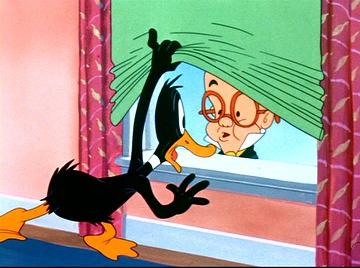
Most people were not excited at the prospect of entering the military in the early 1970s. But I don't think that this sentiment was unique to the Vietnam Era. There's an old Daffy Duck cartoon in my collection, set in World War II, the so-called "Good War." Daffy is living in middle class comfort, listening to the war news on the radio, waving the flag and singing patriotic songs.

Image from Draftee Daffy obtained from Wikipedia.
Then Daffy gets his notice from the Draft Board. The rest of Draftee Daffy (1945) is about Daffy's ultimately futile efforts to evade the comical little man from the Draft Board. But Warner Brothers was not trying to stir up anti-war sentiment in 1945. The humor comes from Daffy's reluctance to back up his patriotic fervor with real, personal commitment. Audiences had to understand and identify with Daffy's attitude or they would not have laughed. The cartoon could not have been made.

Today, nobody has to back up nothin'. Our endless wars are fought with proxies. Men who maxed out their deferments or sought shelter in the National Guard ("protecting Oak Street Beach from invasion by godless Canadians," as one of my ex-partners put it) got us into Iraq and Afghanistan and may yet get us into Iran. And we'll continue to yo-yo young men and women out of their daily lives (no hiding in the National Guard for this generation -- and, too often, no armor or training either) and thrust them into harms' way. But we'll gush over our men and women in service at sporting events and on Memorial Day and Veterans Day and think that makes it all OK.

But it doesn't, does it?

There have always been miscreants in the military, bullies, cowards, even outright thieves. Notwithstanding all the sentimental schmaltz on TV this weekend, not everyone who served was Sgt. York; some were Sgt. Bilko. When the all-volunteer military came in, it was believed that the general, overall quality of America's fighting forces would improve. Malcontent civilians would be replaced by persons hoping to fight. But even if we assume that this was true, it must also be agreed that there is a toll, a price to be paid, when our soldiers are subjected to deployment after deployment, in hot spot after hot spot, in endless wars where there are no front lines and where any civilian man, woman or child may be out for blood.

The cracks are beginning to show. In late September the U.S. Army observed a stand down day to focus on the problem of soldiers committing suicide. Think about that: There have been record numbers of suicides among active duty soldiers.

It is expected that the defense offered on behalf of the sergeant now facing a preliminary hearing in Washington State, charged with the massacre of 16 Afghan civilians, many of them children, will be that he was suffering from PTSD at the time of the massacre, caused by a prior concussive head injury sustained in Iraq. In fact, the sergeant was apparently on his fourth war zone deployment when the massacre took place (the other three being to Iraq). Each deployment lasts approximately a year. (Let's put that in perspective: A soldier who came ashore in Normandy on D-Day, June 6, 1944, would have been in combat for only 11 months before V-E Day in May 1945.)

Meanwhile, in North Carolina, a brigadier general is now on trial on sex crime charges. The general -- while on deployment in Afghanistan, mind you -- allegedly demanded nude pictures from female subordinates. Other charges faced by this officer include "forcible sodomy, wrongful sexual conduct and adultery, which is a crime under the military justice system."

And, of course, try and make it through today without hearing more lurid innuendo concerning David Petraeus (the former CIA Director), or his mistress, or the woman allegedly threatened by Petraeus's mistress, or the Marine four star general who succeeded Petraeus in overall command of Iraq and Afghanistan -- and who now is being questioned about thousands of allegedly inappropriate emails to the second woman.

The stress and strain of 11 years of unrelenting war on all ranks can not be dissipated by staging college basketball games on the deck of a retired aircraft carrier or at an American airbase in Germany. Hugging vets or thanking them for their service is nice, but it won't make anyone's limbs grow back or even make the nightmares go away.

We have these lovely Veterans Day ceremonies and we think we are then entitled to pretend that everything is fine. We've done our part. But it's not fine. We haven't done our part. Thus my discomfort. We either have to have some peace for our warfighters or start spreading the burden of service around.

All I am saying... is give peace a chance.

Thursday, October 04, 2012

Demographics is destiny: The China Syndrome

You've got a few (thousand) choices besides me if you're looking for hard-hitting analysis of last night's presidential debate.

But there's one line Mr. Romney used -- and he's used it lots before -- that sparks this morning's effort: "I'm not going to keep spending money on things I got to borrow money from China to pay for."

It's a good line. China holds a huge amount of our national debt. I've joked for years that there's no need for China to ever invade us if they want to bring us to our knees: All they've got to do is call their loans.

That's called kidding on the square. Or whistling past the graveyard. Something like that.

As we keep buying more and more we can't pay for, China owns more and more of our debt.

Some people look at this and -- in all earnestness -- think it's dangerous for a potential enemy to have so much of an investment in our country. But think about it for a minute: It would also be dangerous for China to have no stake.

Right now, if America succeeds, China profits. That's an incentive for them not to do anything bad to us, except send us the occasional Asian Longhorned Beetle, Emerald Ash Borer, or Brown Marmorated Stink Bug infestation. And put lead in our kids' toys.

So even if, by some economic miracle, we could buy all our debt back from China, we wouldn't really want to. We want China to feel invested in us, but we don't want to be dependent on them. It's a balance we must seek, not an either-or proposition.

But China has another problem besides potentially shaky American T-bills (remember that financial cliff we're about to go over?) and it's not easily solved.

China has a surplus of men. Young men.

China decided to control its population with a strict one child per family policy. Forced abortions, sterilizations, all sorts of repressive tactics were used to enforce this policy.

In a perfect world, even with a one-child policy, roughly half of the one-child families in China would have a daughter and half would have a son. (When nature takes its course there are slightly more girls born than boys.)

But, in our imperfect world, that's not how it worked out. Many Chinese baby girls were aborted, or killed after birth. For cultural reasons, and perhaps instinctive ones too, parents who could have only one child wanted that child to be a boy.

But now... there's lots of Chinese boys and few Chinese girls. That's great if you're obsessed with Malthus: the Chinese population must and will go down.

In the meantime, though, what do you do with all the extra boys?

There are three possibilities and two of them aren't likely: The Chinese government could embrace and promote homosexuality. Let the boys pair off. Cultural reality, however, says that's unlikely.

There could be some sort of mass religious movement with a strong monastic component. If young men want to go off and be monks, that would ease the problem of having too few girls to go around. But... how do you start a monastic movement in an officially atheist country?

The third choice -- and by far the most likely -- is to start a war.

There's a reason why 18-year olds are sent off to wars: They're naturally aggressive, they want to prove themselves, and they think they're immortal. The Chinese government either must find an outlet for the aggressions of their male surplus population or they may be toppled by them. What do you think the Chinese oligarchs will try to do?

If I were in the Russian government -- with a thinly-populated, resource-rich East and a long border with China -- I'd be taking this possibility very, very seriously. The Mongolians have resources as well, and a lot of empty space. They can't be comfortable either.

There are other targets for potential Chinese aggression, the United States included. But the Chinese government is practical and cynical. Resources are wealth. A little war will ease the population pressure and bring great potential wealth to the Middle Kingdom. And sad, bloody human history is replete with examples of brides being found in conquered territories. A push into Russia and/or Mongolia seems most probable.

Will the winner of the November election have to deal with this? Maybe not. Maybe the lid can be held on the pot a few years more. But I hope they're making plans in Washington, too. How do we handle this? How do we ride this out? Can we stay neutral? And, if we can't, with whom must we stand?

Saturday, September 15, 2012

Curmudgeon goes on a field trip

Long Suffering Spouse's school goes down to Springfield every couple of years -- at least the middle school students go to Springfield -- there to visit as many of the Lincoln sites as they can in a single day.

I last went with in 2009. I wasn't asked to go again until yesterday.

"We need another male," I was told.

Well, OK, I thought, that's fine.

"We need someone who's mature," I was told.

Well, OK, I thought, that's kind of a nice way of noting that I'm not as young as I used to be.

"We need someone who knew Lincoln personally --"

Now cut that out!

Sadly, the gloves I wrote about in 2009 were no longer on display at the Abraham Lincoln Presidential Library. I asked what had happened to them. "They're being given a rest," I was told. "We like to rotate the artifacts we have on display."

There were a lot of retired schoolteachers at each stop on our itinerary, leading the tours or supervising the exhibits. I got something from each of them; I'm not sure how much the kids picked up, of course, but you never know what might stick, even by accident, inside the mind of a junior high kid.

Wednesday, September 05, 2012

"Bozo's Circus is on the air!"

Über-blogger Ken Levine describes his recent trip with the Seattle Mariners (he broadcasts for the team part-time) in blog posts today and yesterday. Levine's post this morning included this remark, and it got me to thinking:
Hawked my book [The Me Generation... By Me] on the WGN-9 Mid-Day News. The station is God knows where. Certainly the cab driver didn’t have a clue. Drove by Wrigley Field and I think Wisconsin.
Neither Levine nor his cabbie were Chicago natives. Growing up in Chicago in the 60s kids learned two addresses -- their home address and WGN's -- and not necessarily in that order.

Ringmaster Ned, Bob Trendler, Bozo,
Oliver O. Oliver and Sandy the Tramp
2501 W. Bradley Place was the address for the postcards that kids sent in hopes of becoming the 'at home' player on The Grand Prize Game -- a daily feature of Bozo's Circus (in those days, a live TV extravaganza, with Ringmaster Ned and Bob Trendler and the Big Top Band). Creaky old Vaudeville animal acts -- and some creaky old Vaudeville sketches -- were part of the package. And, however creaky and old some of the bits were, they were all new to us kids. There were cartoons sometimes, too.

Kids could go home from school for lunch in those days and that's when Bozo was on. My mother would have sandwiches waiting and we'd watch the show. Because the show was live, there was a lot of spontaneous ad-libbing -- not all of it suitable for (or aimed at) children. My mother watched that show long after all of my siblings were grown.

The show was put on before a live audience and tickets were impossible to come by. Engaged couples would register for china patterns and Bozo tickets. Maybe the tickets would come in time for their kids to use. Maybe their grandkids. That's why kids send in so many postcards to be at-home players in the Grand Prize Game. After the "magic arrows" picked the day's lucky contestants Ringmaster Ned would shout, "Let's go over to the Bozo Drum!"

The Bozo Drum was a giant, hollow monstrosity. It looked like a Ferris Wheel, only a little smaller. The sides were clear so we could see all the postcards inside -- and it was stuffed. There was a little door in the side of the drum. The day's contestants would reach in and choose the at-home players -- the boy would pick a boy's card, the girl would pick the girl's. When the boy picked a girl's card, Ringmaster Ned would pluck it from the kid's hand and tell him to plunge in again.

This is from a later iteration of the show. Ringmaster
Ned was gone; even Frazier Thomas has come and gone.
I'll bet Professor Andy was all that was left of Bob Trendler's
Big Top Band. But the Grand Prize Game remained.
The Grand Prize Game itself involved tossing a ping pong ball into each of six painted garbage cans. It was harder than it looked: Even if one's aim was true, that darned ball might bounce out. And the pressure increased with each bucket: Kids got bigger and better prizes with each bucket safely reached (and the at-home players got duplicates). For years, the game would start with Ringmaster Ned pulling out a shiny silver dollar and letting one of the kids put that in Bucket No. 6. The pot would roll over every day. And a new bicycle awaited that lucky kid who successfully reached Bucket No. 6.

Those few kids who did beat the Grand Prize Game had icewater in their veins. They're probably cleaning up today on golf courses all over the country.

I never got to play the Grand Prize Game but I did get to go to Bozo once -- and I even got picked for a tug of war contest. Ringmaster Ned asked my name and everything -- but I must have mumbled because he called me by the wrong name. And my team lost the tug of war. Still, I was rewarded with a genuine Bozo decal. It was stuck to a dresser for years before some Philistine painted it over.

Fast forward nearly 50 years. Earlier this year I had to be at WGN for a political show (OK, I didn't have to be there; I was on the list to get by security because I'd arranged for one of the show's actual guests to be there). Anyway, on my way to the newsroom, I got to peek inside the old Bozo studio -- much of the set is still there -- and I was instantly transported. Hey, the newsroom was interesting, too -- but I saw the Bozo set.

Wednesday, July 25, 2012

Jim Thorpe and more on the dangers of rewriting history to suit any agenda other than accuracy

In its July-August issue, Smithsonian Magazine carries an article by Sally Jenkins, "The All-American."

The title of the linked on-line article is better: "Why Are Jim Thorpe’s Olympic Records Still Not Recognized?"

It's a darn good question -- and there's no good answer.

Jim Thorpe, a member of the Sac and Fox Indian tribe from Oklahoma, won the decathlon and pentathlon at the 1912 Olympics in Stockholm. According to legend, when Thorpe received his gold medals, Swedish King Gustav V said, "You, sir, are the greatest athlete in the world" -- and Thorpe replied, "Thanks, King." It was a pitch-perfect all-American we're-not-impressed-with-all-the-kings-and-crowns-in-the-world response. Wikipedia notes that Thorpe got a ticker-tape parade in New York on his return from the Olympics.

But Thorpe was not just a track and field athlete. He played professional football for the Canton Bulldogs before and after the formation of the National Football League in 1920. He played for a number of teams in the infant NFL, ending his playing career with the Chicago Cardinals after the 1928 season. He played his college football for the Carlisle Indian Industrial School, which wasn't really a college at all, but a Pennsylvania boarding school designed to "civilize" American Indians.

Yes, that was a thoroughly racist attitude. But the Carlisle Indians, coached by Glenn "Pop" Warner, played a major college football schedule and, for a time, led by stars like Jim Thorpe, so thoroughly dominated that sport (and sports generally) that, even today, athletic teams from grammar school through the professional ranks have names like "Indians," "Braves," or even "Redskins." The ignorant protests of the politically correct crowd (including, of course, the NCAA) that these team nicknames are racist slurs are simply wrong. Teams name themselves for other teams or qualities they admire, that they wish to emulate -- and early in the 20th Century, most athletes (of any ancestry) wanted to emulate the skill and success of Jim Thorpe and the Carlise Indians.

Thope also played major league baseball from 1913 until 1919. Indeed, it was baseball that cost Thorpe his gold medals. It seems that in 1909 and 1910, Thorpe -- like a whole lot of college kids -- played semi-pro baseball to earn pocket money during the summer. Most of the kids used aliases. Apparently, Thorpe did not.

In 1913, when word got out that Thorpe had made a few pennies from baseball, the IOC stripped Thorpe of his medals and rewrote the record books to edit out Thorpe's dominating performances. How dominating? Thorpe's time in the 1,500 meter run, the last decathlon event, was not beaten until 1972. And Thorpe ran the race in mismatched shoes (someone had walked off with his shoes early in the competition). Jenkins' Smithsonian article quotes Olympic historian bill Mallon, a co-founder of the International Society of Olympic Historians, as saying he believes Thorpe's 1912 performances establish him as "the greatest athlete of all time."

Thorpe was discredited because he was not a "pure" amateur. Times changed. LeBron James will be playing basketball for Team USA in London any day now. Jenkins' Smithsonian article notes that, in 1982, the IOC, ostensibly bowing to public pressure,
delivered two replica medals to [Thorpe's] family, announcing, “The name of James Thorpe will be added to the list of athletes who were crowned Olympic champions at the 1912 Games.” What’s less commonly known is that the IOC appended this small, mean sentence: “However, the official report for these Games will not be modified.”
But, of course, the records already had been modified. In 1913. They've not been put right yet.

I understand that you may not be as excited about this as I am. You may say this is only sports. It is therefore trivial. Who cares if records -- whether Thorpe's times or Penn State's football victories -- are blotted out according to the whims and fashions of the day?

If you accept the premise that we can rewrite the past to suit current needs and requirements (at least of the persons wielding the erasers), why can't the past be rewritten in other areas as well? Henry Ford supposedly said "history is bunk." George Orwell knew better.

We'd better know better too.

Friday, June 01, 2012

Yes, the house is lovely, but...

Apethorpe Hall, in Northamptonshire, about four miles north of the ancient market town of Oundle, is on the market, and priced to sell at £2.5 million (roughly $3.88 million).

It's quite a house -- 48 rooms -- and think of what a 'man cave' you could make of this room!


The place is just dripping with history: The oldest parts date from the late 1400s. Queen Elizabeth I stopped off for visits. So did King James I. The house was the family seat of the Earls of Westmorland for 350 years.

But the Fanes don't live there any more.

Although Wikipedia assures us that the 16th Earl is still very much among the living, Americans familiar with the collected works of P.G. Wodehouse will not be surprised to learn that the family sold the place. The surprising thing is that the family sold out early -- in 1904 -- to a Mr. Leonard Brassey. Whether he was later Lord Brassey or merely a relation, English Heritage tells us "Lord Brassey sold the house and gardens in 1949, though retained much of the remaining estate." Like a lot of old English manor houses, Apethorpe Hall "became an approved school, which closed in 1982."

In short, the joint was abandoned. It fell to rack and ruin, snatched from destruction only by the timely acquisition of the property by English Heritage which, in 2004, "undertook a multi-million pound programme of rescue works, with the aim of selling the Hall for use as a private country house."

Apparently, they're not even going to try and get back all the dough they plowed into the place.

So -- here's a true bargain -- oozing with history and potential. You can invite your friends down for weekends. You can play Upstairs, Downstairs or Downton Abbey.

And did I mention that Rowan Atkinson lives just down the road in the Village of Apethorpe?

You could have him over to tea and maybe persuade him to reenact scenes from Blackadder in the very apartments where Queen Lizzie I once took a royal snooze. I believe House is going off the air; maybe Hugh Laurie can be persuaded to visit, too. Maybe he'll bring Stephen Fry.

And, of course, if you get them you can do Jeeves and Wooster too.

What fun!

I know you're interested -- perhaps reaching even now for your checkbook -- so I should mention that there is one, teeny, tiny problem with the house.

A small thing, really.

But Eric Pfeiffer, on Yahoo! News (where I first learned of this -- and from whence I grabbed the two big pictures here) did mention in his article that there aren't any bathrooms in the house.

Forty eight rooms. Not one toilet.

Must have been a heck of a school. Now we know why the Brits are so famed for their reserve....

Friday, April 29, 2011

Santo subito? Not so fast, please

Among the many opinions that no one in the world is clamoring to hear are mine concerning the pending beatification of the late Pope, John Paul II.

At his funeral, crowds in St. Peter's Square unfurled banners and chanted "santo subito," which means (I am told) "sainthood now." And the canonization process, streamlined under John Paul II himself, was really fast-tracked for JPII by his successor, Benedict XVI.

John Paul II is, and I think will continue to be, regarded as one of the heroes of the 20th Century.

I imagine Joseph Stalin, skewered and rotating on a spit over an open flame in one of the hotter regions of the Netherworld. Long before John Paul II's reign, Stalin once famously sneered, "How many divisions does the Pope have?" Now, roasting in eternity, Stalin has his answer -- and JPII provided it: Enough. There are others deserving of credit, too, but John Paul II, as much as any other man, is responsible for the destruction of Soviet Communism.

But is John Paul II a saint?

The horrors that some (and far too many) Catholic priests and brothers inflicted on minors were revealed, in nation after nation, during John Paul's papacy. Reforms were adopted in America during his reign -- important reforms, badly needed, and, for the most part (as far as I can tell) sincerely implemented to date -- but the Church has never seemed to completely understand, acknowledge and accept its complicity in so many crimes over so many years.

As long as there are children there will be evil, sick or twisted individuals who will seek to exploit them. The Catholic Church was never alone in this. The Boy Scouts, protestant churches, even public schools -- there have been abusers in all of these, too. And in far too many cases, abusers in all of these settings were allowed to resign quietly, and even given carefully neutral references. But in none of these other settings were abusers systematically protected and moved to other fields of opportunity. To protect the Church. To protect the Church! To descend, for a moment, into kid-speak, but only because it seems particularly appropriate: OMG. But it wasn't just evil or venal or incredibly short-sighted bishops. There were well-meaning people involved there, too. Ironically, and tragically, an institution built on faith too many of these put their faith in science, hoping and relying on doctors and psychiatrists to "cure" errant clergy. It didn't work. We know better now. We hope.

The stain of clergy abuse clings to John Paul II, and not just because it was revealed on his watch. He appears to have defended or supported Marcial Maciel, the Mexican priest who founded the Legion of Christ and who also, according to Wikipedia, "was found guilty of raping underaged males and... also fathered at least one child."

Now the Pope -- any Pope -- sits atop a very steep pyramid. Not everything that goes on in the Church is or could be known by the Pope. In many ways the Pope -- any Pope -- is a figurehead, a prisoner of the Vatican bureaucracy, the Curia. The Curia is practically a living creature and, as such, is certainly far older than the Catholic Church. It is the bureaucracy of Rome -- Republican Rome, Imperial Rome -- still living on, adapting, growing. Like any living creature, the Curia responds to stimulation. And Maciel sent a lot of it to Rome during his heyday -- money, favors, money. When rumors swirled, they could be put down. Buried. Ignored. Dismissed as the mutterings of jealous rivals. What the Pope knew, therefore, and what the Pope should have known, on this issue or on many others, is not necessarily obvious.

But with these uncertainties I can not get too excited about John Paul II's coming beatification, unlike so many of my fellow Catholics here in Chicago. Cardinal George is heading up a large Chicago delegation to the ceremony this weekend. Part of it is ethnic pride: Chicago is the largest Polish city in the world after Warsaw (and home to more Poles than Warsaw at one time).

I take solace in this: Beatification is not sainthood. The media don't quite understand all this Catholic mumbo-jumbo and don't trouble themselves to learn, either. A man or woman who is beatified may be venerated by the faithful, but the Church does not declare, by beatification, that this man or woman is worthy of veneration as a friend and true servant of God.

I'd love to have met John Paul II. I was at his Mass in Chicago's Grant Park in 1979 -- me and a million or so of my closest friends. As I've already said, he is surely a hero for his role in bringing down the Soviet bloc. But there's no hurry, so far as I'm concerned, to declare the man a saint. Time will tell.

Thursday, April 21, 2011

Curmudgeon gets conspiracy-minded about 1918 Cubs World Series loss

This morning's Sun-Times carries a story about the possibility that the infamous 1919 Chicago White Sox (the "Black Sox") were not the first Chicago baseball team to throw a World Series.

Indeed, if a sworn statement by Black Sox pitcher Eddie Cicotte is to be believed, Cicotte and the other "Eight Men Out" may have been inspired to throw the 1919 Series to the Cincinnati Reds by a rumor that the Cubs had purposely tanked in the 1918 Series, against the Boston Red Sox.

That's the series in which Babe Ruth pitched for the BoSox. His contract was sold to the Yankees soon thereafter, the start of the pervasive New England myth -- "the Curse of the Bambino."

The Chicago History Museum has posted part of Cicotte's statement online, in an article by Peter Alter entitled, "Did the Cubs lose the the 1918 WS on purpose?"

Even casual baseball fans know what happened to the Eight Men Out. Judge Kenesaw Mountain Landis, a man with a hard face and a shock of white hair that made him look like an Old Testament prophet with a sour stomach, disregarded the 1921 court verdict in which the Black Sox were acquitted (despite confessions from Cicotte and "Shoeless Joe" Jackson) and banned all eight implicated players from baseball for life. You may even recall his famous quote on that occasion: "Regardless of the outcome of the juries, no player that throws a ball game, no man that entertains proposals or promises to throw a game, no player that sits in a conference with a bunch of crooked players where the ways and means of throwing games are discussed, and does not promptly tell his club about it, will ever again play professional baseball."

But was Judge Landis so tough on the Black Sox because he so hated gambling... or was his antipathy to the White Sox generally also involved?

Judge Landis was appointed to the United States District Court for the Northern District of Illinois by President Theodore Roosevelt in 1905. He had a talent for grabbing headlines by his rulings, but these did not always stand up to the test of appellate review. From Wikipedia:
In 1907, [Landis] presided over a Standard Oil antitrust trial fining them $29 million for accepting rail freight rebates, although the verdict was later set aside.

In 1918, he presided over the trial of over 100 members of the Industrial Workers of the World (including Big Bill Haywood) on the charge of violating (by hindering the draft) the Espionage Act of 1917. He also presided over the December 1918 trial of 5 prominent Socialist Party of America leaders, including Victor Berger, SPA Executive Secretary Adolph Germer, youth section leader William Kruse, and editor of the party's national newspaper J. Louis Engdahl. While Landis oversaw the convictions of many in these trials, imposing draconian verdicts, many of the verdicts were reversed on appeal or nullified by presidential pardon. The convictions were overturned because Landis had demonstrated his lack of impartiality; notably, Landis said during the trial that "If anybody has said anything worse about the Germans than I have, I would like to know it so I can use it." 255 U.S. 22 at 28.

Landis was also instrumental in getting African-American heavyweight champion Jack Johnson banned from the sport by charging him with transporting a white woman over state lines for prostitution.
And Landis was an open and notorious Cub fan. I remember reading once that Judge Landis was frequently AWOL from his courtroom, taking in Cub games at the West Side Grounds or, later, at Wrigley Field.

This morning, I looked online to see what corroboration, if any, existed for this recollection.

MLB.com says that Landis "often found time to attend games at both Comiskey Park and Wrigley Field in Chicago," but an unofficial Cub history website, JustOneBadCentury.com, asserts, "Landis was... a regular at West Side Grounds, home of the Chicago Cubs. He openly rooted for the Cubs against the White Sox in the 1906 World Series, something White Sox fans never forgot. When the Cubs moved to what is now Wrigley Field, he was a regular there as well."

Now... I don't pretend that this is anything close to authoritative proof... but isn't it interesting that the man who thundered so angrily against ballplayers who consorted with gamblers -- threatening to ban for life even a player who "sits in a conference with a bunch of crooked players where the ways and means of throwing games are discussed, and does not promptly tell his club about it" -- seems not to have investigated the rumors swirling around his beloved Cubs? Jury verdicts may not have been the only thing disregarded by Judge Landis in his handling of baseball's gambling crisis.

Joe Jackson, it is widely believed, knew about the fix and took the gamblers' money (it may have been thrown on the floor of his hotel room after he refused it); there is some evidence to support the claim that he tried to tell Charles Comiskey about the fix, but the Old Roman wouldn't see him. Jackson's so-called "confession" may have been procured following the liberal administration of whiskey by a White Sox team attorney, Alfred Austrian. Even so, Jackson arguably sat "in conference" with crooked players, but he did hit .375 in the 1919 Series, going 12 for 32 -- including three doubles and a homer -- going 5 for 12 with runners in scoring position. He scored five times, driving in six runs and committed no errors. (See, linked Wikipedia article; see also, Shoeless Joe Jackson's Virtual Hall of Fame.)

Would Judge Landis have been as stern and unyielding toward Jackson if he had worn Cubbie blue?

Monday, February 28, 2011

The War to End All Wars (and didn't) passes into American history

Frank Buckles, the Last American Doughboy, died yesterday at his West Virginia home.

With his passing, World War I becomes strictly a matter of history for Americans. It is no longer an event within "living memory." (Wikipedia says there are two confirmed World War I veterans yet living; both served in the British armed forces, though Claude Choules moved to Australia after the Great War and served under that nation's colors in World War II.) Oh, there are yet some who were alive during the War to End All Wars, but all living memory of going "Over There," the trenches, the mud, the rats, the gas, the thunder of the guns -- all of this is gone now.

When I was a boy, there were lots of World War I veterans. They were the granddads. When Charles Schultz drew Snoopy as a World War I flying ace, there were a good many newspaper readers who had thrilled to the first accounts of the battles between those Knights of the Air. Some of the real air aces were still around to chuckle at Snoopy's misfortunes right along with the rest of us.

But no more.

The other night Youngest Son had computer issues: It crashed just after he'd completed a paper and would not restart. My wife volunteered me to get up and sit with him as he called across the world for assistance in bringing the machine back to life. It was the wee small hours of the morning, of course; that's when high school seniors tend to write papers that are due immediately after sunrise. Youngest Son was on hold forever and I flipped on the TV to stay awake. There was a silent comedy on TCM; it was about two doughboys who escape from a German prison camp. It occurred to me that Youngest Son wouldn't have seen German uniforms from World War I; come to think of it, I couldn't remember the last time I had seen any either -- certainly not outside of some program on the History Channel. World War I had once dominated the popular imagination. Then the horrors of World War II crowded World War I from the collective consciousness.

And now World War I becomes a matter for historical study only.

The veterans of the Second World War were the dads of my youth. They are dwindling fast now; the last of these will be go someday, too, like Mr. Buckles, honored and celebrated and revered as the last of his kind.

The last World War II survivor will probably have been a kid who lied about his age to get into uniform, just like Mr. Buckles did. It will probably be that way for the last Korean War veteran, too, or the last veteran of Vietnam.

All the debates over strategy and tactics are glossed over, simplified, or even forgotten, as the generals fade away. The historians decide who was right and who was wrong (and change their minds every generation or so). The last living memories of any war aren't the grand schemes of planners and staff officers, but the vivid impressions made on a teenager's mind, far from home and kin.

Monday, December 13, 2010

What is America?

That's the challenging question posed by "Landgirl," a transplanted Midwesterner now at Home in the Highlands. The Scottish Highlands, that is.

She writes, "I'm doing an unofficial poll of real Americans in response to a BBC series over here trying to define America."

Although I'm anonymous, I'm quite real, and quite willing to take a crack at this one.

First, America is not just a place. The space we occupy on a map isn't even particularly important (although, once you're in you're required to stay in. See, Lincoln and the Civil War).

It is for this reason that the very notion of "Homeland Security" bothers me so. Germany has a fatherland. Russia has a motherland. But America is the only nation, ancient or modern, that is founded more on shared ideals than geography. Geography is at the root of most nations. Or religion. Or ties of blood. Sometimes combinations of these three things.

But not America. What makes America America is that we hold these truths to be self-evident: That all men are created equal, that they are endowed by their Creator with certain unalienable rights, that among these are life, liberty and the pursuit of happiness. That to secure these rights, governments are instituted among men, deriving their just powers from the consent of the governed.

We the People of the United States haven't always lived up to these ideals. The tired, the poor, the huddled masses of the Old World yearning to breathe free, the wretched refuse of their teeming shores -- these were not always welcomed to America with open arms, and certainly not always and by everyone in accord with our highest ideals -- but where in the world have more been welcomed better?

America is a state, of course, like France is a state, or Germany. (It's a grammatically incorrect state: The United States of America is a state... but I digress.) The point, though, is that unlike other states, America is also a particular state of mind. And that is where the notion of American exceptionalism comes from, at least for me.

So many people, here and elsewhere, are 'one worlders.' Human progress will be stifled, they think, and wars will flourish, until we are all united under a single government. Some idealists at the end of World War II saw in the United Nations a vehicle for eventually accomplishing this goal. Many other Americans have been scared to death of the U.N. for that very reason.

But, actually, the best vehicle so far invented for uniting humanity into a single nation was promulgated in Philadelphia in 1787. It is the instrument that allowed the 13 original independent nations to unite to form a more perfect union, establish justice, insure domestic tranquility, provide for the common defense, promote the general welfare, and secure the blessings of liberty to themselves and their posterity. It allowed independent nations like Texas and California and Hawaii to join as well. (We can also defer to a different date the question of just exactly how voluntary or unanimous was Hawaii's surrender of national sovereignty.)

I don't know if this abstract discussion has really explained what I think America is. An evening of Frank Capra films will help: Mr. Smith Goes to Washington, Mr. Deeds Goes to Town, It Happened One Night, It's a Wonderful Life -- even the much darker Meet John Doe. No, we don't always live up to the ideals portrayed in these movies either. And sometimes that spirit is sorely lacking here in the sinful, wicked City. But not always. And I've been in small towns on bright, sunny days; I've felt the warmth of strangers' greetings; I've basked in the courtesy and respect of people I've never met and will never meet again and I am here to testify: Capra had it right.

However, if you're not in a cinematic mood, you might want to read this post I put up in November 2007, about the South Korean landlords and the Iranian tenants.

One final attempt to illustrate America: Before I was married, my future wife's apartment was next door to a synagogue. I was a frequent visitor at the apartment, of course, and, one Fall evening, the future Long Suffering Spouse and her roommate and her roommate's boyfriend (now her husband) and I were all out on the back porch of her building looking down into the Sukkah constructed behind the synagogue. It was after dinner, near dusk. We were watching the little kids from another apartment in my wife's building playing around the Sukkah. The kids were Iranian (around the time of the Shah's fall, there were a lot of Iranian immigrants in Chicago). It occurred to me, even then, that we were four Catholics (of Irish, Cuban, German, and Lithuanian descent) happily watching Muslim kids playing in the yard of a Jewish house of worship. The wide open spaces of the West and the cornfields of the Midwest are uniquely American -- but so, too, was this tranquil scene around the Sukkah.

Does this answer the question?

Friday, August 27, 2010

Crusades vs. Jihads

Western political and military leaders blanch at the prospect that any of their adventures in the Middle East or Central or South Asia may be described as 'crusades.' Conversely, the Qaeda sympathizers are quick to label all westerners, and particularly all western soldiers, as 'crusaders.'

The Crusades were wars with an ostensibly religious purpose; they were proclaimed by the Pope. Most, but not all, of the wars labeled as 'crusades' were fought in Egypt or the Holy Land. (Or at least they were supposed to have been fought there. The Fourth Crusade wound up capturing and sacking Constantinople, something the Turks would be unable to do for another 250 years.)

We can not sugarcoat the semi-barbaric state of our European forebears in the High and Late Middle Ages, nor can we deny the wretched excesses of the Crusaders (the slaughter following the Siege of Antioch in 1098, for example, or Richard the Lion Heart's slaughter of 2,700 Muslim hostages after the Siege of Acre in 1191). These were not nice people. And if your history teacher told you that one of the main ideas behind the Crusades were to thin the ranks of "noble" thugs by sending them overseas to be killed, or to die from shipwreck, starvation or disease in transit (all the while keeping these creeps from wreaking havoc at home), I don't know that I could disagree.

But...

Let's back up and take a longer view for a moment, can we?

The Arabs came storming out of Mecca and Medina in the 600s, conquering North Africa and the Holy Land -- all formerly Christian territory, much of which was controlled by Rome's eastern remnant, Constantinople. The Arab armies crossed into Europe, gobbling up most of Spain and threatening France until Charles Martel blunted their advance. This was jihad. Conquest. Aggression.

In a broad sense, the Crusades may be seen as a largely defensive reaction to Muslim aggression. There was a real intent to reclaim the Holy Land so that Christian pilgrims could travel safely there and walk where Jesus walked. (Granted, there was a strong treasure motive. While some of the Crusaders may have been genuinely animated by religious passion, however misguided it may seem to our modern eyes, there can be no doubt that a lot of the Crusaders were in it for the potential riches they could find and carry back. Who knows? Maybe some individuals had both motives.)

The point is, the Crusades did not seek to completely destroy Islam (however many forced conversions -- or re-conversions -- were inflicted on populations in their path): There was no attempt to invade Arabia. In that sense, the Crusades were not intended as wars of conquest.

There have been oceans of blood spilled by Christians in the name of religion. But Christians seem to have saved their worst atrocities to inflict on each other. Consider the Fourth Crusade, mentioned above. Of course, even that may be interpreted as a reaction to the Byzantines' "massacre of the Latins" in 1182. The Italian trading cities encouraged the sack of Constantinople in revenge.

And, then, of course, once Martin Luther nailed his 95 theses to the church door in Wittenberg, so-called Christians really turned on each other. More than a century of seemingly unlimited violence broke loose. One of the main reasons why England's Glorious Revolution of 1688 was so "glorious" was that it was accomplished without re-starting the religious wars in the British Isles.

Except in Ireland, of course.

Europe's self-inflicted wounds from their interminable religious wars have never entirely healed over. Modern European secularism may owe its popularity to Europeans' fears that strong religious feelings might yet revive religious bloodshed. (My blogfriend Bee's comment to my post earlier this week illustrated this point beautifully. She wrote, "i cannot tell you how many baptists i have had arguments with that catholics ARE christians. they disagree.") And I can sympathize: Northern Ireland could erupt again at any moment. The wounds of the Spanish Civil War are still fresh. (We can take up Europe's excesses against the Jews some other time.)

We come now to the lesson to be drawn from this very broad survey of European history. I suggest we in the West should stop reflexively apologizing for the Crusades. Neither should we demand apologies from the Arabs for conquering Northern Africa, Egypt, the Holy Land -- or the Turks for finally extinguishing Constantinople. We shouldn't demand apologies for the attempted Muslim conquests of Spain, France or Vienna. (Come to think of it, has anyone really ever demanded apologies from the Muslims for any of this?) Anyway, instead, we should live in the present, and demand that our Muslim cousins do the same (as descendants of our common father Abraham, we're all family, aren't we?).

Respected Muslim scholars have concluded that jihad need not be military adventures, bent on conquest. Jihad can properly refer to man's personal struggle against sin -- temptation -- evil. Let's hope (dare I say, let's pray?) that this idea takes root and becomes universally accepted in the Muslim world. If there can be no more military jihads, there can be no more Crusades.

Tuesday, August 24, 2010

Mr. Language Curmudgeon defines "martyr"

Readers of this blog will note that I frequently inveigh against the creeping Orwelliazation of the English language, that is, the taking of wholly useful, commonly understood words and infusing them with a new and different meaning and, then, all too often, denying that the prior definition ever existed.

I am old enough to remember, for example, when "gay" meant "happy." Once upon a time, children, "queer" meant "odd" or "different." "Marriage" was the union of a man and a woman. "Police action" meant Officer O'Flaherty swinging a billy club at some miscreants, not hundreds of thousands of American troops fighting wars in Asia. For that matter, "war" meant a violent confrontation between nations, or among groups of nations, fought with armies and navies and air forces, not a public relations campaign against (pick any or all of the following) poverty, drunk driving, obesity, drugs....

Another word which has been hijacked and perverted (without apparent protest!) is "martyr."

Suicide bombers are lionized in certain parts of the world as "martyrs."

Victims of terror bombings are sometimes also referred to as "martyrs."

Murderous brutes launch rockets from the courtyards of mosques or school playgrounds, hoping to draw retaliation at the launch point. The inevitable casualties will be hailed as "martyrs," while the monsters ultimately responsible for their deaths will have slunk away, dragging their portable rocket launchers with them.

None of these, though, are "martyrs."

A martyr does not commit suicide. A martyr is murdered. A martyr does not kill others; he or she is killed.

How then does the martyr differ from any murder victim? A murder victim does not know that he will be murdered. He may know -- as an inner city gang member, for example -- that his life expectancy is short, but he does not know the day or the hour.

As a young boy in a fairly progressive Catholic school there were often times during the school day when I had finished my assignment and was free to pull a book off the shelves to read.

The options were fairly limited, of course, but there was all the excitement and adventure (and blood and guts and gore) a boy could wish for in The Lives of the Saints. Oh, sure, some stories were boring -- impossibly good priests or nuns, devoted to prayers and scrubbing floors, reluctantly performing miracles for the faithful who gathered 'round in expectation -- but, then, there were the stories of the martyrs.

Early Christians endured hundreds of years of persecution before Constantine had his vision of the Cross. The persecutions produced legions of martyrs -- men and women and children singing hymns of praise and thanksgiving as they bravely marched into the Coliseum to be devoured by lions or hacked limb from limb by gladiators.

Later, of course, I would learn that the Romans had been remarkably tolerant of other faiths in their day, co-opting the local deities whenever they conquered a region, building temples to the local favorites (and doing their best to identify the hometown heroes with someone in their own pantheon). The trouble was that the early emperors also co-opted the eastern idea that rulers were gods on earth, thus entitling them to sacrifices. It became something of a loyalty oath -- give the emperor his stick of incense and worship whoever else you wanted.

This the Christians could not do. (Well, some did, of course, but none of them ever made it into The Lives of the Saints.) Jesus had taught the early Christians to render unto Caesar the things that were Caesar's and to God the things that are God's. And they took Him quite literally. Worship was over on the God side of the line and hundreds -- thousands -- of Christians refused to cross that line.

The Christian martyrs did not court death. They hid out. They tried to fly below the radar (the Catacombs, surely, qualify). Like Thomas More in a later age, they tried to say nothing rather than say anything that would damage their lives here or in the Hereafter.

But, sometimes, the Christians were forced out into the open. Perhaps they were betrayed. Or the local officials were required to make a proper demonstration. Each tale of martyrdom had its unique elements. But there was a unifying theme: The Christian martyrs did not volunteer to die; they were condemned because of their faith. They did not choose death except as a less evil alternative to dishonor and damnation. They had to choose between sacrificing to the emperor or sacrificing themselves.

In making this awful choice, the Christian martyrs became braver than the bravest firefighter or police officer or soldier. The firefighter or police officer is trained to cope with danger and learns to live with the possibility that any call may be his or her last. Soldiers are trained to cope with the possibility that enemies will try to kill them -- and, preferably, how to kill the other side's soldiers first. But the martyrs knew they were going to die and they would not, and could not, fight back.

And they went in singing.

For a boy reading The Lives of the Saints, this was awesome, inspirational stuff. It made quite an impression on the Romans, too. Though the martyrs were anything but terrorists, their calm acceptance of their fate terrified many Romans. The deaths of the martyrs inspired a lot of Romans to convert. Eventually the bloody path of martyrdom led to the Milvian Bridge.

The important thing, for a modern person, is that the loser who wires his body with explosives trying to kill women and children at a bus stop is not a "martyr." He is a suicide and a murderer. He is a criminal. And, in the long run, he will inspire no one.