If anyone remembered I was out here, and missed me, I'd feel bad about this.
But no one does -- or should -- let's be real, here -- why should anyone keep following someone who doesn't update for a year at a time?
Of course, I didn't set out to ignore the site for a year... I, uh, fell into a health challenge... and now I'm looking at another one. And there are so many other things I'm trying to do, too.
But I am still using this site... in my real life... this has been a helpful repository for me... so I think I'd better publish this brief update while I am visiting... lest this site wither away from neglect.
Maybe I'll even come back regularly... but not just yet....
Monday, May 04, 2026


Tuesday, April 15, 2025
No, actually, child sacrifice is violent

The article is about the discovery of an altar from the Teotihuacan culture in Tikal National Park in Guatemala, the center of Mayan culture. The Teotihucan culture was centered more to the north, closer to Mexico City, so this discovery proves some sort of "sociopolitical and cultural interaction between the Maya of Tikal and Teotihuacan's elite between 300 and 500 A.D."
According to the linked article, Lorena Paiz, the archaeologist who led the discovery, said that the Teotihuacan altar was believed to have been used for sacrifices, "especially of children." The remains of three children, no more than than four years old, were found on three sides of the altar, according to a quote from Paiz in the article.
Quoting directly, now, from the article:
María Belén Méndez, an archaeologist who was not involved with the project, said the discovery confirms "that there has been an interconnection between both cultures and what their relationships with their gods and celestial bodies was like."No.
"We see how the issue of sacrifice exists in both cultures. It was a practice; it's not that they were violent, it was their way of connecting with the celestial bodies," she said.
Killing little children is violent. Period. Full stop. People who would countenance the killing of little children are violent. Period. Full stop.
Perhaps Belén Méndez made such a ridiculous statement because she doesn't want people to dismiss either the Mayan or Teotihuacan cultures as uncivilized. The existence of their ruined cities is more than sufficient evidence that these cultures achieved a type of civilization. In addition to building cities, they made advances in astronomy, developed an intricate and accurate calendar, and made discoveries in agriculture, allowing them to feed large populations in a jungle (albeit possibly triggering, at least in the case of the Maya, a climate catastrophe that brought their civilization crashing down).
But if we must acknowledge that these were civilizations, we must also admit that these were violent civilizations. They murdered little children. I cannot fathom why there is a perceived need to sugarcoat this obvious fact.
I suppose this desire to paper-over-the-child-sacrifice business may come from a need to denigrate the Christian, European civilization that ultimately displaced these cultures: At least in academic circles, the Mesoamerican cultures must be considered as at least morally equivalent, if not, indeed, superior to the bad, evil, European colonizers.
Horsefeathers.
The intellectual sophistication and intelligence of some of the indigenous leaders over the barely-literate younger sons of perpetually impoverished Extremaduran noblemen may be conceded without hesitation -- but Christian Eurpoean civilization did not demand child sacrifice. In that sense, clearly, Christian European civilization was superior to the cultures it displaced. At least, it was superior to those cultures which killed little children (even if it was just "their way of connecting with the celestial bodies").
At least our civilization was superior until recently....
Thursday, March 13, 2025
Daylight Savings Time: Providing neither more daylight nor any other appreciable savings

Traffic accidents go up on the Monday after Daylight Savings Time begins; there is also an uptick in heart attacks. And how many people fall off chairs, or ladders, trying to change the clocks in the kitchen or on top of a bookshelf?
Do you know anyone who really likes DSL? When I was working full-time, of course, I raged that losing an hour of my precious weekend was a terrible burden -- but, even in retirement, I see no virtue in it. I saw something online about an old Indian chief who allegedly said only the American government could cut the top foot off a blanket, then sew it back on the bottom of the same blanket, and then claim the blanket was now a foot longer. That story about sums up my current attitude toward DST. Do we turn on the lights a little later in the evening now at the Curmudgeon home? Yes, we do. But, just as we were starting to no longer need to light every light in the house to get moving in the morning, we now need them again.
A month ago (or so) we were turning into a blinding sunrise as I pulled out of our driveway to take Long Suffering Spouse to school. But the days got a little longer and the Sun became no longer an issue. Now, with DST, we are turning into the blinding sunrise again.
These are not terrible things; they are merely dumb. Pointless....
...but not permanent.
In a week, we won't be driving into the sunrise (again). In two weeks, we won't need to turn all the lights on in the house to get started in the morning.
Once I finish changing the clocks, the new time is the only time I know. Or acknowledge.
Long Suffering Spouse is made differently. I suspect she is far from alone in this: She clings to the notion that it is 5:00, although the clock says 6:00, for many days. The alarm doesn't ring at 5:30 a.m. (though the clock says otherwise). For Long Suffering Spouse, it is still 4:30 a.m. And she is more tired accordingly.
Middle Son and Margaret and their five children live in Michigan now, down among the Insufferable Elitists, according to this "Painfully Honest" map of Michigan:

I well know that I am not as accepting of as many things as I should be. But when all the clocks in the house agree that it is 8:15, I accept their verdict. Because everyone else in the vicinity is in the same boat.
Still... the only good thing I can think of about DST is that it furnishes an excuse for us to turn back our clocks to Standard Time in the Fall. And who doesn't appreciate an extra hour on the weekend? [Rips foot off bottom of blanket and sews it back to the top of blanket... and all the while wonders... could we do this with velcro instead?]
Friday, February 28, 2025
A Boomer moment for which I do *not* apologize

Check writing is apparently a lost art.
Indeed, when I went online this morning to search for a picture of a check with which to illustrate this post (not wishing to provide a picture of one of my own -- I see no reason to make it even easier for the Russians or North Koreans to drain my meager checking account), I found all sorts of helpful bank tutorials about how to properly write a check. Because the kids these days... and by "kids" I mean almost anyone 50 or younger... and certainly darn near everyone 30 or younger... don't know how to write checks. Instead, they apparently point their telephones at one another, like ray guns from a 1950s sci-fi kids show, and zap money to each other when required.
The accounts in which their zappable funds are held are still referred to as "checking" accounts, but the word has rather lost its meaning, since account holders seldom or never draw checks on these accounts. At least the phrase 'checking account' is no longer understood in its original sense, much like this symbol:

And, of course, referring to the 3.5" disk as a "floppy" is a further example of a word that lost its original meaning, inasmuch as the 3.5" disk was entirely rigid and not floppy at all, as opposed to its predecessor, the 5.25" floppy drive that could hold an (at one time) astounding 360kb of data. Astounding, that is, compared to the 8" floppy disk... which was really floppy. I don't have any of the 8" floppy disks laying around... but there is quite a collection of 5.25" disks gathering dust in my home along with their 3.5" brothers and sisters.
But we will quickly climb out of that rabbit hole and resume our rant about checks.
The young people don't write checks anymore.
My wife, who is still teaching, has had occasion in recent years to order t-shirts for a school club she moderates. She asks the parents to send a check to cover the cost... and, with each passing year, this apparently becomes a more and more arduous task. Put it this way: The school parents need to look at the online tutorials I saw this morning. One parent wrote my wife a check with the amount of the check on the "pay to the order of" line. I had to take these checks to the bank for deposit... and I was afraid this one might not be accepted for deposit... and, indeed, the young teller gazed quizzically at that particular check for some time, before deciding to accept it.
If all goes well, later this summer, most of the Curmudgeon family will vacation together at a house I've rented for this purpose in another state. Middle Son wanted to book the house, but I pulled rank and claimed the honor. Among other reasons, I don't know how to point my phone at his and make money magically jump to his device from mine. "That's fine, Dad," Middle Son said, "now I'll get to write the first check since I wrote you the check for our vacation rental last year."
So I fully understand that the Young People don't write checks.
But... last I heard... the Uniform Commercial Code is still the law of the land (there may still be some variations of the UCC in Louisiana which are inapplicable to this discussion). A check is money.
So this past Tuesday, when I had occasion to be downtown for my only day of work this month, I brought with me a check to pay a department store charge card bill which was, by coincidence, due that very day. The walk to the store during my break would satisfy my Fitbit that I was exercising as it demands, and lend purpose to my wanderings.
I hoofed over to the store at my first opportunity.
I won't name the store, of course. I'm sure the store would be tremendously embarrassed by this story, or at least it should be, but if you guessed that the store in question has a modified bullseye for a logo, you'd be right on target. *Ahem*.
Anyway, I went to the customer service desk (I believe they call it 'guest relations,' but I have no relations working in that store that I know of) and presented the payment coupon and my check, whereupon the smile on the face of the nice lady behind the counter froze. "Oh, no, sir," she said, "we don't take checks here any more. It's store policy."
Now... being a reasonable fellow... I can understand a merchant being wary of accepting a check for the purchase of goods. If the check is no good, the customer has effectively absconded with the merchandise. There are civil and criminal remedies for passing bad checks, of course, but, while these consequences are far more onerous for the person passing the bad paper, there is, undeniably, a certain amount of inconvenience involved for the merchant. If the merchant does not wish to deal with that possibility, I do not say him nay.
I do not reflexively condemn every reduction of payment options. To cite an example: I am not happy with the fact that the pizza joint where I go for lunch on those few days I work downtown no longer accepts cash. Only credit or debit cards are accepted. But that is because, in Chicago, as perhaps in other big cities, there are people who view a cash register containing cash as an untapped wellspring for their own personal use. The pizza joint's policy is an unfortunate, but arguably necessary, response to a bleak reality of our modern world. The department store's position regarding accepting checks for payment of its store-issued credit card, on the other hand, is just plain stupid.
It is stupid because, when a person tenders a check for the payment of store-issued credit card, the merchant has no additional risk than it would if a person tried to pay online, and no inconvenience whatsoever. It is out no merchandise -- at least no new merchandise -- and, should the check prove to be backed by insufficient funds, the merchant can suspend credit, close the account, and maybe even sue. It certainly will add large penalties and fees and charge usurious interest on the balance due, just as it would do if no attempt at payment were made, or if payment were defectively tendered online.
So... yes, I suppose it was a 'Boomer moment' as I stood at the counter, brandishing my check, dumbfounded by the store's refusal to take my lawfully tendered payment. But it was not simply that I am old and the world has passed me by. I was right, and within my rights, and the store was stupid. So I make no apology -- this time -- for my Boomer moment. (I later paid the bill online, as I usually do....)
Monday, January 27, 2025
Long Suffering Spouse fails to attain verticality
I jinxed us.
In our last episode I suggested that Long Suffering Spouse would defy any virus that tried to lay her low; I said she'd consider herself healthy enough just as long as she could attain verticality. As long as she could get up and go.
Friday morning, Long Suffering Spouse's get up and go got up and went. She failed to attain verticality.
Almost from the moment I posted last week, my health deteriorated. My Fitbit told the tale: Instead of my now-customary 10,000+ steps, on Tuesday, I achieved fewer than 2400. On Wednesday, determined to get ahead of my personal creeping crud (nothing more exotic than a bad cold), I tried to sleep the day away and managed not even a thousand steps.
My wife suggested I was roughly a week behind her, health-wise, and she carried on as usual. She worked until midnight Tuesday. And Wednesday. And Thursday, too.
Friday morning, while I was laying awake and trying to concentrate more on the radio news and less on my hopelessly clogged sinuses, Long Suffering Spouse started to scream.
 When she tried to sit up, the room started spinning, she started feeling sick, and garish, pulsating visions started to impose themselves upon her field of vision. Then she thought everthing had or would go black... and that would have been a relief.
The above illustration is garish and nausea-provoking, perhaps, but it isn't close to what Long Suffering Spouse experienced by way of her vertigo attack Friday morning: We made the diagnosis fairly quickly, after consulting the greatest medical mind the profession has ever known... Dr. Google.
It took a couple of hours for Long Suffering Spouse to make it out of bed, and another hour besides before we could get downstairs to our coffee. I texted my wife's principal immediately after the first round of screaming stopped, letting her know that Long Suffering Spouse would not make it in. I was then free to try and find some place where she might be seen.
The trick to accessing quality medical care in America these days is to never try. There'd be no point in even trying our internist; she doesn't see sick people. Actually, that's probably unfair to suggest: She may well see sick people... if they've gotten, or remained, sick whilst waiting for their appointments. We'd made it downstairs; we were no longer in a true emergency sistuation. We'd not have to bother an ambulance. But, even though Dr. Google had made it quite clear that the vertigo attempt was alsmost certainly just a temporary, if miserable, condition, my wife wanted to be seen by someone. And my daughters agreed.
I therefore found an immedate care (a 'doc-in-the-box') nearby and having ability to see us... allegedly... pretty quickly.
I made an appointment online... and we were still there for more than two hours. For most of this time I waited in the car (we had plenty of our own germs, thank you, we didn't need to mix and mingle with any new ones unnecessarily), while Long Suffering Spouse languished in an exam room. At one point, Long Suffering Spouse texted me that she was beginning to think that they'd forgotten her.
This proved to be only partially true: A nurse practitioner did indeed find Long Suffering Spouse and administer various tests -- ruling out ear infection and stroke and that sort of thing -- and then triggered another blinding episode of vertigo by having my wife lean back in a certain way. Apparently the exercise was designed to set off an attack, but the suddenness and intensity of the attack was such that it seemed to have scared the NP as well as my wife. Anyway, they decided I'd best come into the examination room, and I immediately answered the summons that came in via text.
I gave the receptionist my wife's name and asked how may I get to her room -- and she first told me that they didn't have anyone by that name -- then she asked me if I maybe had intended to wander into the physical therapy place next door instead -- and only then, when I persisted, scrolled back far enough on her screen to find out where Long Suffering Spouse was. So I guess they were in the process of forgetting she was there.
Anyway, long story short, Long Suffering Spouse is much better today -- having attained verticality again, if unsteadily -- she's back at school, teaching.
You, the reader, may take today's essay as testimony to my wife's grit and determination. Her toughness. And, of course, that is a reasonable and correct interpretation of this tale.
But I see something else that may be going on here, something having to do with some hietherto unsuspected predictive power that this site may possess: I had only to comment about my wife's insistence on going to work as long as she could 'attain verticality' and -- voila! -- not only is she not able to go to work, but she is in fact kept out of work by a malady that makes 'attaining verticality' a near-impossibility.
Well, then. This may be an opportune moment to say I am going out to buy winning Lotto tickets. Which, now that I think about it, is exactly what I want to do next. If there's anything to it, my next entry may be datelined from the South of France....
In our last episode I suggested that Long Suffering Spouse would defy any virus that tried to lay her low; I said she'd consider herself healthy enough just as long as she could attain verticality. As long as she could get up and go.
Friday morning, Long Suffering Spouse's get up and go got up and went. She failed to attain verticality.
Almost from the moment I posted last week, my health deteriorated. My Fitbit told the tale: Instead of my now-customary 10,000+ steps, on Tuesday, I achieved fewer than 2400. On Wednesday, determined to get ahead of my personal creeping crud (nothing more exotic than a bad cold), I tried to sleep the day away and managed not even a thousand steps.
My wife suggested I was roughly a week behind her, health-wise, and she carried on as usual. She worked until midnight Tuesday. And Wednesday. And Thursday, too.
Friday morning, while I was laying awake and trying to concentrate more on the radio news and less on my hopelessly clogged sinuses, Long Suffering Spouse started to scream.

The above illustration is garish and nausea-provoking, perhaps, but it isn't close to what Long Suffering Spouse experienced by way of her vertigo attack Friday morning: We made the diagnosis fairly quickly, after consulting the greatest medical mind the profession has ever known... Dr. Google.
It took a couple of hours for Long Suffering Spouse to make it out of bed, and another hour besides before we could get downstairs to our coffee. I texted my wife's principal immediately after the first round of screaming stopped, letting her know that Long Suffering Spouse would not make it in. I was then free to try and find some place where she might be seen.
The trick to accessing quality medical care in America these days is to never try. There'd be no point in even trying our internist; she doesn't see sick people. Actually, that's probably unfair to suggest: She may well see sick people... if they've gotten, or remained, sick whilst waiting for their appointments. We'd made it downstairs; we were no longer in a true emergency sistuation. We'd not have to bother an ambulance. But, even though Dr. Google had made it quite clear that the vertigo attempt was alsmost certainly just a temporary, if miserable, condition, my wife wanted to be seen by someone. And my daughters agreed.
I therefore found an immedate care (a 'doc-in-the-box') nearby and having ability to see us... allegedly... pretty quickly.
I made an appointment online... and we were still there for more than two hours. For most of this time I waited in the car (we had plenty of our own germs, thank you, we didn't need to mix and mingle with any new ones unnecessarily), while Long Suffering Spouse languished in an exam room. At one point, Long Suffering Spouse texted me that she was beginning to think that they'd forgotten her.
This proved to be only partially true: A nurse practitioner did indeed find Long Suffering Spouse and administer various tests -- ruling out ear infection and stroke and that sort of thing -- and then triggered another blinding episode of vertigo by having my wife lean back in a certain way. Apparently the exercise was designed to set off an attack, but the suddenness and intensity of the attack was such that it seemed to have scared the NP as well as my wife. Anyway, they decided I'd best come into the examination room, and I immediately answered the summons that came in via text.
I gave the receptionist my wife's name and asked how may I get to her room -- and she first told me that they didn't have anyone by that name -- then she asked me if I maybe had intended to wander into the physical therapy place next door instead -- and only then, when I persisted, scrolled back far enough on her screen to find out where Long Suffering Spouse was. So I guess they were in the process of forgetting she was there.
Anyway, long story short, Long Suffering Spouse is much better today -- having attained verticality again, if unsteadily -- she's back at school, teaching.
You, the reader, may take today's essay as testimony to my wife's grit and determination. Her toughness. And, of course, that is a reasonable and correct interpretation of this tale.
But I see something else that may be going on here, something having to do with some hietherto unsuspected predictive power that this site may possess: I had only to comment about my wife's insistence on going to work as long as she could 'attain verticality' and -- voila! -- not only is she not able to go to work, but she is in fact kept out of work by a malady that makes 'attaining verticality' a near-impossibility.
Well, then. This may be an opportune moment to say I am going out to buy winning Lotto tickets. Which, now that I think about it, is exactly what I want to do next. If there's anything to it, my next entry may be datelined from the South of France....
Tuesday, January 21, 2025
January birthday parties in particular typically come with something extra...
Disease.
So I left off last Thursday, saying I was about to head out to pick up Grandchild Nine from pre-school. Which I did.
I wasn't exactly on time... but I wasn't so late that the school felt it necessary to notify Younger Daughter or her husband, Olaf. Actually, Nine said that he wasn't even the last kid to be picked up. Only next to last... but I will take my triumphs when I can.
My instructions were to bring Nine to Younger Daughter's House. What was to transpire thereafter was at first a trifle vague, but, ultimately, I wound up staying there for a few hours, during which time Olaf dropped off Grandchild One from her pulmonologist's appointment, scooped up the new puppy, and headed off to the vet.
Olaf returned from the vet about the same time that Younger Daughter came home with Grandchild Four. I had asked for instructions about giving my charges lunch -- they did not have a slice of bread in the house for sandwiches, so, with Long Suffering Spouse's permission, I volunteered to take One and Nine back to my house and feed them. We have bread. But neither Younger Daughter nor Olaf responded to my request for authorization to pull up stakes... even when I promised to bring them right back.
Whatever.
I did my duty and got my lunch when I returned home. Around 3:00 p.m. Just before I would have to pick up Long Suffering Spouse.
Four's adenoid surgery was, initially, the only complication known for the weekend. It was hoped, however, that Four would rally in time to go to the family January birthday party. Birthdays party?
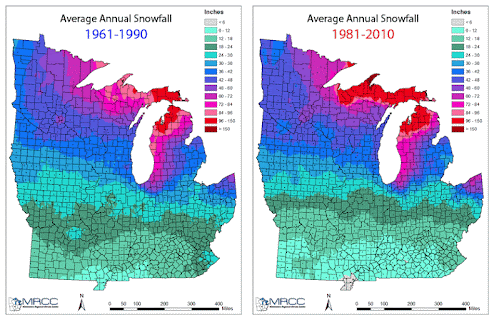 Three of our grandchildren were born in the first month of the year: Grandson Seven (Younger Daughter's older boy), Granddaughter Eight (Middle Son's second born) and, celebrating his very first birthday, Grandson Fourteen (Youngest Son's younger boy). Middle Son, his wife Margaret, and their five children now reside in Michigan, an hour or so outside Detroit, so a degree of planning is required for any Curmudgeon family event. And a certain amount of good luck, too: Even if everyone stays healthy, coming around Lake Michigan in January can be somewhat hazardous. That's where most of our lake-effect snow goes... somewhere from Gary to Benton Harbor... depending on the wind direction. The entire area is not usually subject to heavy snowfalls all at the same time; the snow comes off the lake in bands of varying width. Buffalo may have it worse, but driving through a lake effect snow squall in Indiana or Michigan can be blinding at best. And very scary. A bad weather forecast would result in the party being cancelled, or at least rescheduled.
But the weather forecast seemed promising. Cold -- a real arctic blast by the end of the holiday weekend -- but not snowy.
Younger Daughter and Youngest Son both volunteered to host the party at their respective houses. By some process that did not involve me, Youngest Son's house in the western suburbs was chosen as the venue. Middle Son would arrange for catering. Younger Daughter would bring the birthday cakes and party bags.
(If you're wondering, all we were asked to do was bring a vegetable tray... but Long Suffering Spouse decided to make cookies for the party, too.)
It seemed a good thing that Youngest Son and Danica were hosting, too, when, on Friday morning, Younger Daughter disclosed that Grandchild One -- you know, the one I was watching just the day before? -- had woken up with a temperature of 102.8.
There was a scramble to find out what virus had felled One: She tested negative for Covid, Flu A, Flu B, and strep. If it had been one of these, Birthday Boy Seven and all his siblings and Long Suffering Spouse and I would all be forced to cancel. But since it was nothing identifiable... well, the question was still open for discussion.
All I cared about was that Middle Son was properly notified before he set out Saturday morning. When I talked with Older Daughter Friday, she seemed not to know about One's bug. So I flat-out asked Younger Daughter is she'd actually warned her brother.
She was mad at me for even suggesting that this might not have happened. When she calmed down, Younger Daughter told me that she and Margaret had decided that those kids who had gone to school on Friday could go to the party, unless they had become actively ill in the meantime.
This may have explained why Older Daughter was being coy when I'd spoken with her on Friday: Her youngest daughter, Grandchild Six, had been kept home from school on Thursday because she had some bug or another. I wasn't exposed, at this point, to Six's bug. But (guessing before she learned about the Friday school rule) she had decided to hold Six out on Friday as well. Older Daughter was most insistent that Six was much improved on Friday: She was eating like a Hobbit, Older Daughter told me, scarfing down two breakfasts at least.
And so Middle Son and his brood came in. His youngest, the twins Twelve and Thirteen, had runny noses, but they are teething. Seven and Nine came with Younger Daughter (One and Four -- who was not recovering as fast as had been hoped from her surgery -- did not).
The party went off well enough. With all the presents for the three birthdays it looked like Christmas. Fourteen's older brother, Eleven, kept trying to open his brother's stuff, but he's two and you wouldn't expect anything else. Seven seemed to run down a bit, at one point, but he rallied instantly when his uncle put video games on the basement TV.
Sunday, Middle Son and his brood came over to our house after early Mass. Youngest Son came along a little later -- his boys had slept in and he was not going to rush them. Older Daughter's oldest, Grandchild Two, had an indoor soccer game Sunday morning, but she and her mom and dad and her sisters, Three and Six, came by in the afternoon and everyone stayed well into the evening. (Yes, if you're keeping score at home, we provided breakfast, lunch, and dinner during the course of the day... if you had been thinking we'd gotten off easy with the vegetable tray on Saturday, you are now free to think again....) Younger Daughter and her brood did not make an appearance; then again, Younger Daughter had to work Sunday afternoon, so that was not a surprise.
The surprise came later: Seven, who'd been at Youngest Son's house for the birthday party -- after all, he was one of the honorees -- had a 105 degree temperature Sunday night. Not a typo. 105.
Eleven had a low-grade fever yesterday, too. And Danica is not pleased. She's had to cancel some plans today on account of Eleven's condition and (I think) she may feel that her husband's siblings and their respective spouses were not entirely forthcoming with regard to the risk of contagion. She will learn, in the fullness of time, that everybody gets sick in the winter, especially once the kids start school or day care. There's not much anyone can do about it. I'm pretty sure that's what happened to poor One: This is her first year in middle school -- hence, a whole new set of germs to sample and to spread. Next year, Two will be in a different middle school for the first time and she will probably have more than her share of creeping crud come next winter, too.
Curmudgeon family gatherings will be increasingly difficult for some time, as the grandkids age up.
Younger Daughter was very upset about the unexpected illnesses that played havoc with our party plans, too, and I don't blame her.
But here's the awkward truth: With any luck at all, my grandkids can look forward to decades of parties with their cousins. My kids should likewise be able to enjoy each other's company for many years to come. As bad as one of the kids or grandkids feels about having to pass on a party because of illness, it's much, much more difficult for Long Suffering Spouse and me. I hope we may yet have several more good years... but the actuarial tables are starting to turn against us.
So we went to the party Saturday and we hosted on Sunday because we know this can't last forever. Even though we know there will be consequences: Long Suffering Spouse started in with a bit of a dry, unproductive cough a few days ago. She never acknowledged illness, of course: As long as she can attain verticality, she's healthy enough, in her view. As long as she's actually breathing there's no way she'd get sent home from school. The cough got worse over the weekend, but the kids and the grandkids didn't hear it. She's got a sore throat today and various aches and pains, but it's below zero outside, and it could be the weather, you know. It's certainly a contributing factor. But she's at school today, teaching as if nothing were amiss.
I had been entirely fine all weekend and in the days leading up thereto. My cough started in last evening. I slept badly last night and feel worse today. I cancelled my dental appointment today because it probably isn't a good thing to hack up a long while the hygenist is stabbing at my gums. I wish everyone could stay healthy... and then I wake up.
So I left off last Thursday, saying I was about to head out to pick up Grandchild Nine from pre-school. Which I did.
I wasn't exactly on time... but I wasn't so late that the school felt it necessary to notify Younger Daughter or her husband, Olaf. Actually, Nine said that he wasn't even the last kid to be picked up. Only next to last... but I will take my triumphs when I can.
My instructions were to bring Nine to Younger Daughter's House. What was to transpire thereafter was at first a trifle vague, but, ultimately, I wound up staying there for a few hours, during which time Olaf dropped off Grandchild One from her pulmonologist's appointment, scooped up the new puppy, and headed off to the vet.
Olaf returned from the vet about the same time that Younger Daughter came home with Grandchild Four. I had asked for instructions about giving my charges lunch -- they did not have a slice of bread in the house for sandwiches, so, with Long Suffering Spouse's permission, I volunteered to take One and Nine back to my house and feed them. We have bread. But neither Younger Daughter nor Olaf responded to my request for authorization to pull up stakes... even when I promised to bring them right back.
Whatever.
I did my duty and got my lunch when I returned home. Around 3:00 p.m. Just before I would have to pick up Long Suffering Spouse.
Four's adenoid surgery was, initially, the only complication known for the weekend. It was hoped, however, that Four would rally in time to go to the family January birthday party. Birthdays party?

But the weather forecast seemed promising. Cold -- a real arctic blast by the end of the holiday weekend -- but not snowy.
Younger Daughter and Youngest Son both volunteered to host the party at their respective houses. By some process that did not involve me, Youngest Son's house in the western suburbs was chosen as the venue. Middle Son would arrange for catering. Younger Daughter would bring the birthday cakes and party bags.
(If you're wondering, all we were asked to do was bring a vegetable tray... but Long Suffering Spouse decided to make cookies for the party, too.)
It seemed a good thing that Youngest Son and Danica were hosting, too, when, on Friday morning, Younger Daughter disclosed that Grandchild One -- you know, the one I was watching just the day before? -- had woken up with a temperature of 102.8.
There was a scramble to find out what virus had felled One: She tested negative for Covid, Flu A, Flu B, and strep. If it had been one of these, Birthday Boy Seven and all his siblings and Long Suffering Spouse and I would all be forced to cancel. But since it was nothing identifiable... well, the question was still open for discussion.
All I cared about was that Middle Son was properly notified before he set out Saturday morning. When I talked with Older Daughter Friday, she seemed not to know about One's bug. So I flat-out asked Younger Daughter is she'd actually warned her brother.
She was mad at me for even suggesting that this might not have happened. When she calmed down, Younger Daughter told me that she and Margaret had decided that those kids who had gone to school on Friday could go to the party, unless they had become actively ill in the meantime.
This may have explained why Older Daughter was being coy when I'd spoken with her on Friday: Her youngest daughter, Grandchild Six, had been kept home from school on Thursday because she had some bug or another. I wasn't exposed, at this point, to Six's bug. But (guessing before she learned about the Friday school rule) she had decided to hold Six out on Friday as well. Older Daughter was most insistent that Six was much improved on Friday: She was eating like a Hobbit, Older Daughter told me, scarfing down two breakfasts at least.
And so Middle Son and his brood came in. His youngest, the twins Twelve and Thirteen, had runny noses, but they are teething. Seven and Nine came with Younger Daughter (One and Four -- who was not recovering as fast as had been hoped from her surgery -- did not).
The party went off well enough. With all the presents for the three birthdays it looked like Christmas. Fourteen's older brother, Eleven, kept trying to open his brother's stuff, but he's two and you wouldn't expect anything else. Seven seemed to run down a bit, at one point, but he rallied instantly when his uncle put video games on the basement TV.
Sunday, Middle Son and his brood came over to our house after early Mass. Youngest Son came along a little later -- his boys had slept in and he was not going to rush them. Older Daughter's oldest, Grandchild Two, had an indoor soccer game Sunday morning, but she and her mom and dad and her sisters, Three and Six, came by in the afternoon and everyone stayed well into the evening. (Yes, if you're keeping score at home, we provided breakfast, lunch, and dinner during the course of the day... if you had been thinking we'd gotten off easy with the vegetable tray on Saturday, you are now free to think again....) Younger Daughter and her brood did not make an appearance; then again, Younger Daughter had to work Sunday afternoon, so that was not a surprise.
The surprise came later: Seven, who'd been at Youngest Son's house for the birthday party -- after all, he was one of the honorees -- had a 105 degree temperature Sunday night. Not a typo. 105.
Eleven had a low-grade fever yesterday, too. And Danica is not pleased. She's had to cancel some plans today on account of Eleven's condition and (I think) she may feel that her husband's siblings and their respective spouses were not entirely forthcoming with regard to the risk of contagion. She will learn, in the fullness of time, that everybody gets sick in the winter, especially once the kids start school or day care. There's not much anyone can do about it. I'm pretty sure that's what happened to poor One: This is her first year in middle school -- hence, a whole new set of germs to sample and to spread. Next year, Two will be in a different middle school for the first time and she will probably have more than her share of creeping crud come next winter, too.
Curmudgeon family gatherings will be increasingly difficult for some time, as the grandkids age up.
Younger Daughter was very upset about the unexpected illnesses that played havoc with our party plans, too, and I don't blame her.
But here's the awkward truth: With any luck at all, my grandkids can look forward to decades of parties with their cousins. My kids should likewise be able to enjoy each other's company for many years to come. As bad as one of the kids or grandkids feels about having to pass on a party because of illness, it's much, much more difficult for Long Suffering Spouse and me. I hope we may yet have several more good years... but the actuarial tables are starting to turn against us.
So we went to the party Saturday and we hosted on Sunday because we know this can't last forever. Even though we know there will be consequences: Long Suffering Spouse started in with a bit of a dry, unproductive cough a few days ago. She never acknowledged illness, of course: As long as she can attain verticality, she's healthy enough, in her view. As long as she's actually breathing there's no way she'd get sent home from school. The cough got worse over the weekend, but the kids and the grandkids didn't hear it. She's got a sore throat today and various aches and pains, but it's below zero outside, and it could be the weather, you know. It's certainly a contributing factor. But she's at school today, teaching as if nothing were amiss.
I had been entirely fine all weekend and in the days leading up thereto. My cough started in last evening. I slept badly last night and feel worse today. I cancelled my dental appointment today because it probably isn't a good thing to hack up a long while the hygenist is stabbing at my gums. I wish everyone could stay healthy... and then I wake up.
Thursday, January 16, 2025
Trust your gut... and your bladder: Curmudgeon makes an alarming decision

The volume control on my radio is shot, erratically going LOUDER or softer, but not everyday, and I'm not too certain how well the tuner would work, were I ever to try and change stations. Which I haven't tried for years. Anyway, the darn thing is old, but it works well enough for our purposes: The first alarm goes off at 5:00 a.m. WBBM Newsradio comes on -- the AM station, not that FM upstart which I would occasionally tune into for traffic updates while downtown, because AM never worked in the shadow of skyscrapers -- and Long Suffering Spouse and I respond by 5:30 or so. She gets moving first. As long as I don't blink, I'm only five minutes or so behind.
Of course, one is expected to blink when taking one's glaucoma drops in the morning, which I do -- I resisted for years, but I have run out of excuses in retirement. But I am mortified on those few mornings when my blinks... extend.
Our radio has a 6:00 a.m. alarm setting as well. The news goes off for a minute at 5:59 and that silence -- if I haven't already gotten out of bed -- will jumpstart me into frantic action.
That's enough detail about our regular routine for this story, which concerns Granddaughter Four.
She is having her adenoids removed today -- they're probably already out as I type this, actually, given her surgery time.
But we didn't know what time her surgery was scheduled for until quite late yesterday evening.
This was not the fault of Younger Daughter and Olaf, Four's parents: The hospital is supposed to call them the day before the schedued surgery and tell them what time the surgery is set and what (much earlier) time they are to arrive.
There was a question whether I would be pressed into service getting Grandsons Seven and Nine off to their respective schools (Granddaughter One takes the bus to middle school and so does not need my transportation services). I know what time the boys have to leave... but when would their parents be leaving with Four? Because that would be when I would need to arrive.
Older Daughter works evenings these days. She was already at work by the time the hospital got around to calling. Olaf let me know that the surgery was set for 8:50 a.m.
I did some quick ciphering. The hospital usually wants check-in at least an hour before the procedure -- they were supposed to specify this when they called Olaf, but did not -- and the hospital is a good half hour away from their home. Build in a little cushion... I figured they'd be fine if they left by 7:00.
But to get to Younger Daughter's by 7:00, I'd have to drop off Long Suffering Spouse at school by 6:30 (she's still teaching). The 5:00 alarm would have to be advanced... to 4:30 at least. Maybe 4:00. I communicated most of this to Olaf.
Hang on, he texted back (you don't think I actually spoke with a Millennial on the phone, do you?), there are complications.
Granddaughter One had a pulmonologist's appointment that apparently could not be rescheduled, and their new puppy (long story) had her first appointment with the vet. So Olaf and Younger Daughter would be playing a game of divide and conquer. He would handle the appointments for One and the puppy while Younger Daugher got Four to the hospital. If he did these things, he would be able to drop off the boys, too.
(Honestly, my grandchildren -- all of them, or darn near all -- have each had more doctor's appointments and procedures and surgeries than I ever had -- and I've had cancer and a heart attack -- I don't want to go all MAHA on you so soon after coming back here... but, gosh, one can't help but at least wonder.)
Anyway, Olaf concluded, I should plan on being there at 7:00... but maybe that would change and all I'd have to do would be to pick up Nine from pre-school around noon. He said there should be a message on my phone by morning as to my final instructions.
That's when I texted that I'd have to advance the alarm a bit to make it there by 7:00... and he said he'd get back to me as soon as he could (meaning when Younger Daughter was through with work, so they could finalize their own allocation of labor).
I promptly fell asleep in my chair watching TV. Long Suffering Spouse eventually did, too. There was no further direction on my phone when we woke up to go upstairs.
But it sounded, at least to me, like I would be spared early morning duty. I told Long Suffering Spouse that I would not advance the alarm. We'd improvise if necessary.
This is what passes for risk-taking by grandparents, right?
But it all worked out.
Through a happy combination of Old Man Bladder and Catholic Guilt, I was up at 4:00 a.m. anyway. I checked the phone: Sure enough, a message had come in while I was off in the Land of Nod excusing me from early morning duty. So I have time to tell this story... and maybe do some other stuff, too, before I have to go out in the cold....
Thursday, January 09, 2025
ABA spreads ludicrous claims about lawyer income
Ed. note -- I find it difficult to believe that I haven't posted here since 2022, but the list in the archives appears dispositive on the question.
A bit has happened between then and now, and I've written about it extensively, of course -- just not here.
I had a heart attack a couple of days after my last post (no, it wasn't fatal, why do you ask that?) and we've welcomed four more grandchildren into the family between that last post and this one. I've also retired from the active practice of law, mainly because I wasn't earning any money from it. Persons searching the archives here will quickly discern that I've often bitched about not making any money from my chosen profession -- but I'm dead serious here: At the end, it was costing me money to pretend to be in business. I wasn't making enough money to pay for my malpractice insurance, bar dues, and license fees. Why that was the case is not what brought me back here today. The actual reason should become clear momentarily. Read on.
----------------------------------------------------
This past November, the American Bar Association published, as part of its annual survey of the profession, an article purporting to describe the average wage of the American lawyer.
According to the article, which I first spotted on Twitter, or X if you prefer, as of May 2023, according to statistics apparently obtained from the Bureau of Labor Statistices, the average lawyer in America was earning $176,000, a 19.2% increase from 2021-2023. The linked article includes this chart: Yes, I know some attorneys that made this kind of money. Some.
No, none of them was ever me.
In my best year ever, my K-1 -- the total that got reported to the IRS -- the total on which I had to pay taxes -- was somewhere around $50,000 more than I ever actually saw. Ah, the joys of working at a small firm.... (Of course, I'm grateful for that K-1 now -- that was one of the most important numbers that the Social Security Administration used in calculating the monthly benefit on which I now subsist. And since I did in fact pay taxes as if I'd actually received the amount reported -- according to the partnership's accountants, this really was the share of partnership income attributable to me, my vociferous protests notwithstanding -- the SSA in particuar and the good people of the United States in general aren't being cheated in any way.)
I had some good years. But never $176,000 good. There were more than a few years where it was nip and tuck for much of the year whether I would clear more from the practice of law than my Long Suffering Spouse earned as a Catholic school teacher. (Don't get her started on that -- the starting pay for a newly-graduated teacher in the Chicago Public Schools is somewhere around $55,000 -- well more than my wife makes after nearly 30 years at the parish school.) I'd say I usually beat her number... but not always. Toward the end, I had a year where I made nothing after expenses. And, of course, at the very end, in 2023, when the average lawyer was supposedly banking $176,000, I was loaning the business money to pretend to be in business.
I trust it is now clear why I had to vent about this anonymously. Were I to write about it under my own name, it might appear that I was trolling for sympathy or, worse, setting up a GoFundMe.
No. If I ever attempt to profit from my many failures (a notion I have toyed with in the past) it will be by delivering something of value -- a book, I hope -- that you can buy of your own free will, whether online or at your nearest bookstore.
But, in the meantime, I felt compelled to call out this crazy ABA claim about lawyer income: While there are indeed some lawyers who make $176,000 annually, and some, indeed, who make a whole lot more, there are a whole bunch of us who make a whole lot less. And who have done honorable work nonetheless.
I'm not just talking about public interest lawyers either: The linked ABA article notes that that average salary for lawyers in legal aid, public prosecution or defense, other public agencies, or not-for-profits earned far less than $176,000. They bring down the average, if you will. But there were years I would have killed to make so 'little' as these claimed average figures for lawyers at NFPs or doing legal aid.
Well... maybe not killed... but I would have been significantly envious.
So, bottom line: I think these ABA figures, though grounded in government statistics and other seemingly reliable sources, are ludicrous. The average work-a-day lawyer simply doesn't command this kind of dough. I can't prove the ABA wrong, but I am certain that, on the question of average lawyer income, they most certainly are wrong.
A bit has happened between then and now, and I've written about it extensively, of course -- just not here.
I had a heart attack a couple of days after my last post (no, it wasn't fatal, why do you ask that?) and we've welcomed four more grandchildren into the family between that last post and this one. I've also retired from the active practice of law, mainly because I wasn't earning any money from it. Persons searching the archives here will quickly discern that I've often bitched about not making any money from my chosen profession -- but I'm dead serious here: At the end, it was costing me money to pretend to be in business. I wasn't making enough money to pay for my malpractice insurance, bar dues, and license fees. Why that was the case is not what brought me back here today. The actual reason should become clear momentarily. Read on.
----------------------------------------------------
This past November, the American Bar Association published, as part of its annual survey of the profession, an article purporting to describe the average wage of the American lawyer.
According to the article, which I first spotted on Twitter, or X if you prefer, as of May 2023, according to statistics apparently obtained from the Bureau of Labor Statistices, the average lawyer in America was earning $176,000, a 19.2% increase from 2021-2023. The linked article includes this chart:

No, none of them was ever me.
In my best year ever, my K-1 -- the total that got reported to the IRS -- the total on which I had to pay taxes -- was somewhere around $50,000 more than I ever actually saw. Ah, the joys of working at a small firm.... (Of course, I'm grateful for that K-1 now -- that was one of the most important numbers that the Social Security Administration used in calculating the monthly benefit on which I now subsist. And since I did in fact pay taxes as if I'd actually received the amount reported -- according to the partnership's accountants, this really was the share of partnership income attributable to me, my vociferous protests notwithstanding -- the SSA in particuar and the good people of the United States in general aren't being cheated in any way.)
I had some good years. But never $176,000 good. There were more than a few years where it was nip and tuck for much of the year whether I would clear more from the practice of law than my Long Suffering Spouse earned as a Catholic school teacher. (Don't get her started on that -- the starting pay for a newly-graduated teacher in the Chicago Public Schools is somewhere around $55,000 -- well more than my wife makes after nearly 30 years at the parish school.) I'd say I usually beat her number... but not always. Toward the end, I had a year where I made nothing after expenses. And, of course, at the very end, in 2023, when the average lawyer was supposedly banking $176,000, I was loaning the business money to pretend to be in business.
I trust it is now clear why I had to vent about this anonymously. Were I to write about it under my own name, it might appear that I was trolling for sympathy or, worse, setting up a GoFundMe.
No. If I ever attempt to profit from my many failures (a notion I have toyed with in the past) it will be by delivering something of value -- a book, I hope -- that you can buy of your own free will, whether online or at your nearest bookstore.
But, in the meantime, I felt compelled to call out this crazy ABA claim about lawyer income: While there are indeed some lawyers who make $176,000 annually, and some, indeed, who make a whole lot more, there are a whole bunch of us who make a whole lot less. And who have done honorable work nonetheless.
I'm not just talking about public interest lawyers either: The linked ABA article notes that that average salary for lawyers in legal aid, public prosecution or defense, other public agencies, or not-for-profits earned far less than $176,000. They bring down the average, if you will. But there were years I would have killed to make so 'little' as these claimed average figures for lawyers at NFPs or doing legal aid.
Well... maybe not killed... but I would have been significantly envious.
So, bottom line: I think these ABA figures, though grounded in government statistics and other seemingly reliable sources, are ludicrous. The average work-a-day lawyer simply doesn't command this kind of dough. I can't prove the ABA wrong, but I am certain that, on the question of average lawyer income, they most certainly are wrong.
Thursday, September 01, 2022
Just another unexpected problem of contemporary life...

You may not have something exactly like this -- I wouldn't have had this one if the kids hadn't gotten it for me -- but you may have something similar.
A small device -- just right for getting wedged in the recliner, or buried in the couch cushions. Small and light enough to be carried by even an unsteady toddler -- and deposited in any number of places, including the garbage can in the kitchen. I'm pretty sure that the kitchen garbage was the final destination of at least one of our TV remotes. We had a Vizio remote, a little shorter than the Roku remote, a trifle wider, but still light and very portable.
Then one day, a couple of years back, we were watching Granddaughter No. 6 -- but not closely enough -- and the Vizio remote was never seen again.
I thought I was vigilant before about keeping remotes remote from curious grandchildren. But that incident redoubled my resolve.
As evidenced by the Roku remote herein shown.
It is the same remote that we received with our Roku device, some Christmases back. Not a replacement. The exact same one.
I stress this because it is apparently a signal achievement: These remotes are made to be lost.
I have occasion to babysit at Younger Daughter's house on a recurring basis. When I arrive and something horrible is playing on the TV (I didn't like My Little Ponies when my kids were young, and I like the latest incarnation no better) I always inquire as to the whereabouts of the remote. It had been months since they've been able to find one (until tonight, that is -- Younger Daughter was a little vague on where it had been found).
Regardless, the one she handed me this evening was by no means the original.
But things getting lost in the couch cushions is nothing new. Even in my youth couches were notorious for swallowing wallets, keys, or eyeglasses. So losing a remote would not be a particularly unique problem of contemporary life.
And, inasmuch as I can show you this picture, my problem is not losing the remote anyway.
We recently cut the cord (actually we had subscribed to DirecTV for the last few years, which we used after ousting Comcast Cable) and so have been using the Roku remote quite frequently now.
Quite frequently.
And, in the natural course of things, given the increased usage, the remote stopped working entirely just this afternoon. This happens. I assumed that the batteries must have died. Nothing new about batteries failing.
Replacing the batteries in this device was... difficult. There was no little fabric strap to facilitate pulling out the old ones. But I perservered. I achieved. I got the replacement batteries from a brand new package, too.
And, yes -- before you ask -- just as Younger Daughter asked -- I did make sure I put the + and - ends of each battery where they were supposed to go. I had to put my glasses on and turn on the lamp -- on a bright sunny day -- to ensure that I did this. But I did do it.
And then... nothing.
The remote with the new batteries, properly installed, was just as dead as it was with the old batteries.
We're flush with batteries at this time. So there was still another, unopened package of AAA batteries I could open and make another attempt. Which I did.
And then... still nothing.
Younger Daughter knew about my troubles because she happened to call whilst I was engaged in this ultimately futile effort (she wanted to engage Long Suffering Spouse and me for babysitting duty tonight). So I asked: Have you ever had a remote fail? Has one ever stopped transmitting?
I should have known these were foolish questions before I asked them. We weren't speaking by video this afternoon, but I could, at least in my mind's eye, see her give me a pitying look. No, she said. Of course we haven't, she might have added, but did not; we've never been able to hold onto one long enough.
Replacement remotes are plentiful on Amazon, Younger Daughter assured me, and, in the meantime, or in the alternative, Roku has an app that turns any mobile phone into a remote. Immediate problem solved.
But it's got me wondering: Do remotes 'burn out'? Do they lose the ability to transmit over time? Why? What is the life expectancy?
I promise that is a problem we never had to address 'back in the day.' Certainly, I never have. The TV or VCR or DVD player would burn out before any remote ever failed. This was something new. Just what I needed: A new annoyance....
Tuesday, August 23, 2022
Culture War nonsense is the least of the problems with the new Disney/Pixar Lightyear movie

Wrong, but cute.
The idea -- and this is not a spoiler since it is shown before anything happens in the movie -- is that Lightyear is the movie that "Andy" saw in 1995, launching his desire for space toys, Buzz Lightyear in particular, and ultimately jeopardizing Woody's primacy among the toys in Andy's bedroom.
Get it? Except... the original Toy Story was released in 1995. It was not set in any particular year. In a range, perhaps, between 1965 or so, when every other primetime TV program stopped being a Western (when Star Trek beamed into our living rooms for the first time), and, I don't know, maybe sometime in the early 1980s, when every Summer or Holiday blockbuster movie came with its own merchandising campaign. A lot of great stories are set in an indeterminate past to maximize the audience to whom the story might appeal.
The kids who saw the original Toy Story weren't the real target audience for the film, or certainly not the only target audience. It was parents -- such as Boomers like me, who remembered cowboy toys and lived through the excitement of the Space Race, or GenXers, who were the targets of merchandising campaigns for Star Wars toys. The Toy Story films were not just children's entertainments about talking toys in a nursery; that concept had been thoroughly explored in the Raggedy Ann books a generation or two earlier. The Toy Story movies touched the memories of the ticket-buying parents, bringing up their own memories of childhood.
So "Andy" wouldn't have seen Lightyear in 1995.
But I could get past that easily enough. Entering into a movie or play is all about (or usually about) turning off your skeptical self and suspending your disbelief. So... OK, then... I'm watching a movie "made" in 1995....
But then came the controversial bit. It's not even fair to call it a plot twist. It's almost a throwaway, really. Backstory. Under the circumstances, it made sense that the character in question would find someone with whom to settle down. The identity of the person chosen is not important to the story, really; it could have been anyone. The person chosen is so tangential to the plot that said person has no lines in the script. Not a one. In 2022, the choice made causes more shrug than shudder.
But it would never, ever, ever have happened in a movie "made" in 1995. So Lightyear could not have been made in 1995. If it had been made in 1995 it would not have been a family film. If it were released at all, Andy would never have seen it. And there certainly would not have been rows and rows of Buzz Lightyear figurines at Al's Toy Barn. The movie destroys its already shaky premise for no good reason.
Not to mention getting the actual 2022 release banned, or rated for adults-only, in many parts of the real, non-Hollywood world.
It was a totally unforced, unnecessary error.
But that's only the beginning of Lightyear's problems.
It contradicts the Lightyear origin story hinted at in Toy Story 2 -- without improving on it in any way. I don't think this should count as a spoiler alert, but there is a temporal twist in Lightyear -- a twist that was handled better, and more credibly, in (believe it or not) The Lego Movie 2: The Second Part. For a studio that has prided itself on great, layered storytelling, that is a harsh criticism.

Disney/Pixar did a better Buzz Lightyear origin story in Buzz Lightyear of Star Command: The Adventure Begins, a 2000 direct-to-video release (with Tim Allen voicing Buzz). The makers of the new Lightyear movie had obviously seen that movie, and the Buzz Lightyear TV show, where Patrick Warburton did a pretty good Tim Allen imitation. Some of the robots in the new movie reflect at least a passing familiarity with these precedents. Buzz's dislike of rookies is another plot element brought forward from these prior projects.
But the new Lightyear makes Buzz's cockiness a cover-up for his deep-seated, and frankly understandable, self-doubt. I don't think the Buzz in the new movie would inspire a gazillion kids like Andy to aspire to infinity and beyond.
I get that the makers of this movie wanted to 'humanize' the cartoon character. But a little less angst and a bit more hard-earned success and triumph for the title character would have gone a long ways to rescuing this movie.
It's a pretty film -- Pixar still knows how to do visuals -- and there are some ideas of relativistic physics and tidally locked planets that might have been interesting elements in a better movie. The talking cat-robot was a reasonably fresh take on the Disney talking-animal-companion trope (but the cat would have been prominently displayed at Al's Toy Barn if Lightyear had somehow been the movie that Andy saw).
I didn't hate Lightyear; it's just not that good.
And, especially with Pixar, I'm always hoping for better.
Tuesday, June 28, 2022
No hot takes on Dobbs: Curmudgeon offers opinions that can upset everyone on all sides, at least to some extent
This image, of what looks like a letter to some unnamed editor from a Mr. Robert Veitch of Richfield, has been making the rounds in my social media posts of late:
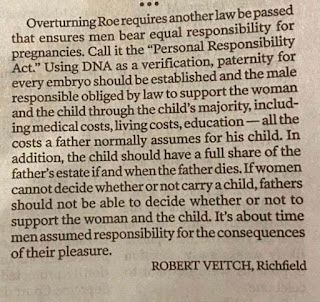 Here is the text of what appears in the image:
To which I say... um.
I am not endorsing a specific statutory proposal, not that one has been made, but it seems to me that this letter reflects what IS and what SHOULD ALWAYS HAVE BEEN the correct attitude. Women should always have insisted that any man capable of completing the marital act, inside or outside of wedlock, should bear the consequences, should any result. Duh.
And any male of the species who desires to be called a "man," and not just a sperm resevoir or animated sex toy, should embrace responsibility for one's offspring as eagerly as he embraced said offspring's mother.
Of course, we have paternity laws now, and "men" who evade them, leaving their children to be raised by over-stressed single mothers or, worse, as wards of the state. Such "men" should be shunned and shamed. And society should do all possible to provide for the spurned mother and her child.
But I promised not-hot takes on Dobbs. Here they are:
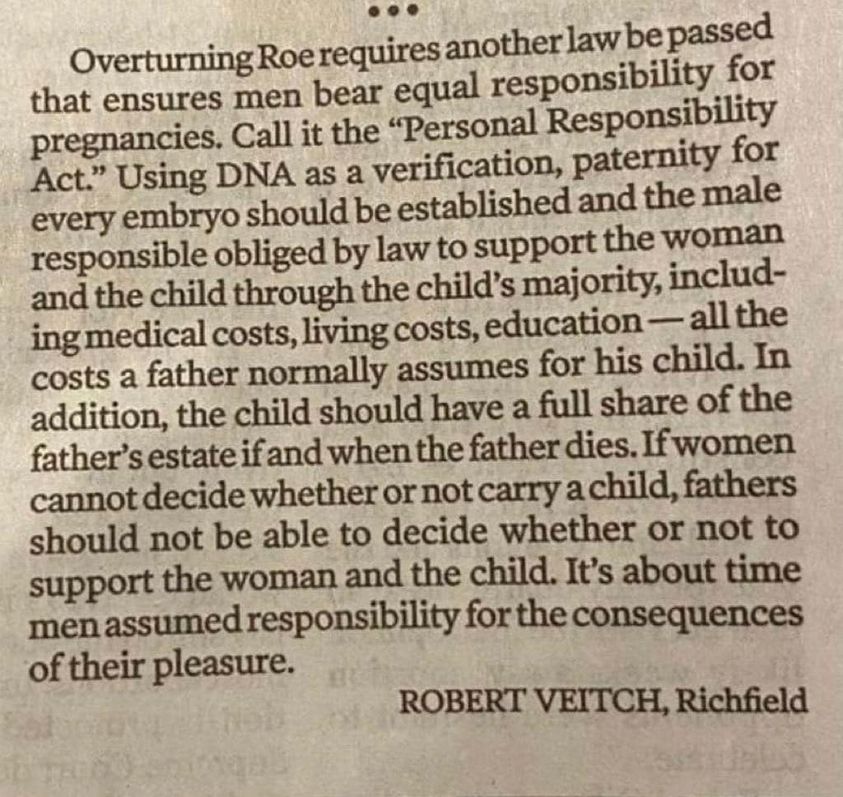
Overturning Roe requires another law be passed that ensures men bear equal responsibility for pregnancies. Call it the "Personal Responsibility Act." Using DNA as a verification, paternity for every embryo should be established and the male responsible obliged by law to support the woman and the child through the child's majority, including medical costs, living costs, education — all the costs a father normally assumes for his child. In addition, the child should have a full share of the father's estate if and when the father dies. If women cannot decide whether or not carry a child, fathers should not be able to decide whether or not to support the woman and the child. It's about time men assumed responsibility for the consequences of their pleasure.Some of my outraged progressive friends on Facebook are posting this as if it were some thunderbolt from the blue -- take this you nasty Pro-Lifers! As if this were some new, threatening, and hitherto unknown concept.
To which I say... um.
I am not endorsing a specific statutory proposal, not that one has been made, but it seems to me that this letter reflects what IS and what SHOULD ALWAYS HAVE BEEN the correct attitude. Women should always have insisted that any man capable of completing the marital act, inside or outside of wedlock, should bear the consequences, should any result. Duh.
And any male of the species who desires to be called a "man," and not just a sperm resevoir or animated sex toy, should embrace responsibility for one's offspring as eagerly as he embraced said offspring's mother.
Of course, we have paternity laws now, and "men" who evade them, leaving their children to be raised by over-stressed single mothers or, worse, as wards of the state. Such "men" should be shunned and shamed. And society should do all possible to provide for the spurned mother and her child.
But I promised not-hot takes on Dobbs. Here they are:
- Dobbs, the shrill protests notwithstanding, is not judicial legislation. In reversing Roe v. Wade, the Dobbs court undid what amounted to judicial legislation. It returns the matter of whether to allow abortions, or under what circumstances, to the leglislatures of the several states, where the matter should have been, in my opinion, all along. That's such a mild take that, at one time, no less than Ruth Bader Ginsburg agreed with it.
- Dobbs did not outlaw abortion anywhere. Some states had legislation in place that imposed various restrictions on abortion, up to and including outright abolition, that were 'triggered' or revived by the reversal of Roe. Until recently, Illinois was one such state. But our enlightened, 'progressive' legislature changed the laws a while back, making Illinois one of the most pro-abortion states in the union. And yet, here in Illinois, our political leaders howled in outrage, as if something had actually changed here. Gov. Pritzker issued an immediate call for a special session of our General Assembly in the coming weeks to take "swift action to further enshrine our commitment to reproductive health care rights and protections."
Our legislature will posture and preen about how they support the right of women to make their own health decisions. As long, of course, as women the right health decisions -- as opposed to, say, making a decision not to get vaccinated against COVID-19. Then the State can interfere, and must! Other states, Red States, as they are called, will now have to live with the consequences of the statutory anti-abortion regimes they have created: Promising bounties to snitches and informers who turn in their neighbors who might seek an abortion. Freedom and Justice -- East German style!
For all their supposed ideological differences, all of these performance artists, Left and Right, are united in this: They are all a**holes.
- None of the Supreme Court justices promised not to overturn Roe. Or to support it, for that matter. Sens. Collins and Manchin may say now that they thought they'd received assurances, but it is not so. Rep. Alexandria Ocasio-Cortez, AOC to her friends and foes alike, wants the Trump-era justices 'impeached' for 'lying under oath' about their views on Roe at their confirmation hearings. What crap.
No judge -- at any level -- can ethically say in advance how he or she would rule on a given case. In Illinois, Supreme Court Rule 67A(3)(d)(i) expressly provides that a candidate for judicial office shall not "make statements that commit or appear to commit the candidate with respect to cases, controversies or issues within cases that are likely to come before the court." That's for the man or woman hoping to sit in the basement of the Daley Center hearing speeding cases in Traffic Court. But it applies just as much to those who would sit on the nation's highest court.
Elena Kagan had never been a judge at any level when she was nominated for the U.S. Supreme Court in 2010. At the time, as I wrote in this post, the red-meat Right was particularly upset about this because they didn't have a body of judical opinions they could use against her. They did have an article she'd written, some years before, "in which she criticized the Supreme Court confirmation process as vacuous, farcical and devoid of substance." I said her confirmation hearing would be no different -- and it wasn't -- and I added, "Grandstanding Senators from both parties will demand that Kagan commit herself on abortion, gay rights, and the proper reach of executive power. Some idiot will undoubtedly ask for her opinion on Obama Care. Were she ever to answer such loaded questions, she would be committed, not confirmed." She didn't answer those questions, of course, and she was confirmed, just as Gorsuch, Kavanaugh, and Barrett likewise dodged those questions on their way to confirmation.
- Dobbs does not signal an attack on gay marriage or birth control or anything else that the "experts" were claiming five minutes after the opinion was handed down. The majority opinion is 108 pages long; with the three concurring opinions and the dissent, the whole Dobbs opinion is 213 pages long. Yet, all manner of opinions were launched within minutes of the first report that the case had been decided making all sorts of outlandish claims. You may be assured that these claims were based on supposition or political expedience, not on actual analysis of the case.
At several points in the majority opinion, the Court goes out of its way to assure the world that it is not using this case as a 'starting point' for some new judicial offensive in the Culture Wars. In the law we sometimes refer to an argument as suggesting a 'parade of horribles' -- this is bad enough, but this leads naturally to x, y, and z.... This one statement from the majority opinion (slip op. at pp. 71-72) addresses the dissent's charge that Dobbs is just the beginning of such a parade:Finally, the dissent suggests that our decision calls into question Griswold, Eisenstadt, Lawrence, and Obergefell. Post, at 4–5, 26–27, n. 8. But we have stated unequivocally that “[n]othing in this opinion should be understood to cast doubt on precedents that do not concern abortion.” Supra, at 66. We have also explained why that is so: rights regarding contraception and same-sex relationships are inherently different from the right to abortion because the latter (as we have stressed) uniquely involves what Roe and Casey termed “potential life.” Roe, 410 U.S., at 150 (emphasis deleted); Casey, 505 U.S., at 852. Therefore, a right to abortion cannot be justified by a purported analogy to the rights recognized in those other cases or by “appeals to a broader right to autonomy.” Supra, at 32. It is hard to see how we could be clearer. Moreover, even putting aside that these cases are distinguishable, there is a further point that the dissent ignores: Each precedent is subject to its own stare decisis analysis, and the factors that our doctrine instructs us to consider like reliance and workability are different for these cases than for our abortion jurisprudence.Justice Clarence Thomas, bless his heart, did provide some kindling to stoke the fears of all the "experts" in his separate concurrence. But he joined the majority opinion, which means he subscribes, whether he likes it or not, to the above statement. And the attack in his concurrence is on the legal doctrine of substantive due process, which underpins those other cases, not on the 'rights' to contraception or gay marriage as such. And none of the other justices joined his concurrence. He is on an island on this one and there is no reason to think that any of the Trump-era justices plan to join him there.
- Abortion is a moral issue, not a legal issue. Until and unless there is a national consensus on abortion, there is no law, or set of laws, that will heal the nation's divisions on this contentious issue.
Here is the inescapable truth: Depending on who asks the questions, and how they are asked, a majority of Americans are both pro-life and pro-abortion. Americans are in favor of a right to abortion in at least these four circumstances: (1) in cases of rape, (2) or incest, (3) where medically necessary to save the life of the mother, or (4) when a 'nice' girl gets 'into trouble.'
It's this last category that will get people screaming at one another.
The challenge for those who claim to be pro-life will be to persuade their neighbors that abortion, whether legal or not, is morally wrong. That's going to be a very steep hill to climb.
Friday, May 20, 2022
Hate is not a mental illness? It sure as heck is not a sign of mental health

And, from what I can see, everyone who has posted it garners lots of "likes" and even "loves." Comments to these posts tend to be of the "Amen" variety.
But I'm really not so sure.
I completely and totally agree that "mental illness" can never be a justification for the murder of innocent grocery shoppers, such as happened in Buffalo this past Saturday. It is certainly not any sort of excuse.
Legally, it may be a defense to the crimes for which the shooter now stands charged. But I have no opinion on the viability of the insanity defense in this case. Anyway, whether or not the Buffalo shooter is legally insane probably just bears on the question of where the shooter spends the rest of his life, whether in a mental institution or a jail.
But hate is not a mental illness? Before last weekend's massacre, the Buffalo shooter apparently posted rambling screeds online, spewing hatred of Blacks, of Jews, of large corporations. Surely irrational hatred of various groups is not normal. Surely we have not yet sunk that low.
And -- even if you are one of those who thinks that those with whom you disagree -- you know, the other half of the country? -- are motivated by irrational, unfounded group hatreds -- even you must admit that most of these -- the vast majority of these -- do not act on their irrational racist beliefs by acquiring semi-automatic weapons and body armor and searching for and shooting up a 'soft target' like a grocery store.
The unreasoning, unyielding hatred of persons for merely being born Black -- or Jewish -- or Taiwanese (the victims in a California church shooting last Sunday) -- is not normal. It's not healthy. It may not itself be a mental illness.
But it sure is a symptom.
In the Rodgers and Hammerstein musical South Pacific, Lt. Cable sings "You've Got to Be Carefully Taught," a song that argues racial and ethnic hatreds are not hard-wired in children, but have to be learned. Someone has to teach a child to hate.
I don't pretend to know where the Buffalo shooter learned to hate as he did. But I can be pretty sure it was not an official part of his school curriculum growing up. I am equally sure that there are dark corners of the Internet, equally accessible to you and me as well as the Buffalo shooter, in which all manner of hatreds can be sampled. But why does it take such deep root, and produce such lethal fruit, in the case of the Buffalo shooter, when so many of us can ignore and dismiss it for the garbage it is?
Hate may not be mental illness, no more than a skin rash is chickenpox. But that rash may suggest the presence of chickenpox, and unreasoning hatreds may likewise suggest the presence of mental illness.
The alternative is too chilling to contemplate.
Monday, May 16, 2022
When a play camcorder is not a play camcorder

This was not one of my kids' toys when they were growing up; at least, I don't remember it. I suspect it came from the Abuela Collection: When she passed we brought over a lot of the toys she had available in her rec room for visiting grandkids and great-grandkids.
Whatever its true provenance, the object is a favorite among my younger grandkids.
But it isn't always a camcorder. Which is understandable, inasmuch as none of them have actually seen a real camcorder. I suppose it's remarkable that some of them recognize that it is some sort of camera at all -- usually more like a Polaroid than a camcorder, though: One of the kids will take my picture by pressing the big yellow button that opens the cassette door and, voila, there is my picture. (I don't really look that much like Cookie Monster, but I always agree that it is a good likeness.)
The other day, my three-year old granddaughter (Grandchild No. 8) decided that this object was not any sort of camera... but that gets ahead of the story.
Let me back up, just a bit.
Middle Son and his wife Margaret have been over quite a bit recently, which is nice.
But the reason for the increased frequency of their visits is not so nice. At least, not so nice for Long Suffering Spouse and me.
Margaret has accepted a transfer to Detroit. She works for one of the Big 4 accounting firms. In my day, it was the Big 8. I remember when it was the Big 6, too. But, as I understand it, it's down to four now.
Anyway, she's in line to be a partner in the firm -- but there is no partnership slot available for her in her tax specialty in the Chicago office. There are opportunities in San Francisco, Miami, and Detroit. Middle Son and Margaret, both CPAs, promptly vetoed San Franciso (no one was offering a $5 million housing allowance, they explained, and they'd need at least that much to purchase a home similar to their far less pricey home just in the next parish). I might have considered Miami for a bit, if I were in their shoes, but they claimed to be uninterested in that possibility, too. They have no connections there.
But Detroit was another story. Margaret grew up in Michigan, not far from Detroit, and she has lots of family in the area. And Middle Son initially had visions of getting a gigantic house in the Detroit area with the proceeds of the sale of his Chicago-area home.
And then he started looking.
Yes, there are now working farms in Detroit, but housing costs in the more desireable suburbs are at least comparable to anything around here.
Now that their house is up for sale, they have noticed it is better to be away from the premises when it is shown -- and they find it is much easier to keep the house ready to be shown if they keep their three children (4-year old Grandchild No. 5, one-year old Grandchild No. 10, and the aforementioned 3-year old, Grandchild No. 8) out of the house as much as possible.
So we're seeing a lot of them, these days, and we are doing our best to be grown-up about it, and supportive, and encouraging, and helpful... even though it also makes us very sad.
Middle Son was not here on this particular visit a week or so ago; he's working on an MBA now, too, and he was doing something in connection with that. (What's that list of most-stressful life events again? I think he's got most of them currently ongoing.)
But Margaret and Long Suffering Spouse were conversing in the living room. Grandchild No. 10 was clinging to his mother. We'll refer to her as Mom now, for the duration. Grandchild No. 5 had some toys in which she was very engaged. Grandchild No. 8 seemed likewise engaged, I thought, as I surveyed the peaceful domestic scene from the comfort of a recliner.
I must have looked too comfortable for Grandchild No. 8's tastes. Perhaps she thought I might doze off. (I do that, now and then.) In any event, Grandchild No. 8 announced that she was going grocery shopping and, moreover, I would go with her.
I suggested that we would drive -- I was already seated, of course -- but this suggestion was rejected.
No, Grandchild No. 8 announced, we will go to the grocery store and, wherever that might be, it was not in the living room. I got up as ordered.
Grandchild No. 8 has a very vivid imagination. My only question about her is which is better -- her imagination or her vocabulary? When she starts imagining things, she tends to supply all the dialog -- hers and anyone else who participates. And she does not always appreciate improvisation: If she has given me a line, I must recite it as directed.
So she took my hand and started leading me around the house. The grocery store was not in the dining room. It was not in the old den either. But, as we went into the new den, and she saw the Sesame Street camcorder sitting on the kitchen table there, she announced that we had arrived.
The Sesame Street camcorder turned out to be an apple dispenser -- her words -- did I mention she has a great vocabulary? -- and it turned out we needed an apple.
But how to make it dispense apples? Grandchild No. 8 -- who knows perfectly well what button to push to open the cassette door -- insisted on pushing every other button first. "How are we going to get our apple from this dispenser?" she asked with every successive button-push.
Let's try the green one, she said. No, not that one.
Let's try the blue one. No, not that one either....
Finally, having exhausted all other options, she pressed the big yellow button. The cassette door opened -- and out popped the apple.
Hooray! We have our apple!
Now you may think that our apple looked suspiciously like a Cookie Monster videotape. But you are not 3-years old. That was an apple, right enough.
Well, I inquired hopefully, now that we have gotten our apple, shouldn't we go back to the living room and tell Mom and Grammy about our shopping trip? (And, maybe, allow Grampy to take his place again in the recliner?)
Grandchild No. 8 saw right through that one.
No, she said. We have more groceries to get. We need an orange.
"Where will we go for that?" I asked, mostly because I, too, am not 3-years old and don't remember how these things work.
Grandchild No. 8 popped the cassette back in the camcorder. The camcorder/apple dispenser at once became a camcorder/orange dispenser.
And, funny thing, as smart as this child is, she could not remember which button to push to get the orange out! We went through each button again, one by one, before -- finally -- on the last possible try -- the orange popped out.
Said orange did bear an uncanny resemblance to the apple we'd so recently acquired but, it turns out, there was a crucial difference: This orange could fly! And it started flying away immediately.
What could we do but chase it?
We chased it into the kitchen, but it was too fast for us. We chased it into the dining room but we could not catch it. We chased it into the living room where Mom and Grammy looked up from their conversation to inquire what the heck we were doing. I explained as best I could -- but there was no time to dawdle. We had to catch that orange before it got out the front door.
And we did. We wrestled that runaway orange back to earth on the landing going upstairs. What an exhausting grocery trip! I was now standing next to the recliner and I could hear it call my name -- but Grandchild No. 8 said we were not yet done shopping. We needed a banana.
And back we went to the camcorder/banana dispenser.
Once again, we had to press every single button except the one that would give us our banana. I challenged Grandchild No. 8 about this, pointing out that she has a tremendous memory and surely she could remember which button to push without trying all the wrong ones first.
But that was one of those improvisations of which Grandchild No. 8 does not approve. We kept pushing buttons.
Let's try the green one, she said again. No, not that one.
Let's try the blue one. No, not that one either....
Finally, on the last possible try, the banana popped out! Hooray!
Admittedly, this banana looked exactly like the orange and the apple but -- what was more important -- this banana behaved just like our wayward orange: It flew away making a beeline for the front door.
We gave chase, of course, but the flying banana got through the kitchen and the dining room and into the living room again. Mom and Grammy weren't quite as suprised this time when we came rushing in, but they offered no assistance either. We had to use our last burst of speed to capture that banana in the exact same place where we'd run that runaway orange to ground.
Surely by now we must be done with our shopping, right?
Wrong.
We also needed a pear.
Well, I told Grandchild No. 8, as she began pushing every button but the right one on the newly repurposed camcorder/pear dispenser, this had better not be a flying pear. I'd had quite enough of flying produce for one day, thank you.
Grandchild No. 8 would make no promises. You never know, she said philosophically as, for the fourth time now, the green button did not open the dispenser. And the blue button did not open the dispenser. And so on.
But, finally, we reached the last possible button.
And guess what?
The pear popped out -- and promptly flew away!
Who would ever have expected that?
OK, admittedly, I was a little suspicious that this might happen -- but it did me no good. Even though I was prepared for this eventuality, the pear got through the kitchen and dining room and into the living room, just like the banana and the orange, before we could capture it, in the same place where we'd snagged the other flying fruits, seconds away from their getting out the door.
I think Grandchild No. 8 might have had a longer shopping list, but by this time Mom had received a text from the Realtor. The coast was clear. The family could return home.
And so they did.
Wednesday, April 13, 2022
Curmudgeon family goes to the dogs -- Part I -- family history
Not my immediate family, mind you. Long Suffering Spouse and I have not acquired a pet.
But Younger Daughter just did. And Older Daughter tried to.
In fact, in the last month or so, Younger Daughter acquired three puppies, one of whom was the one that Older Daughter tried to get.
I'll explain presently -- but let me back up just a bit first.
I have a complicated relationship with dogs. I like them well enough. I'm not fond of cleaning up after them. (Is anyone?) As near as I can tell, most dogs like me well enough, too.
My parents almost always had a dog when I was growing up. One, of course, was "my" dog.
When I was in first grade or thereabouts one of the kids at school had a dog (of indeterminate lineage) who had puppies (of even more indeterminate lineage). This happened at one of those rare times when my parents had no dog (they had recently gotten rid of a dog, Sam, who turned out to be a cur -- I suppose he must have bit one of my siblings -- or my parents thought it was inevitable that he would).
Anyway, my parents agreed that we could look at the new puppies and, just possibly, pick one out.
I think very few humans are immune to puppies. I'm not, certainly. I was smitten as badly as either of my daughters recently or any of their kids with any of the puppies referred to above. And it just so happened that, at the time of our visit, one of the litter was not yet spoken for.
That became "my" dog.
My parents extracted all the usual promises: I would clean up after the dog. I would feed it. I would walk it. I would take care of it. Day or night. No excuses. No whining. I meant each and every word of every solemn vow when I made them. And, like every kid before and since, I broke each and every one of these vows within weeks, if not days, thereafter.
The dog was still "my" dog because I got to name it.
My father had very specific criteria for dog names: Something simple. One or two syllables at the most. That way, the dog would recognize its name, he explained, and learn to come when called. If at all possible, the name should describe some characteristic of the animal.
I pondered long and hard over this naming business. Eventually, though, inspriation struck.
I remember my father was shaving when I gave him the good news. I had a name: Piddle. Two syllables. And it certainly described a characteristic of the animal -- it seemed to be the animal's primary occupation.
To no one's surprise, except my own at the time, my father's response to my announcement was less than enthusiastic. But he was kind about it. "Suppose the dog gets out of the yard," he asked, putting his mug and brush aside (I'm not that old -- it's just what he used), "and you had to go out to call the dog back. Would it be a good idea to yell 'Piddle' out on the front sidewalk?"
I had to admit that I hadn't thought of that.
"You'll just have to think of another name," he said, and resumed shaving.
I was hung up on this defining characteristic thing. "Will the puppy be very big when he is full-grown?" I asked.
"Not particularly," my father replied. He knew about this stuff.
"Will he be very small?"
"No, sort of in-between."
"So not big or little, but medium?" I asked.
"I suppose, yes."
"That's it then!" I enthused. "We'll call him Medium."
"That's three syllables," my father said, or started to say. But he seemed to know the battle was lost as soon as he said it. I recognize the feeling now, only too well. I'm sure he thought well, it's better than Piddle. And, besides, he had to finish shaving.
* * * * *
Medium became the kind of dog a future Curmudgeon would appreciate. Mean. Ornery. Irascible. He didn't like most people, men especially. He excepted my father and me from his general disdain for the male of the human species, although there was one time, long after we'd moved to Boondockia, that he seems to have forgotten that he liked my father, because one day, for no apparent reason, the dog turned on him, and my father had to remind the dog of their long-standing mutal affection with a 2x4 that he just happened to be carrying.
I realize that looks awful in print. It wasn't quite so bad in reality. You'll just have to take my word for it. (At one point my father explained he quickly realized the dog had simply forgotten himself. "If I thought he really meant to attack me," he said, "I would have killed him. But, instead, I just knocked some sense into him.")
I'm not sure if the explanation helps.
In any event, thus reminded, Medium resumed cordial relations with my father that lasted for the rest of the dog's life.
I was not present when "my" dog died. He lived to a ripe old age for dogs and, by that time, I was living away from home.
However, I thought one afternoon that I had witnessed the dog's demise. We lived on a country road in Boondockia. There wasn't much traffic at the busiest times and there wasn't much concern about the dog being out in front of the house. He had never chased cars before.
One afternoon, however, the dog apparently decided to tick that particular item off his bucket list: He attacked a school bus coming down the street. I saw the dog get run over................. and I saw him come out of the other side, shaken, perhaps a bit chastened, but otherwise unharmed. The bus, likewise, was uninjured and continued on its way. That dog was so mean he could fight a school bus to a draw. As far as I know, however, he never sought a rematch.
Medium had one talent. He could pick things up off the floor and return them to the nearest human. The human's expected response was, "Thank you," whereupon the dog would drop the item or allow it to be pried from his muzzle. For this service, the dog expected to compensated with a dog treat. Which was promptly provided. I mean, it would be the height of folly to keep a mean dog waiting.
Socks, used facial tissues, laundry that didn't make it in the hamper, a kid's toy -- anything on the floor in the house was subject to retrieval in this way. If you didn't want the dog to put it in his mouth, you learned to keep it off the floor.
One day, after we'd moved to Boondockia, my mother was tending to bushes in front of the house when Medium approached with something he'd found outside. He dropped a wriggling, badly injured, and thoroughly terrified baby bunny right in my mother's lap, expecting "thank you" followed by a dog treat. He was not expecting my mother's ear-piercing shriek.
I wound up taking the bunny back into the field next door from whence it most likely came. I don't suppose it survived -- it's possible -- but the dog learned that picking things up outdoors was not as rewarding as picking things up indoors.
* * * * *
I was in high school when my aunt and uncle followed us up from Chicago's South Side to Boondockia. I don't remember, now, if there was some delay before their house was ready but I do recall that their dog came to reside with us for several months during this time of transition.
Taffy was as sweet and good-natured as Medium was mean and ornery. One might think that a recipe for disaster, but exactly the opposite provded to be the case.
Taffy was enormously fat when she came to us. But Medium soon sweated the pounds off her. Both were rejuvenated by the experience.
When his canine cousin returned to her regularly scheduled family, Medium moped to the point that my parents decided to get another dog to keep him company. And they did. From that point on, my parents always had two dogs.
Four, altogether.
Three of them were large enough that, standing on their hind legs, they could rest their paws on my shoulder and take my chin in their mouths.
Dog fanciers will know that there is no greater sign of affection. My wife, who thought she was a dog fancier, but grew up with a miniature poodle and a pekingese mop head and so didn't know better, was scared to death the first time she saw that.
The point is, I liked dogs. Still do. They like me. And, after I moved out of my parents' home, I never, ever wanted one of my own.
When you have a dog, you live according to the dog's schedule. I make fun of saccharine pet food commercials that ooze about loving 'pet parents,' but, disputes over nomenclature notwithstanding, I agree that dogs are people, too. The dog's needs must be taken into consideration. The dog must be let out, even when you want to sleep in. You can't stay too long with friends after work if no one is home to feed the dog at its accustomed time. One certainly can't just disappear for a few days. Vacations must be planned around the dog, if not actually with the dog.
I had five children, ultimately, and each had different needs and interests and schedules. A dog would have only added an entirely unwelcome additional set of complications.
Not that my kids didn't try, when they were younger, to get me to relent on the dog issue. Older Daughter was the most insistent.
In fact, one night when she was in third grade, Older Daughter told us, with absolute and grim certitude, that her teacher required all her students to have dogs. As homework. If we did not get a dog immediately, Older Daughter would fail third grade.
It must have seemed to her to be a brilliantly logical, foolproof plan. Older Daughter knew we valued education and we would never let her fail third grade if we could prevent it merely by taking in a dog.
She failed to take into account, however, the possibility that we might seek confirmation of this 'assignment.'
Not that we were in any way confrontational. Rather, we approached the teacher with the story as related to us by Older Daughter and asked if she could figure out any reason why Older Daughter would come up with such a whopper. Which of course there was: It seems Older Daughter wanted a dog so badly that she had actually made up stories about her longed-for dog and (to mix an animal metaphor) the chickens were coming home to roost. Evidence of said dog had been requested by skeptical classmates.
Toward the end, my parents' schedule completely revolved around their dogs. Boondockia was nearly an hour away from where Long Suffering Spouse and I set up our household. When Younger Daughter was an infant, my parents decided Boondockia was getting too crowded and they sold their one acre home for one set on 10 acres, another half hour (or so) further away. (In the Chicago area the 'half hour' is a unit of distance, used instead of miles or kilometers.)
Even before they got too sick to travel that distance, my parents' visits were always cut short by the need to "rescue the dogs." I suppose it's possible that my parents used their dogs as an excuse to extract themselves from the chaos of my household. At least sometimes. My kids could be rather loud. We live on a major O'Hare flightpath -- and I used to tell the kids that the airport had called complaining that they were so loud the control tower couldn't hear the jets coming in for a landing. I couldn't do anything about the physical damage to my eardrums, but I could take the edge off my nerves with an occasional scotch.
My parents were never teetotalers. In fact, if all the benefits claimed for red wine were true, both my parents would still be alive today. And my father would certainly join me if I offered scotch, though he might ask for vodka instead. These days I drink more vodka than scotch, too. Easier on the insides while still providing the same soothing effect despite the noise made by my 10 grandchildren (or whatever combination is present on any given occasion). The grandkids are at least as noisy as were their parents.
I have thus begun to suspect that, sometimes, when my parents expressed a need to "rescue the dogs" after visiting with us for only an hour, or even less, they were not always sincere. The dogs may have merely furnished a handy excuse when my parents were feeling a tad overwhelmed. But, I am just as certain that there were many instances where they really did have to cut short a visit because of genuine canine considerations.
I don't know how much time I'll have with my grandchildren. (Thank you, Captain Obvious.) But I don't want whatever time I do have to be cut short by taking care of dogs.
So, while I like dogs, I don't want dogs of my own and I've counseled all of my children against owning dogs. And, if you've ever stopped in here at all, you'll know how far I got with that advice.
I haven't forgotten that I set out to tell the tale of how Younger Daughter had three puppies in the last month, including one that her sister tried to get. But, before I get to that story, finally, there is still a little more you need to know first. I'll get to that next time.
But Younger Daughter just did. And Older Daughter tried to.
In fact, in the last month or so, Younger Daughter acquired three puppies, one of whom was the one that Older Daughter tried to get.
I'll explain presently -- but let me back up just a bit first.
I have a complicated relationship with dogs. I like them well enough. I'm not fond of cleaning up after them. (Is anyone?) As near as I can tell, most dogs like me well enough, too.
My parents almost always had a dog when I was growing up. One, of course, was "my" dog.
When I was in first grade or thereabouts one of the kids at school had a dog (of indeterminate lineage) who had puppies (of even more indeterminate lineage). This happened at one of those rare times when my parents had no dog (they had recently gotten rid of a dog, Sam, who turned out to be a cur -- I suppose he must have bit one of my siblings -- or my parents thought it was inevitable that he would).
Anyway, my parents agreed that we could look at the new puppies and, just possibly, pick one out.
I think very few humans are immune to puppies. I'm not, certainly. I was smitten as badly as either of my daughters recently or any of their kids with any of the puppies referred to above. And it just so happened that, at the time of our visit, one of the litter was not yet spoken for.
That became "my" dog.
My parents extracted all the usual promises: I would clean up after the dog. I would feed it. I would walk it. I would take care of it. Day or night. No excuses. No whining. I meant each and every word of every solemn vow when I made them. And, like every kid before and since, I broke each and every one of these vows within weeks, if not days, thereafter.
The dog was still "my" dog because I got to name it.
My father had very specific criteria for dog names: Something simple. One or two syllables at the most. That way, the dog would recognize its name, he explained, and learn to come when called. If at all possible, the name should describe some characteristic of the animal.
I pondered long and hard over this naming business. Eventually, though, inspriation struck.
I remember my father was shaving when I gave him the good news. I had a name: Piddle. Two syllables. And it certainly described a characteristic of the animal -- it seemed to be the animal's primary occupation.
To no one's surprise, except my own at the time, my father's response to my announcement was less than enthusiastic. But he was kind about it. "Suppose the dog gets out of the yard," he asked, putting his mug and brush aside (I'm not that old -- it's just what he used), "and you had to go out to call the dog back. Would it be a good idea to yell 'Piddle' out on the front sidewalk?"
I had to admit that I hadn't thought of that.
"You'll just have to think of another name," he said, and resumed shaving.
I was hung up on this defining characteristic thing. "Will the puppy be very big when he is full-grown?" I asked.
"Not particularly," my father replied. He knew about this stuff.
"Will he be very small?"
"No, sort of in-between."
"So not big or little, but medium?" I asked.
"I suppose, yes."
"That's it then!" I enthused. "We'll call him Medium."
"That's three syllables," my father said, or started to say. But he seemed to know the battle was lost as soon as he said it. I recognize the feeling now, only too well. I'm sure he thought well, it's better than Piddle. And, besides, he had to finish shaving.
I realize that looks awful in print. It wasn't quite so bad in reality. You'll just have to take my word for it. (At one point my father explained he quickly realized the dog had simply forgotten himself. "If I thought he really meant to attack me," he said, "I would have killed him. But, instead, I just knocked some sense into him.")
I'm not sure if the explanation helps.
In any event, thus reminded, Medium resumed cordial relations with my father that lasted for the rest of the dog's life.
I was not present when "my" dog died. He lived to a ripe old age for dogs and, by that time, I was living away from home.
However, I thought one afternoon that I had witnessed the dog's demise. We lived on a country road in Boondockia. There wasn't much traffic at the busiest times and there wasn't much concern about the dog being out in front of the house. He had never chased cars before.
One afternoon, however, the dog apparently decided to tick that particular item off his bucket list: He attacked a school bus coming down the street. I saw the dog get run over................. and I saw him come out of the other side, shaken, perhaps a bit chastened, but otherwise unharmed. The bus, likewise, was uninjured and continued on its way. That dog was so mean he could fight a school bus to a draw. As far as I know, however, he never sought a rematch.
Medium had one talent. He could pick things up off the floor and return them to the nearest human. The human's expected response was, "Thank you," whereupon the dog would drop the item or allow it to be pried from his muzzle. For this service, the dog expected to compensated with a dog treat. Which was promptly provided. I mean, it would be the height of folly to keep a mean dog waiting.
Socks, used facial tissues, laundry that didn't make it in the hamper, a kid's toy -- anything on the floor in the house was subject to retrieval in this way. If you didn't want the dog to put it in his mouth, you learned to keep it off the floor.
One day, after we'd moved to Boondockia, my mother was tending to bushes in front of the house when Medium approached with something he'd found outside. He dropped a wriggling, badly injured, and thoroughly terrified baby bunny right in my mother's lap, expecting "thank you" followed by a dog treat. He was not expecting my mother's ear-piercing shriek.
I wound up taking the bunny back into the field next door from whence it most likely came. I don't suppose it survived -- it's possible -- but the dog learned that picking things up outdoors was not as rewarding as picking things up indoors.
Taffy was as sweet and good-natured as Medium was mean and ornery. One might think that a recipe for disaster, but exactly the opposite provded to be the case.
Taffy was enormously fat when she came to us. But Medium soon sweated the pounds off her. Both were rejuvenated by the experience.
When his canine cousin returned to her regularly scheduled family, Medium moped to the point that my parents decided to get another dog to keep him company. And they did. From that point on, my parents always had two dogs.
Four, altogether.
Three of them were large enough that, standing on their hind legs, they could rest their paws on my shoulder and take my chin in their mouths.
Dog fanciers will know that there is no greater sign of affection. My wife, who thought she was a dog fancier, but grew up with a miniature poodle and a pekingese mop head and so didn't know better, was scared to death the first time she saw that.
The point is, I liked dogs. Still do. They like me. And, after I moved out of my parents' home, I never, ever wanted one of my own.
When you have a dog, you live according to the dog's schedule. I make fun of saccharine pet food commercials that ooze about loving 'pet parents,' but, disputes over nomenclature notwithstanding, I agree that dogs are people, too. The dog's needs must be taken into consideration. The dog must be let out, even when you want to sleep in. You can't stay too long with friends after work if no one is home to feed the dog at its accustomed time. One certainly can't just disappear for a few days. Vacations must be planned around the dog, if not actually with the dog.
I had five children, ultimately, and each had different needs and interests and schedules. A dog would have only added an entirely unwelcome additional set of complications.
Not that my kids didn't try, when they were younger, to get me to relent on the dog issue. Older Daughter was the most insistent.
In fact, one night when she was in third grade, Older Daughter told us, with absolute and grim certitude, that her teacher required all her students to have dogs. As homework. If we did not get a dog immediately, Older Daughter would fail third grade.
It must have seemed to her to be a brilliantly logical, foolproof plan. Older Daughter knew we valued education and we would never let her fail third grade if we could prevent it merely by taking in a dog.
She failed to take into account, however, the possibility that we might seek confirmation of this 'assignment.'
Not that we were in any way confrontational. Rather, we approached the teacher with the story as related to us by Older Daughter and asked if she could figure out any reason why Older Daughter would come up with such a whopper. Which of course there was: It seems Older Daughter wanted a dog so badly that she had actually made up stories about her longed-for dog and (to mix an animal metaphor) the chickens were coming home to roost. Evidence of said dog had been requested by skeptical classmates.
Toward the end, my parents' schedule completely revolved around their dogs. Boondockia was nearly an hour away from where Long Suffering Spouse and I set up our household. When Younger Daughter was an infant, my parents decided Boondockia was getting too crowded and they sold their one acre home for one set on 10 acres, another half hour (or so) further away. (In the Chicago area the 'half hour' is a unit of distance, used instead of miles or kilometers.)
Even before they got too sick to travel that distance, my parents' visits were always cut short by the need to "rescue the dogs." I suppose it's possible that my parents used their dogs as an excuse to extract themselves from the chaos of my household. At least sometimes. My kids could be rather loud. We live on a major O'Hare flightpath -- and I used to tell the kids that the airport had called complaining that they were so loud the control tower couldn't hear the jets coming in for a landing. I couldn't do anything about the physical damage to my eardrums, but I could take the edge off my nerves with an occasional scotch.
My parents were never teetotalers. In fact, if all the benefits claimed for red wine were true, both my parents would still be alive today. And my father would certainly join me if I offered scotch, though he might ask for vodka instead. These days I drink more vodka than scotch, too. Easier on the insides while still providing the same soothing effect despite the noise made by my 10 grandchildren (or whatever combination is present on any given occasion). The grandkids are at least as noisy as were their parents.
I have thus begun to suspect that, sometimes, when my parents expressed a need to "rescue the dogs" after visiting with us for only an hour, or even less, they were not always sincere. The dogs may have merely furnished a handy excuse when my parents were feeling a tad overwhelmed. But, I am just as certain that there were many instances where they really did have to cut short a visit because of genuine canine considerations.
I don't know how much time I'll have with my grandchildren. (Thank you, Captain Obvious.) But I don't want whatever time I do have to be cut short by taking care of dogs.
So, while I like dogs, I don't want dogs of my own and I've counseled all of my children against owning dogs. And, if you've ever stopped in here at all, you'll know how far I got with that advice.
I haven't forgotten that I set out to tell the tale of how Younger Daughter had three puppies in the last month, including one that her sister tried to get. But, before I get to that story, finally, there is still a little more you need to know first. I'll get to that next time.
Subscribe to:
Posts (Atom)